
We’ve all seen "The Monster." You know the one it’s that single, sprawling HubSpot workflow that takes a full thirty seconds just to load the visual editor. It’s a tangled mess of if/then branches that looks less like a business process and more like a bowl of digital spaghetti. You’re terrified to touch it.
Why? Because if you break one branch, lead routing fails for the entire DACH region! But here’s the hard truth: that complexity isn't a sign of sophistication. It’s a symptom of "stateless" automation that’s costing you deals. If you are leading Revenue Operations HubSpot teams today, you need to stop building bigger rules and start building smarter decisions.
Why Your "If/Then" Branches Are Bleeding Revenue
Human buying journeys are messy, chaotic, and decidedly non-linear. A prospect might click a marketing email on Monday, ghost your sales rep on Tuesday, and then suddenly pop up asking a specific pricing question via WhatsApp on Wednesday.
The problem? A standard HubSpot workflow if then branch simply can’t keep up with that volatility.
It is rigid. It fires based on a trigger, not the context.
The result is a painful disconnect where your automation fights against your customer's reality.
Your workflow sees a "form fill" and blindly triggers Nurture Email #3: "Just bumping this to the top of your inbox." Meanwhile, that same prospect is actively negotiating a contract with your sales rep on LinkedIn.
That isn't just annoying for the customer; it’s active revenue leakage. HubSpot marketing automation is powerful, but without a brain to interpret context, it’s just a set of dumb rules firing into the dark.
The "Stateless" Trap of Traditional Lead Scoring
Let’s talk about the number "85." In traditional lead scoring HubSpot setups, a score of 85 is cause for celebration. But what does it actually mean?
- Are they an 85 because they love your product and are ready to buy?
- Are they an 85 because they are angry, confused, and frantically searching your knowledge base for support articles?
- Are they an 85 because a college student is downloading every PDF on your site for a term paper?
The score looks the same, but the intent is wildly different. Current predictive lead scoring HubSpot models often rely on static demographics or cumulative clicks. They are "stateless"—they don't remember the story behind the clicks. They lack the memory to differentiate between a "ready buyer" and a "confused browser." To fix this, we need to move beyond scores and start tracking states of mind.
From "Dumb Rules" to "Smart Decisions" (Agentic AI)
This is where the paradigm shifts. We are moving from linear automation to Agentic AI. While a rule follows instructions, an agent makes decisions based on goals.
To do this, we need a "brain" upgrade. We use a Conversation Graph. Unlike a flat list of contact properties, this is a temporal knowledge graph that links identities, threads, intents, and outcomes. It remembers that the person chatting on the web is the same person who just replied to an SMS.
Here is the difference in action:
- Dumb Rule: Prospect downloads ebook → Wait 2 days → Send Email #2.
- Smart Decision: Prospect downloads ebook → Agent sees they also complained on Twitter → Agent pauses Email #2 to avoid friction → Agent creates a high-priority support ticket.
The agent perceives the environment and creates a path to the best outcome, rather than just executing a pre-programmed script.
Discover how an agentic brain can sit on top of your CRM.
Implementing "Next Best Action" for Revenue Operations HubSpot Leaders
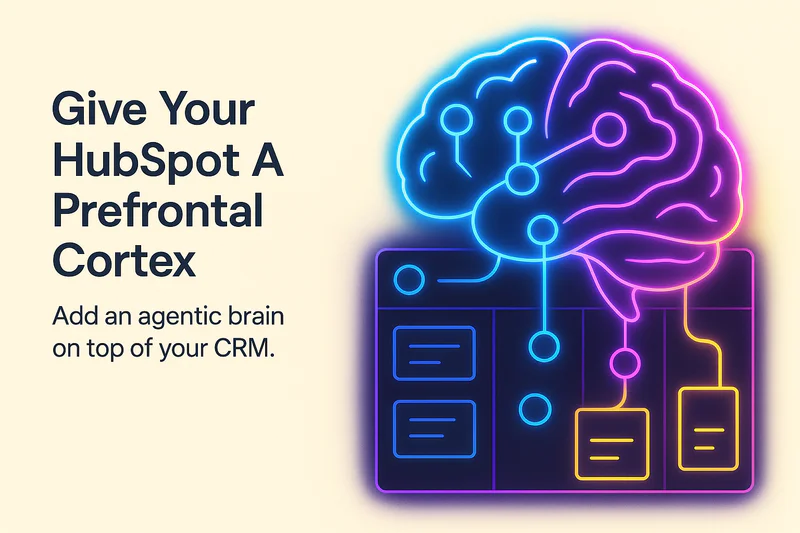
Here is the good news: you do not need to rip and replace your CRM. Zigment adds a stateful, agentic layer on top of HubSpot. It acts as the "Pre-frontal Cortex" for HubSpot's "Central Nervous System."
By layering Zigment over your existing stack, you unlock three critical capabilities:
- Memory: We utilize working memory (current thread) and long-term memory (stable preferences and consents) to maintain context across every channel.
- Planning: Instead of a simple trigger, the agent uses a "Planner Loop"Perceive, Propose, Score, Decide, Act to determine the Next Best Action.
- Governance: We apply policy packs (like "Quiet Hours" or "Consent First") to ensure the agent never goes rogue, keeping your brand safe.
Orchestrate intelligent decisions without a migration nightmare.

A "Smart Decision" Workflow You Can Build
Let’s get practical. How does this look in a real lead nurturing HubSpot scenario? We call this the "Lead to Demo" play.
Instead of a 20-step workflow, you set a goal: "Book qualified demo." Here is how the agent handles it:
- Ingest Signals: The agent detects a form fill and analyzes UTM parameters.
- Perceive Intent: The agent analyzes the input text. "High intent, but the user is asking about pricing specific to enterprise."
- Decide & Act: The planner realizes a generic email will result in a drop-off. It checks for WhatsApp consent. It decides to skip the nurture sequence and sends a hyper-personalized WhatsApp message: "Great to meet you. I see you're interested in enterprise pricing. Would you like a quick product walkthrough this week?"
- Sync: The result—the conversation transcript and the outcome—is written back to the HubSpot Deal stage automatically.
Start designing your first intelligent orchestration play.
The KPIs That Actually Matter
Forget open rates. In this new era, you need to track Outcome Metrics that reflect business reality.
- Task Success Rate: Did the agent achieve the goal (e.g., booking the meeting)?
- Regret: Did we annoy the customer? This helps refine the "risk" score in the planner.
- Qualified Lead Rate: The ultimate measure of efficiency.
When you move to stateful orchestration, you stop asking "Did the workflow fire?" and start asking "Did we advance the relationship?"

Upgrade your dashboard to track real business outcomes.
Zigment is not another CRM to migrate to; it is the stateful, agentic layer that wakes up the stack you already have. Think of HubSpot as your organization's "Central Nervous System"—it is excellent at feeling signals (form fills, page views) and moving muscles (sending emails, updating deal stages). However, a nervous system without a brain is just a series of reflexes. Zigment acts as the "Pre-Frontal Cortex"—the intelligent layer that analyzes, plans, and decides what to do with those signals before a muscle ever twitches.
By layering Zigment on top of HubSpot, you unlock a new operating model for Revenue Operations without the nightmare of a "rip and replace" migration. Here is exactly how that intelligence layer functions to transform your stack:
From "Properties" to a Conversation Graph
HubSpot relies on static fields: While useful, these are just snapshots in time. Zigment upgrades this to a Conversation Graph.
This is a temporal knowledge graph that functions as a true memory bank. It links identities, threads, intents, and outcomes across time and channels.
It doesn't just know that "Contact A" visited the pricing page; it remembers that "Contact A" is the same person who asked about enterprise security on WhatsApp three weeks ago and expressed frustration with a support bot yesterday.
It connects the dots that standard CRMs leave disconnected, giving your automation the full story, not just the latest chapter.
From "Triggers" to Agentic Planning
Traditional workflows are reactive: Trigger → Action. A form is filled, an email is sent. There is no thinking, only doing. Zigment uses a Planner Loop to be proactive.
When a signal arrives, the Agent doesn't just fire an email. It enters a cognitive loop:
Perceive: It reads the signal and checks the Conversation Graph for context (e.g., "This user is active but stuck in the onboarding flow").
Propose: It generates potential next steps (e.g., "Send generic email," "Ping CSM," "Send helpful WhatsApp tip").
Score: It evaluates these options based on Expected Value (EV), Risk, and Cost.
Decide: It selects the Next Best Action (NBA).
If the "best action" is to do nothing because the user is currently waiting for a support reply, the Agent decides to wait. No dumb rules. Just smart decisions.
3. From "Hope" to Enterprise Governance
The biggest fear with AI is the "hallucination" risk—the idea that an agent might go rogue. Zigment replaces hope with Policy Packs.
These are deterministic guardrails that sit between the AI and your customer, ensuring compliance is baked into every interaction. You define the laws of your universe:
Consent First: "Never send a WhatsApp message without explicit opt-in."
Quiet Hours: "Never text a prospect after 8 PM their local time."
Data Safety: "Mask all PII in logs and never request credit card info over chat."
The Agent cannot act unless it passes these policy checks. This gives you the creativity and fluidity of a human rep with the strict compliance and reliability of a machine.
The Bottom Line
The era of "dumb rules" is ending. You don't need to rebuild your entire operations map or migrate to a new platform to fix your leaky funnel. You just need to give your existing stack a brain.
With Zigment, you turn your HubSpot data into a decision engine that works 24/7 to move your pipeline forward, ensuring every lead is treated as a dynamic relationship, not just a row in a database.