
Picture this.
Someone just donated $250 to your cause. They felt something. A story moved them. They clicked, they gave, and then… silence!
No immediate acknowledgment. No "here's what your gift does." No follow-up for two weeks. By the time your team gets around to the thank-you email, that donor has emotionally moved on.
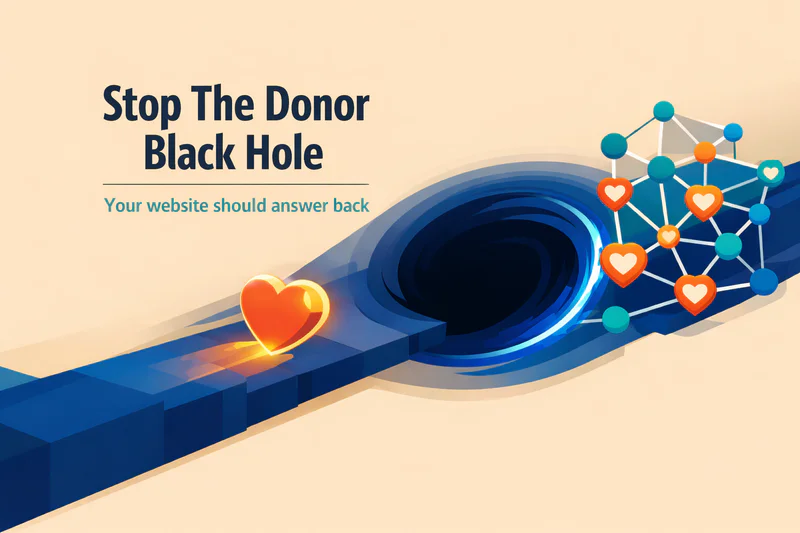
This is the black hole effect!
And it's quietly draining millions from nonprofit pipelines every year.
Why Donors Really Leave?
Ask most nonprofit leaders why donors churn and they'll say: economy, donor fatigue, competing causes.
Those are real. But the most underrated culprit? Speed and quality of response.
A 2024 study by Engage USA tracked 126,822 new donors and found something stark: delays in processing and acknowledging donations directly reduce second-gift rates.
Faster acknowledgment increases retention. The research was unambiguous when organizations fail to acknowledge gifts quickly, they lose donors and revenue according to Engage USA, 2025)
Consider Maria. She gives $100 to a local food bank after watching a moving video. She feels proud. She half-expects an immediate, warm confirmation something that says you did something good today.
Instead, she gets a generic auto-receipt three days later, followed by radio silence for a month. The next email she receives? A fundraising ask.
Maria doesn't give again. She's not angry. She just… moved on. The moment passed.
That story repeats itself millions of times a year across the sector.
The Real Cost of Letting Donors Fall Through the Cracks
Let's put dollar figures to this, because your CFO needs to see it clearly.
The cost of retaining an existing donor is roughly $0.20 per dollar raised. The cost of acquiring a new one?
$1.50 per dollar raised more than seven times higher according to according to DonorSearch / Neon One, 2024 . Some estimates put that ratio even wider acquiring a new donor can cost 5 to 20 times more than keeping one you already have.
Here's the compounding math your board needs to see: A non-profit raising $4.2 million annually could grow to over $5 million simply by increasing retention by 5% over two years. Not through campaigns. Not through new donors. Through keeping who you already have according to Virtuous CRM)
Yet most non-profits continue investing the majority of their effort in acquisition while stewardship workflows sit broken, understaffed, or entirely manual.
That is not a resource problem. It's a systems problem.
This Is a donor dialogue problem!
Here's how Zigment frames the core issue and it's worth sitting with.
Most non-profits don't have a donor data problem. They have a donor dialogue problem.
Clicks, donations, and email opens exist in one system.
Conversations, questions, and sentiment live somewhere else or nowhere at all. The donor who donated after an Instagram post, then asked a question via web chat, then unsubscribed from emails three months later? That's three dis connected events with no unified story.
Zigment calls this the fragmented engagement trap. And their platform is built specifically to close it.
That philosophy shapes everything about how Zigment approaches donor stewardship.
Zigment is not a chatbot company. It's not another CRM add-on.
What that means in practice for nonprofits and NGOs?
The Conversation Graph.
This is Zigment's proprietary data layer and it's the engine behind everything.
It merges qualitative and quantitative data in real time: clicks, chat messages, mood signals, intent, donation history, volunteer signups. All stored in one query-ready timeline per supporter. (Source: zigment.ai)
When a donor messages your Instagram at 11 PM asking "how was my money used?", Zigment doesn't just answer it logs the emotional context, the timing, the channel, and the intent. That becomes data your team can actually act on.
Omnichannel AI Agents.
Zigment meets donors wherever they are Web Chat, Instagram DMs, WhatsApp, SMS, Email, Facebook. Not in silos. In one seamless journey.
A donor who first engages on your website and later responds to an SMS can be recognized and treated with continuity across both touchpoints. No more "wait, who is this?" moments.
Workflow Orchestration Without Code.
Zigment's no-code workflow builder lets your team create custom journeys in plain language. Route a "ready to give" donor straight to the donation page.
Send an "exploring" donor a series of impact stories first. Branch by condition, by sentiment, by stage without writing a single line of code.
Immediate, Empathetic Response.
Zigment's agents engage donors and volunteers "anytime, anywhere with personalized, mission-driven outreach."
They don't use rigid templates. They adapt to context, language, and emotion so a first-time donor gets guided onboarding while a recurring supporter gets impact updates relevant to their giving history. (Source: zigment.ai)
Multilingual by Default.
Zigment supports engagement in 18+ global languages automatically. This matters enormously for international NGOs and causes that attract global support but have small local teams.
Real Results: What Happens When You Close the Black Hole
This isn't theoretical. Here's what happened when Hope For Ukraine a humanitarian non-profit operating in an active conflict zone deployed Zigment's AI on their website.
Their team was small. Their inbox was overwhelming. Donors, volunteers, and people seeking aid were all landing on the same website with questions and getting nothing back in a reasonable timeframe. Every unanswered message was a missed chance to convert support or deepen trust.
After deploying Zigment:
The team got 10 hours back every week. Not from cutting corners from handing off repeatable, answerable questions to an AI agent that handles them instantly and accurately. That freed the human team to focus on major donors, sensitive cases, and strategic partnerships. (Source: Zigment Case Study Hope For Ukraine, November 2025)
One AI agent now handles over 500 conversations every month around 17 per day, 24 hours a day, 7 days a week. Before Zigment, many of those conversations never happened at all. Visitors left with unanswered questions. Now the website functions as a living, responsive front door.
Supporters were met in 18 languages. About 15% of all conversations happened in non-English languages — donors in Poland, volunteers in Germany, community members searching for information across time zones. Zigment handled all of it. No additional staff. No translation delays.
The website became an engagement channel, not just a brochure. Real-time conversation kept donors on-site, resolved doubts instantly, and guided people to the right next step — whether that was learning more, signing up, or giving.
What NGOs Need to Ask Right Now?
If you're running revenue operations or donor marketing for a non-profit, the strategic question isn't "should we use AI?"
92% of your peers already are according to Virtuous 2026 AI Adoption Report)
The real questions are:
How long does it take your organization to acknowledge a first gift? If the answer is longer than 24 hours, or if it's not automated, you are actively losing donors.
Do you have a second-gift sequence in place? If there's no touchpoint within 30, 60, and 90 days of a first donation, you're missing your highest-leverage retention window.
Can you identify pre-lapsed donors before they're gone? If your CRM isn't flagging donors approaching the 6–9 month no-gift window, you're reacting instead of preventing.
Can you actually see your supporter journeys in one place? If donor data lives across five tools and no one has a unified view, you cannot steward at scale.
Zigment's platform addresses all. And it integrates with what you already use Salesforce Nonprofits, Blackbaud, HubSpot, DonorPerfect, Mailchimp, Stripe, PayPal so you're not ripping and replacing your stack. You're adding an agentic intelligence layer on top of it.
The Bottom Line
The black hole isn't a mystery. It's a systems problem and it's now a solvable one.
Zigment's Agentic AI gives non-profits the infrastructure to respond instantly, steward personally, and scale without losing the human connection that makes donors give in the first place. The results at Hope For Ukraine and BBB Wise Giving Alliance are proof that this isn't future-state thinking.
It's happening now.
Donors give because they feel something. They leave because you went quiet at the exact moment you should have been loudest.
You now have the technology to never go quiet again.