The average B2B company now uses 110 SaaS tools. Your RevOps team alone probably juggles 15-20 platforms each promising to "unlock revenue potential" or "accelerate pipeline velocity."
Here's what nobody tells you: every tool you add slows you down.
Not because the tools are bad! Because context doesn't transfer between them. Your sales rep switches between HubSpot, Outreach, Gong, Slack, LinkedIn Sales Navigator, and ZoomInfo just to research one prospect. Your customer success team needs three screens open to understand account health. And your RevOps leader?
They're spending 60% of their time on integration maintenance instead of strategy.
The cost of HubSpot CRM isn't just the subscription it's the twelve other tools you bought to "complete" it, plus the operational drag of moving data between systems that were never meant to talk to each other.
What if the future of revenue operations wasn't more tools, but radically fewer?
Stack Bloat Today: Death by a Thousand Integrations
Let's audit your current stack honestly. You probably have:
CRM layer (1-2 tools)
HubSpot free CRM or HubSpot CRM features at the core, maybe Salesforce if you're enterprise. This is your system of record.
Engagement layer (4-8 tools)
Outreach or SalesLoft for sequences. Drift or Intercom for chat. Calendly for scheduling. LinkedIn Sales Navigator for prospecting. Maybe Vidyard for video. Each one "essential."
Intelligence layer (3-5 tools)
ZoomInfo or Apollo for data enrichment. Gong or Chorus for conversation intelligence. 6sense or Demand base for intent data. Clearbit for firmographics.
Automation layer (2-4 tools)
Zapier or Make for workflows. Marketing automation (HubSpot marketing, Marketo, or Pardot). Maybe Clay for enrichment workflows.
Analytics layer (2-3 tools)
Tableau or Looker for BI. Maybe Clari for forecasting. A spreadsheet graveyard for "quick analysis."
Count them up. That's 15-20 tools just for revenue operations, each with its own login, data model, API limits, and update cycle. The cost of HubSpot CRM free tier looks attractive until you realize you'll spend $50K-150K annually on the surrounding constellation of tools just to make it functional.
Here's the real cost: decision latency.
When a high-intent prospect hits your pricing page at 11 PM, your "stack" needs to:
Recognize them (data enrichment tool)
Check their conversation history (CRM + chat tool + email tool)
Determine the right action (marketing automation + rules engine)
Execute personalized outreach (engagement tool)
Log everything back (integration middleware)
By the time your stack completes this loop? It's 9 AM the next day, and your competitor already responded.
The problem isn't any single tool , it's the weight of the entire stack.
What orchestration actually means in 2026

Stateful: Remembers every conversation across every channel. If a prospect asks about pricing in chat, then emails your AE, then texts a follow-up question the system treats it as one continuous conversation, not three separate interactions.
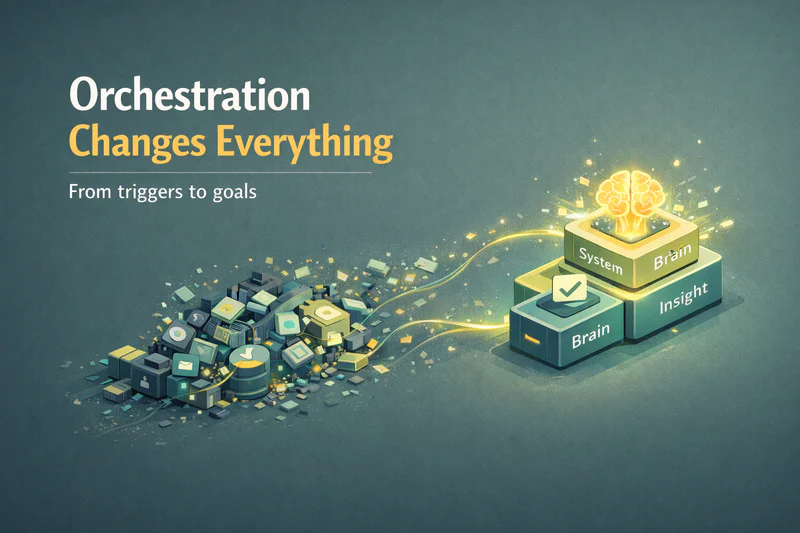
Goal-driven: Works backward from outcomes (book demo, expand account, prevent churn) rather than forward from triggers (form submitted, email opened). It asks "what does this customer need to achieve their goal?" not "what rule just fired?"
Omnichannel: Executes the next best action wherever the customer is—email, SMS, WhatsApp, web chat, phone without requiring them to switch contexts or repeat information.
Governed: Operates within guardrails you define. Human-in-the-loop for sensitive decisions, automated for speed where it's safe. Full audit trail for compliance.
This is the missing layer between your CRM and your team! It's why you bought six other tools you were trying to build orchestration out of duct tape and API calls.
Most teams don't have an orchestration problem. They have an orchestration layer missing entirely.
The Integrations That Actually Matter (And the Ones You Can Kill)
Here's a freeing thought: in a 3-tool stack, you have exactly two integration points. CRM ↔ Orchestration ↔ BI. That's it.
What dies in this model:
Point-to-point integrations: No more Zapier flows connecting twelve tools in a fragile chain. No more "Slack notification when Gong detects competitor mention that updates Salesforce that triggers Outreach sequence." Just… stop.
Engagement silos: You don't need separate tools for email sequences, SMS campaigns, WhatsApp messaging, and web chat. Orchestration handles all channels natively with unified context.
Enrichment daisy-chains: Stop passing contacts through Clearbit → ZoomInfo → Apollo → HubSpot. Push raw data to CRM, let orchestration pull what it needs in real-time from a single enrichment layer.
Redundant analytics: If your BI tool connects directly to CRM and Orchestration, you don't need in-app dashboards in fourteen other platforms.
What you keep (and why):
Your CRM becomes leaner! It stores contacts, companies, deals, and historical records. That's it. Not workflows, not sequences, not chat transcripts, not scoring models. Just clean, reliable data.
Your orchestration layer becomes the brain—conversation memory, intent detection, next-best-action logic, multi-channel execution, A/B testing, and feedback loops that improve over time.
Your BI tool becomes the nervous system, surfacing patterns your team can't see manually: which conversation paths convert fastest, where deals stall, which signals predict churn.
The Salesforce vs HubSpot question becomes simpler too
Once orchestration is separate, CRM choice is mostly about:
Sales team size and complexity
Existing ecosystem and skills
Budget (HubSpot CRM free tier or cost of HubSpot CRM paid vs Salesforce licensing)
Both work perfectly well as systems of record when they're not being forced to do orchestration's job.
Two integration points. Infinite flexibility.
Org Model & Ownership: Who Runs What in a 3-Tool World
Simplifying your stack doesn't just cut costs it clarifies ownership in ways that make your entire revenue org faster.
Who owns the CRM? Sales Ops and Marketing Ops in shared custody. Marketing owns top-of-funnel, Sales owns opportunity management, and Service owns tickets. In a 3-tool world, CRM ownership stays exactly the same you're just not asking it to do things it was never designed for.
Who owns Orchestration? RevOps. This is your RevOps leader's domain, where they define conversation goals, next-best-action logic, and channel strategy with input from Marketing, Sales, and CS. Orchestration is where HubSpot marketing automation meets sales cadences meets service workflows—the unified execution layer needs unified ownership.
Who owns BI? Finance or RevOps, depending on stage. The beauty of this model? Clear swim lanes. Marketing teams can focus on campaigns, not duct-taping Zapier integrations. Sales can focus on conversations, not wrestling with five different tools to prep for one call.
The Bottom Line: Why Simpler Wins
This is the orchestration gap Zigment fills.
Zigment adds a stateful layer on top of HubSpot without replacing it. At its core is a Conversation Graph persistent memory unifying every interaction across web, email, SMS, and WhatsApp. A pricing question at midnight and a follow-up email the next morning are treated as one evolving conversation.
Instead of static workflows, Zigment works backward from outcomes—qualify the lead, book the demo, prevent churn and decides what happens next, where, and when. One strategy, delivered natively across all channels wherever the customer is.
The result: faster response times, higher conversion rates, better retention. No more resetting context every time the channel changes.
The average B2B company runs on 110 SaaS tools. Zigment helps you delete that complexity by giving HubSpot the orchestration layer it was never built to be.
Fewer tools. Shared context. Decisions in minutes, not overnight.