
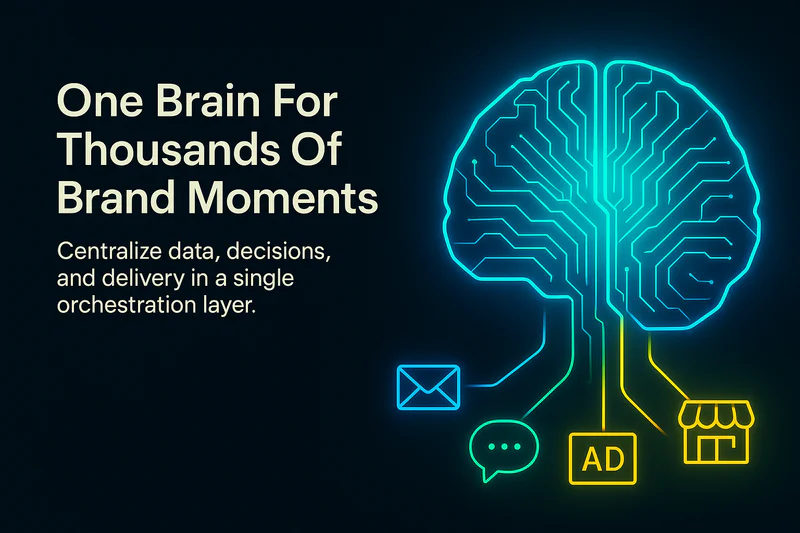
Marketing orchestration turns scattered brand moments into one connected customer experience.
Customers move fluidly between email, social media, websites, and in-store interactions expecting every touchpoint to feel connected and personal. When those experiences feel fragmented, brands risk losing attention, loyalty, and revenue. Marketing orchestration offers a way forward. It’s about strategically connecting channels, data sources, technology, and teams to deliver experiences that are consistent and relevant at every step of the customer journey.
In this article, we’ll unpack what marketing orchestration really is, how it differs from traditional marketing automation, and what makes it such a powerful strategy for creating cohesive, personalized customer experiences, marketing orchestration works behind the scenes, what it takes to achieve it successfully, and the common challenges brands face and how to overcome them. We’ll also highlight a real-world case study of marketing orchestration
What Is Marketing Orchestration?
Think of marketing orchestration as the conductor of your brand’s entire customer experience. Instead of each channel such as email, social media, ads, your website playing its own tune, orchestration ensures they perform in sync. Every note, every message, every touchpoint connects to form one cohesive, memorable experience.
It’s about strategic coordination, connecting your data, technology, and teams to unify cross-channel campaigns that feel intentional, timely, and personal. By merging insights from your website, app, and social channels, marketers can design experiences that feel relevant and connected at every stage of the customer journey.
The real power lies in timing and context. Orchestration uses behavioral data, preferences, and real-time signals to deliver the right message, in the right moment, through the right channel. Done well, it transforms marketing from disconnected efforts into a data-driven symphony that earns attention, trust, and loyalty over time.
The real advantage of orchestration is not scale, but coherence, every message aligns with who the customer is in that moment.
Marketing Orchestration vs. Marketing Automation

Marketing automation had its moment. It made marketers’ lives easier, triggering emails, scheduling posts, and following up with leads automatically. For a while, that was revolutionary! But in a world where customers move fluidly between channels and expect every experience to feel seamless, automation alone just doesn’t cut it anymore.
Marketing automation focuses on isolated actions. It sends, schedules, triggers, and repeats. It’s efficient, but it’s also rigid and static built around workflows that rarely adapt once they’re set. The result? A string of one-off interactions that might be timely, but often miss the bigger picture.
Marketing orchestration, meanwhile, is the evolution. It connects those individual tasks into something cohesive and intelligent. Instead of reacting to static rules, orchestration listens, learns, and adjusts in real time. It bridges the gap between data and experience, turning fragmented campaigns into unified, customer-led journeys.
Think of it this way: automation is a playlist on repeat; orchestration is a live performance that responds to the audience. One is predictable. The other is dynamic, responsive, and unforgettable.
Automation might get the job done, but orchestration gets it done right. It’s what transforms efficiency into empathy and repetition into relevance. It’s what transforms efficiency into empathy and repetition into relevance.
The Benefits of Marketing Orchestration
When marketing orchestration clicks, it transforms more than campaigns, it transforms connections. Every channel, every interaction, every decision starts working together to create experiences that feel effortless and personal.
Seamless, Consistent Experiences
Customers move fast and fluidly between channels. Orchestration keeps each moment connected so your message feels unified. That consistency builds trust and trust drives conversions.
Relevant, Real-Time Engagement
By unifying data from your website, app, and social platforms, you can create cross-channel campaigns that feel timely and relevant. Each interaction reflects what customers actually do, not what you hope they’ll do.
Smarter Decisions, Faster
Centralizing data through an orchestration layer gives teams a single view of the customer journey. Insights surface in real time, empowering marketers to adapt instantly instead of reacting later.
Efficiency Through Alignment
When content, data, and operations align, marketing stops feeling siloed. Teams move faster, messages stay consistent, and campaigns launch with less friction.
Measurable Impact on Growth
When every channel and message supports the same customer story, engagement compounds. That means stronger retention, higher ROI, and a clearer link between marketing activity and business results.
How Marketing Orchestration Works Behind the Scenes
Marketing orchestration isn’t magic, it’s architecture. Let’s break down how the pieces fit together so you can see how it actually delivers those seamless, connected experiences.
The Orchestration Layer: Your Central Command
At the heart sits a strategic orchestration layer, a central system that listens to every channel, every data source, every interaction throughout the customer journey.This layer isn’t just passing data around,it’s interpreting context, deciding next steps, and coordinating actions across systems.It becomes the “brain” of your marketing stack taking inputs from email, web, mobile, chat; applying logic, triggers and rules; then sending instructions to the relevant channels.
Real-Time & Qualitative Data Fusion
It’s key that the data isn’t just quantitative (clicks, visits) but qualitative too (intent, sentiment, mood). For example: chats that show hesitation, messages that show urgency.
With real-time data flowing in, the orchestration layer can trigger next-best actions instantly.
The Conversation Graph: One Timeline for All Interactions
Every click, chat message, call, form fill are stitched into a single timeline.
This graph links structured data (like transactions) and unstructured data (like chat sentiment) so that context isn’t lost when someone switches channels.
Agentic AI & Adaptive Workflows
On top of all that data sits agentic AI systems that don’t just follow pre-set rules, but learn, adapt, and execute dynamically
These AI agents monitor the conversation graph, assess user state (mood, intent, channel), and determine the next best step, whether that’s an email, a chat reply, an ad, or a phone call.
As more data comes in, these workflows recalibrate. So the journey evolves with the customer rather than staying fixed.

Feedback Loops & Continuous Optimization
Every action taken, every response received, loops back into the system. Outcome data what worked, what didn’t, is fed into the orchestration layer.
The system learns: if a certain message responds better to “hesitant” sentiment than another, the next-best-action logic improves.
Challenges of Marketing Orchestration (and How to Overcome Them)
Even the best marketing teams struggle to orchestrate seamlessly. The reason? Most organizations are still piecing together systems, data, and teams that were never designed to work as one. Here’s what gets in the way and how to fix it.
Lack of Real-Time Data
When decisions rely on outdated or batch-processed data, marketing loses its rhythm. True marketing orchestration depends on real-time insights that reflect what customers are doing right now. The solution: connect live data streams across channels so every action triggers timely, relevant engagement.
No Single Customer View
Disparate systems mean fragmented understanding. Without a single customer view, campaigns lack context. Centralizing data within the orchestration layer gives every team a shared, accurate picture so personalization feels seamless at every touchpoint.
Siloed Teams and Tools
When teams operate in isolation, orchestration breaks down. Align marketing, sales, and service around shared KPIs and unified workflows. A connected stack helps everyone play from the same sheet of music.
Complexity and Overload
Too many disconnected platforms slow execution and increase errors. Simplify. Prioritize systems that integrate smoothly and feed back into the orchestration ecosystem to maintain agility.
Overcoming these challenges isn’t about adding more tech, it’s about creating clarity. When data, teams, and tools sync in real time, orchestration becomes effortless
Real-World Case Study: From Signal Capture to Strategic Flow
Here’s what true marketing orchestration looks like when agentic AI and real-time data work in harmony.
It begins with a simple buyer signal:
“Looking for homes in Springfield under $700K.”
The orchestration layer captures that intent and stores it as a persistent memory, not a one-off lead entry. Months later, when matching listings appear, the system activates instantly:
Sends personalized listing emails and texts
Flags the lead for human outreach
No prompts. No manual updates. Just memory-driven activation that flows seamlessly.
As the buyer later browses homes in Maplewood, Meadowview, and Brookside, the conversation graph connects every interaction into one cohesive journey. The AI recognizes location patterns and adjusts messaging on the fly.
Every signal is remembered. Every action is intentional. That’s the power of agentic AI within a modern marketing orchestration ecosystem personalized customer journey engagement.

The Final Note: How Orchestration Becomes Real With Zigment
Marketing orchestration isn’t just a smarter way to run campaigns,it’s the foundation for how modern brands build relationships. When channels, data, and decisions work together, customers feel understood, valued, and guided without friction. The result is a journey that feels less like a sequence of disconnected actions and more like one continuous conversation.
And this is exactly where Zigment fits in. By combining real-time data, conversation-level intelligence, and agentic AI, Zigment becomes the orchestration layer that unifies every touchpoint. It listens, interprets, and adapts across channels, email, chat, ads, web ensuring every message aligns with who the customer is in that moment. Instead of rigid automations, Zigment delivers journeys that learn, evolve, and respond dynamically.
For brands ready to move beyond campaigns and build connected experiences that scale with intelligence, Zigment turns marketing orchestration from a concept into an operational reality. It’s how you transform intent into action, signals into strategy, and every interaction into momentum.