
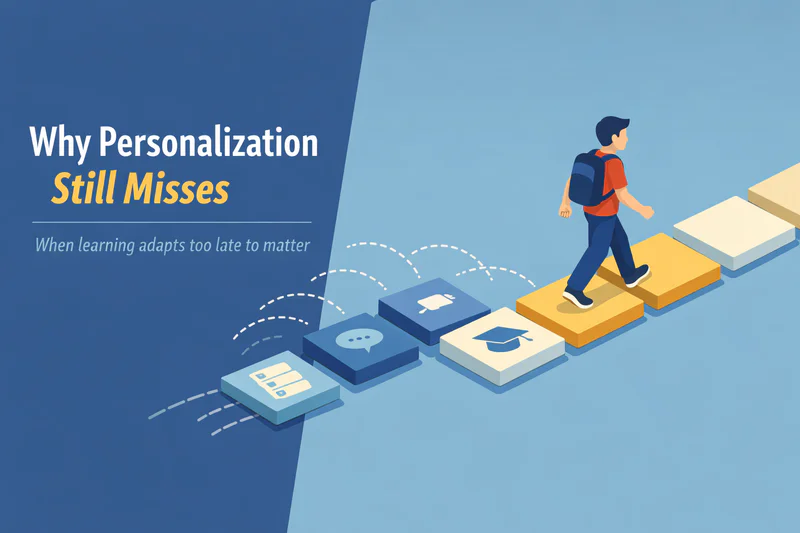
Personalized learning sounds simple on paper.
Teach each learner what they need, when they need it.
Yet here’s the uncomfortable truth: most “personalized” learning experiences still feel generic. Learners click. Scroll. Drop off. And quietly disengage.
That gap between promise and reality is exactly why personalized learning deserves a closer look, not as a buzzword, but as a system of decisions. Decisions about what to show, when to intervene, and how to respond as learner intent shifts in real time.
We’ve spent years optimizing content, paths, and pacing. But learners don’t change in neat steps. Confidence wavers mid-lesson. Motivation spikes after a win, then dips without warning. Static rules can’t keep up.
So the real question isn’t what is personalized learning?
It’s why so much personalized education still misses the moment that matters and what it takes to close that personalization gap for good.
What Is Personalized Learning? A Clear, Practical Definition
Personalized learning is often described as “education tailored to the individual.”
That sounds right. It’s also incomplete.
In practice, personalized learning means designing learning experiences that adapt continuously to the learner, not just at the start of a course, but at every meaningful moment along the way.
At its core, personalized education focuses on three things:
Relevance: Delivering content that aligns with a learner’s goals, context, and current understanding
Timing: Responding when a learner is ready, confused, confident, or hesitant
Direction: Guiding learners forward without locking them into rigid paths

Most personalised learning systems today emphasize pace and content selection. Learners move faster or slower. They see different modules. That’s useful,but limited.
True personalized learning goes further. It adjusts based on signals like:
Sudden hesitation after an assessment
Repeated retries on the same concept
A sharp drop in engagement mid-session
Intent to explore deeper versus intent to exit
This is where personalized learning starts to look less like static customization and more like next best action and decision-making in real time.
It’s also where confusion often creeps in between terms. Let’s clarify:
Customized education typically relies on predefined rules or profiles
Personalized education adapts dynamically as learner behavior and intent change
AI personalized learning can do either, depending on whether it understands context or just content
The distinction matters. A system can recommend the “right” lesson and still feel wrong if it ignores how the learner feels in that moment.
The takeaway is simple and practical:
Personalized learning isn’t about offering more choices. It’s about making better decisions, based on who the learner is right now.
Say “next” and we’ll look at how personalized learning evolved and why that evolution created today’s personalization gap.
Personalized learning is not the act of offering more choices to learners. It’s the discipline of making better decisions for them, continuously, as their goals, confidence, and intent shift in real time.
The Evolution of Personalized Learning in Education
Personalized learning didn’t start with AI. It started with structure.
Early personalized education systems focused on predefined learning paths. Learners were grouped by level, assigned modules, and moved forward based on completion. Helpful, yes. Adaptive, not quite.
Then came data-driven platforms. These systems tracked clicks, scores, and time spent, promising smarter personalization. The logic improved, but the experience often didn’t. Why? Because behavior was measured, not understood.
Today, AI personalized learning raises the bar again. Algorithms can recommend content, adjust difficulty, and predict outcomes. But without context, without knowing why a learner is stuck or disengaged, AI still reacts too late.
This evolution explains the challenge we see now. Tools advanced. Understanding didn’t always keep pace.
The Personalization Gap: Why Most Personalized Learning Doesn’t Feel Personal
On the surface, many platforms check the boxes for personalized learning.
Different paths. Adaptive quizzes. Smart recommendations.
Yet learners still feel unseen.
Where the gap actually forms
The personalization gap appears when systems respond to actions but miss intent. Clicking “next” doesn’t always mean understanding. Replaying a video doesn’t always signal interest. These moments carry meaning, but most personalised learning systems treat them as isolated events.
As a result:
Learners receive harder content when they’re already unsure
Motivational nudges arrive after engagement has dropped
Recommendations repeat instead of adapting
The experience feels mechanical. Predictable. Slightly off.
Why data alone isn’t enough
Most personalized education relies on quantitative data: scores, time spent, completion rates. Useful signals, but incomplete ones.
What’s missing are the qualitative layers:
Hesitation versus curiosity
Frustration versus productive struggle
Confidence versus quiet confusion
Without these distinctions, even AI personalized learning systems default to averages. They optimize for patterns, not people.
That’s the gap.
Personalized learning exists, but it doesn’t always respond when learners need it most.
Signals Over Segments: What Real Personalized Learning Requires
For years, personalization relied on segments.
Beginner. Advanced. At risk. High intent.
Segments help with scale, but they flatten reality. Learners don’t stay in one bucket for long. Intent shifts mid-session. Confidence drops after a single failed attempt. Motivation rises when something finally clicks.
Real personalized learning responds to these shifts as they happen.
That requires signals, not just data points, but meaningful indicators of what a learner is experiencing in the moment. The most effective personalized education systems pay attention to:
Behavioral signals: pauses, retries, sudden exits, rapid progress
Contextual signals: where the learner is in the journey, not just what they’ve completed
Qualitative signals: frustration, curiosity, hesitation, intent to continue or stop
Segments help systems scale, but they flatten human behavior. Signals, on the other hand, capture the nuance of learning as it happens—revealing hesitation, curiosity, and readiness in ways static profiles never can.
This is where personalised learning starts to feel human. The system adjusts tone, pacing, and guidance based on what the learner needs now, not what they needed ten steps ago.
Segments describe learners.
Signals understand them.
How AI Personalized Learning Closes the Gap, When Done Right
AI can personalize learning in two very different ways.
One approach focuses on optimization. It analyzes past behavior, ranks content, and serves what looks statistically relevant. Efficient, yes. Responsive, not always.
The other approach is more adaptive. AI personalized learning systems that work in real time interpret signals as they emerge and adjust decisions immediately. That’s where the experience changes.
When AI understands context, it can:
Slow down when a learner hesitates repeatedly
Offer reinforcement instead of escalation after failure
Shift tone when confidence drops
Introduce depth when curiosity increases
This isn’t about predicting outcomes weeks in advance. It’s about supporting learners in the moment they’re making decisions.
The difference comes down to awareness. Personalized learning improves when AI recognizes why a learner behaves a certain way, not just what they did.
That’s how personalized education moves from automated delivery to responsive guidance.
Next up, we’ll ground this in reality with personalized learning use cases that actually work.
Personalized Learning Use Cases That Actually Work
Personalized learning works best when it responds to signals, not assumptions. Some practical examples show the difference clearly:
Adaptive difficulty: When repeated retries signal uncertainty, the system reinforces fundamentals instead of pushing harder content.
Intent-aware nudges: If a learner pauses frequently, guidance shifts from prompts to reassurance or clarification.
Engagement-based pacing: Rapid progress triggers optional depth, while hesitation triggers simplification.
Contextual timing: Support appears during struggle, not after disengagement.

These moments feel small. They’re not. Together, they shape whether personalized education feels supportive or scripted.
When systems listen closely, learners stay longer, move forward with confidence, and trust the experience.
Personalization Needs Signals, Not Just Data
Personalized learning has never been about more content. It’s about better decisions.
The personalization gap exists because most systems react too late or too broadly. They see outcomes, not intent. Behavior, not context. That’s why even well-designed personalized education can feel impersonal.
Real progress comes from high-fidelity signals. The kind that reveal hesitation, confidence, motivation, and readiness in real time.
This is where Zigment’s approach matters. Personalization is ineffective without high-fidelity signals. Zigment integrates qualitative signals like mood and intent into a unified data layer, ensuring deep contextual awareness drives the delivery of tailored value propositions.
When learning systems understand learners as they change, personalization stops feeling forced and starts feeling right.