
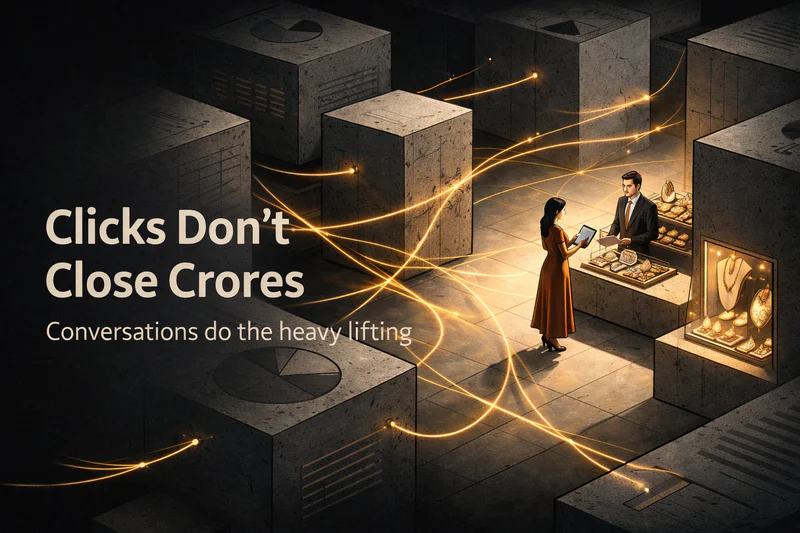
Last Tuesday, Priya walked into a heritage jewellery showroom in Mumbai. She'd been there twice before once browsing bridal sets six months ago, then again for a temple necklace consultation three weeks back.
The sales manager greeted her warmly but asked, "How can I help you today?" as if meeting her for the first time.
Priya had spent forty-five minutes on her previous visit explaining her wedding timeline, budget constraints, family preferences, and why she preferred Jadau over Kundan.
She'd mentioned her sister's upcoming anniversary and her mother-in-law's fondness for temple motifs.
Every word of that conversation every hesitation, preference, and concern lived only in a salesperson's memory, if at all.
The CRM recorded visit dates and product codes. Nothing more.
This isn't an isolated incident. It's the fundamental flaw in how jewellery businesses think about customer data.
Your CRM Captures Clicks, Not Conversations!
Most jewellery CRMs today are glorified spreadsheets.
They track contact information, purchase history, email opens, and website visits. A typical customer record might show: visited website 12 times, opened 8 emails, purchased one 22k gold chain in March 2024, abandoned cart twice.
What's missing? Everything that matters.
Steve, a CRM head at a premium jewellery chain, once told me about their "360-degree customer view." They could see every transaction, every abandoned cart, every email interaction.
Yet when a high-value customer called asking about "that antique piece we discussed," their team scrambled through notes scribbled on paper slips.
The CRM showed product ID JAD-2847 was viewed. It didn't capture that the customer was hesitant because her husband preferred contemporary designs, or that she was waiting for her daughter's approval before making a decision.
Jewellery purchases aren't transactional. They're emotional, deliberative, and deeply personal!
A bride-to-be doesn't just "add to cart" she expresses doubts about gold weight, shares family traditions, asks about resizing policies for pregnancy, worries about matching her mother's heirloom.
These aren't data points. They're the actual decision drivers that your CRM completely ignores.
The ₹47 Lakh Question Nobody's Asking
A CFO once told me: "We have enough data. We just need better dashboards."
Famous last words.
Here's what actually happened at his company. Their analytics showed a customer abandoned a ₹2.8 lakh diamond ring. The automated email fired: "Still thinking about it? Complete your purchase today!"
Radio silence.
The dashboard marked it as "lost opportunity." Case closed.
What the dashboard missed: She'd spent twenty minutes on video call explaining her concerns. Her friend got scammed with fake certificates. She needed assurance, not a discount code. She wanted to know if their certifications are internationally recognized.
One conversation with that context? Sale closed. Instead? Lost forever.
A CEO from a multi-crore retail chain shared his "personalization win" at a summit last year. Birthday emails with product recommendations based on past purchases. Decent open rates. Conversion? Nearly zero.
Why? Because their mother-in-law bought them that exact necklace two weeks ago. They mentioned it during a showroom visit. No system recorded it. The "personalization" felt insulting.
When Every Interaction Starts From Zero
Without conversational memory, every customer touchpoint becomes a fresh start. A customer calls after browsing your website and has to re-explain what she's looking for. She visits the store after a WhatsApp consultation and repeats her budget constraints.
She receives an email promoting the exact category she already rejected in a previous conversation.
This isn't just frustrating for customers it destroys your ability to orchestrate meaningful journeys.
Consider Meera's experience with a luxury jewellery brand. She reached out on Instagram DM asking about kundan chokers. The social media team suggested she visit their website. On the website chat, she explained her requirements again. When she called the customer service number, she repeated everything a third time. Finally, she visited the showroom where she had to start from scratch with a sales consultant who had no context.
Four channels. Four conversations. Zero continuity. The brand lost the sale not because of product or price, but because Meera felt unheard.
Now imagine if each subsequent interaction had built on the previous one. "Meera, you mentioned you preferred lighter designs for daily wear let me show you our 18k collection that matches that preference." That's not personalization theater. That's institutional memory.
Your Marketing Attribution Is a Lie
Here's a CFO nightmare scenario.
Customer makes a ₹4.5 lakh purchase.
Analytics say: last click was email. Success! Email works! Scale it up!
But what really happened?
Day 1: Saw Instagram ad. Got interested.
Day 3: WhatsApp conversation. Expressed concerns about gold purity. Your consultant brilliantly addressed every doubt. Customer basically decided to buy.
Day 6: Email arrives. Customer clicks it not because email convinced her, but because she already made up her mind three days ago.
Your CRM gave email all the credit. You just optimized the wrong channel.
A South Indian jewellery chain CEO told us this story. They cut WhatsApp budget after seeing "low conversion rates." Email looked better in reports.
Six months later? Showroom traffic crashed. Turns out WhatsApp was where relationships happened. Where trust got built. Where concerns got addressed. Email just caught the final click.
Cost of that mistake? North of ₹2 crores in lost revenue.
At Zigment we've analysed this pattern across industries.
Without conversational memory, you're confusing intent capture with intent creation. You're giving credit to the messenger, not the message.
What Conversational AI Actually Does (The Zigment Way)
Customer says: "I'm looking for something under three lakhs."
Your CRM records: Budget = 300000.
That's not enough.
Customer asks: "Will this style look good for a reception?" That's occasion context you need forever.
Customer hesitates: "Let me check with my husband." That's a decision-making signal your next conversation desperately needs.
Conversational AI doesn't just transcribe. It extracts intent. It understands that "I'll think about it" means something completely different when followed by "My anniversary is in two weeks" versus "I'm just browsing."
A Bangalore jewellery brand implemented Zigment's conversational memory. Customer inquired about engagement rings via WhatsApp. Three weeks later, walked into showroom.
The consultant knew: Cushion-cut diamonds. Platinum over white gold. Budget concerns. Partner likes minimal designs.
The conversation didn't restart. It continued.
Conversion rate for customers with conversational context? Up 47%.
That's not a marginal improvement. That's a whole new P\&L line.
The Single Customer View Is a Myth
Most CRMs promise a "single customer view." What they deliver is a single record with multiple data silos. Email interactions live in one tab. Website behavior lives in another. Purchase history sits separately. Phone call logs are in a different system altogether. Technically unified, practically fragmented.
A true single customer view means every team member seeing not just what a customer did, but why they did it and what they're likely to need next. It means your marketing automation doesn't send a "browse our collection" email to someone who spent thirty minutes yesterday explaining exactly what they're looking for. It means your sales team isn't caught off-guard when a customer references "what we discussed on WhatsApp" because that context is surfaced automatically.
Conversational data builds this view. It fills the gap between behavioral signals and actual understanding. Without it, you're assembling a jigsaw puzzle with half the pieces missing and wondering why the picture doesn't make sense.
From Recording to Remembering (The Zigment Solution)
Your CRM is a system of record. It documents what happened.
You need a system of memory. One that understands what it means.
System of record: Customer called three times.
System of memory: She's anxious about delivery timelines for her daughter's wedding. She needs reassurance, not tracking updates.
See the difference?
At Zigment.ai, we don't replace your CRM. We augment it with conversational intelligence that your existing systems can't capture. Every conversation WhatsApp, phone, chat, email gets automatically analyzed for intent, sentiment, and context.
That's the shift. From data to understanding. From clicks to conversations. From forgetting to remembering.
The Real Cost of Forgetting
Every forgotten conversation is revenue walking out the door. Every repeated question erodes trust. Every generic email to someone who shared specific needs is money you'll never see.
Jewellery purchases involve long cycles. Multiple touchpoints. Complex emotions. Family dynamics. Cultural considerations. Investment anxiety.
Without conversational memory, you're optimizing for efficiency in a business that requires intimacy.
Here's what keeps me up at night: Your competitors are figuring this out. Right now.
They're building intelligent layer that compounds with every customer interaction. They know their customers not from spreadsheets, but from actual understanding. In a market where trust drives ₹2-10 lakh purchase decisions, that's not a nice-to-have.
It's existential.
At Zigment.ai, we've seen this transformation happen. Jewellery brands that implement conversational memory see 30-50% improvement in conversion rates. Not from spending more. From remembering better.
The question isn't whether you have enough data.
The question is: Can your CRM remember conversations? Because if it can't remember intent, it can't drive revenue.
And in jewellery retail, that's the only question that matters.