
Here's a scenario.
A senior RevOps manager at a 300-person B2B company opens her dashboard on a Monday morning.
Last month: ₹18 lakhs on paid campaigns.
Traffic is up 22%. MQLs? Flat. Her VP of Sales is frustrated. Her CMO wants answers. Her CFO is circling.
She stares at the form abandonment report.
And that's when it hits her.
It's not the traffic. It's the form.
The Quiet Killer in Your Funnel
Your "Contact Us" form is not a lead generation asset.
It's a leak.
Every day, high-intent visitors land on your pricing page, your demo page, your "Why Us" page. They're curious. They're warm. They're exactly the people your sales team wants to talk to.
And then they see the form.
Name. Company. Email. Phone. Team size. Budget range. Job title. "How did you hear about us?"
They close the tab.
The 2025 Formstack study of 1,500 B2B decision-makers found that form abandonment hits 67.8% when more than 7 fields are required according to Formstack, 2025
HubSpot's 2024 research went deeper: each additional form field drops conversion rates by 4.1% on average. (Source: HubSpot, 2024)
And the MarketingSherpa Research Institute confirmed: forms with more than 5 fields in B2B see a 30% lower conversion rate compared to shorter variants.
Now think about your current "Request a Demo" form. Count the fields. Do the math.
You've optimised yourself into silence.
But Shorter Forms Don't Fix It Either!
Here's where it gets complicated.
The instinct is to shorten the form. Strip it to 3 fields. Name, email, company. Done.
And yes, more people fill it out.
But then your SDR picks up the lead. No budget signal. No urgency. No use case. No idea if this person is a decision-maker or an intern doing competitive research.
67% of B2B sales teams say they regularly lack critical qualification data when an inbound lead arrives according to HubSpot 2024 State of Sales Report
So you've fixed the conversion problem by creating a qualification problem. Your SDR spends the first 15 minutes of every discovery call re-asking questions the prospect already answered except they didn't, because you never asked.
Long forms kill conversion. Short forms kill sales. The form itself is the trap.
This isn't a field-count problem. It's an architecture problem.
The Speed-to-Lead Tax You're Paying Daily
There's another cost hiding in this model. And it compounds every day.
A lead is 21x more likely to convert when contacted within 5 minutes.
Within 5 minutes. Not 5 hours. Not tomorrow.
The average B2B company's response time to an inbound inquiry? 38 hours according to industry benchmarks, 2026
You paid for the click. You earned the interest. Your prospect hit peak intent. And then it evaporated in a queue somewhere between "form submitted" and "SDR follow-up scheduled."
By the time your rep reaches out, the prospect has already taken a demo with three competitors.
Pile on this: 79% of inbound leads never convert into sales. Not because the product was wrong. Not because the price was off. Because the hand-off was broken and the nurturing never happened according to Marketing Sherpa, via Salesforce/Martal, 2026
These aren't edge cases. This is the standard operating model for most B2B inbound teams.
Why the Buyer Has Changed (And Your Form Hasn't)
The B2B buyer of 2025 is nothing like the buyer your form was designed for.
They've already done 70–80% of their research before they ever surface. They've read your case studies. They've compared your pricing. They've watched your product demo video three times.
When they finally land on your "Talk to Sales" page, they're not looking to fill out a census form. They're looking for a conversation. A fast one. A relevant one.
82% of B2B buyers say they'd rather engage with a chatbot than wait for a human agent according to Tidio, October 2024
Only 18% are willing to wait even 15 minutes for a response.
Your static form and its 48-hour follow-up cycle isn't just inconvenient. It's a signal. It tells your prospect: we're not ready to move at your pace.
That's a deal-breaker before the deal has even started.
This Is a Revenue Operations Problem. Not a Marketing Problem.
Let's step back and look at this from a RevOps lens.
Your inbound funnel has a structural inefficiency baked into it at the most critical moment the moment of peak intent. And that inefficiency touches every metric that matters.
CAC goes up because you're not converting enough of the traffic you already paid for. Pipeline quality suffers because leads arrive without context. Sales cycle length grows because reps spend the first few conversations gathering information they should already have. Win rate drops because buyers who waited too long already made a decision.
Every 1% improvement in lead conversion in B2B generates an average 3.7% increase in qualified pipeline according to MetricWorks, 2025.
Read that again.
The inverse is also true. Every 1% you bleed through form friction, slow response, and poor qualification is costing you pipeline. Real pipeline. Every quarter.
This isn't a marketing experiment. This is a revenue equation.
The No-Form Future: What It Actually Means
"No-form" doesn't mean no qualification.
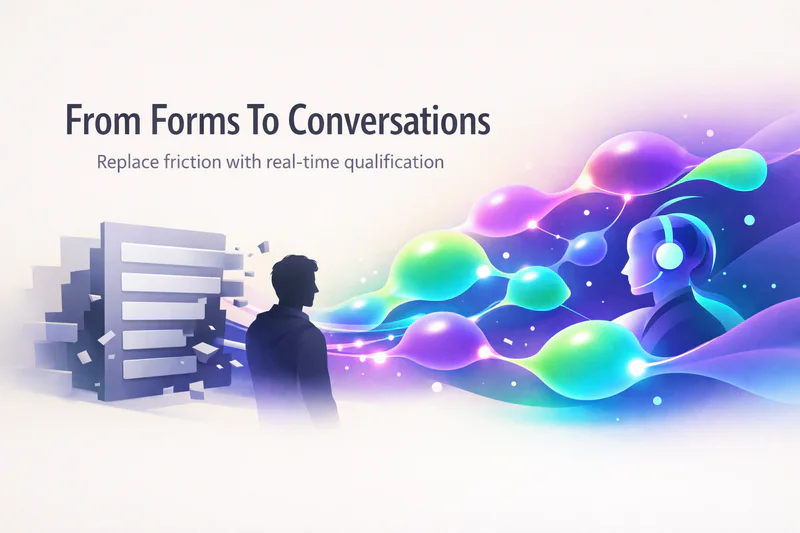
It means replacing passive data collection with active conversation.
Instead of asking a visitor to fill out a form and wait, you meet them where they are right on your pricing page, right on your demo page, right at the moment they're deciding whether to stay or go with a conversational agent that qualifies them in real time.
One question at a time. Naturally. Like a skilled SDR would.
What brings you here today?
How many people are on your team?
Are you looking to solve this in the next 30 days or exploring for later?
It feels like a conversation. Because it is one.
And the data is decisive:
Conversational AI converts 3–5x better than static forms.
Chatbots convert into sales 3x better than traditional website forms.
64% of businesses using AI chatbots report an increase in qualified leads.
Interactive content generates 2x more conversions and 5x more pageviews than static content.
In pilots across B2B brands, unified agentic platforms cut human qualification time by 90% and lifted multi-channel lead conversion by 25–30%.
These aren't chatbot experiments. This is what happens when you design for the buyer instead of the database.
Where Zigment Comes In And Why It's Different?
A chatbot is not a conversational agent.
A chatbot follows a script. It answers FAQs. It breaks when someone goes off-script. It's essentially a form with a chat bubble on it.
Zigment's agentic AI is built differently.
At its core is the Conversation Graph , Zigment's proprietary system that tracks every message, click, intent signal, and decision in a single query able timeline. Not just what visitors click. But why they clicked. Their mood. Their hesitation. Their urgency. Their specific language when they described the problem they're trying to solve.
Here's what that means in practice.
A visitor lands on your pricing page. They've been to your site twice this week. They spent 4 minutes on the enterprise plan. Zigment's agent reads those behavioural signals and opens a conversation not with "Hi! How can I help?" but with something contextually relevant to what they're looking at.
The agent qualifies them: budget range, team size, timeline, use case. One natural question at a time. It detects intent. It detects hesitation. It knows if someone says "we've been evaluating options for a while" that urgency is low and adjusts accordingly.
High-intent, high-fit?
Route to sales instantly. Meeting booked. Context passed to the rep not a lead score, but an actual summary of what was discussed, what the prospect cares about, and what they flagged as concerns.
This is what Zigment means when it says: "Our agents orchestrate actions across systems." They're not collecting data. They're advancing the journey.
And because the Conversation Graph stores everything, your RevOps team doesn't just get cleaner leads. They get a living record of how every prospect moved through the funnel what signals drove qualification, where deals stalled, and what language works.
A Note on Where Forms Still Belong
Let's be precise. "No-form" doesn't mean zero forms.
Forms still work for content downloads, event registrations, and newsletter sign-ups situations where the exchange is clear and the friction is expected.
But for high-intent commercial pages pricing, demo, "talk to sales," ROI calculators he static form is costing you. These are the pages where your buyers are closest to a decision. That's exactly where you need active engagement, not passive capture.
Replace or augment. Your highest-intent pages deserve conversational agents. The rest can keep the form.
The Bottom Line
Inbound marketing promised that the right content in the right place would attract the right buyers.
It delivered on that promise.
But we built a bottleneck at the moment of maximum intent. Visitors land at peak interest and hit a form. A passive, friction-heavy, slow, context-destroying form.
That's not inbound. That's a toll booth.
The no-form future is about meeting your buyer's intent with something that matches their energy: a real conversation, in real time, that qualifies without interrogating and advances the journey without making them wait.
Zigment's Conversation Graph and agentic AI layer are built for exactly this moment. Real-time qualification. Behavioural context. Full CRM integration. Omnichannel continuity WhatsApp, web, email, Instagram, SMS, voice. No friction. No waiting.
Your inbound funnel is leaking. The fix isn't a shorter form.
It's a better conversation.