
Let’s be honest: for most of us, "automation" is just a fancy word for sending more emails faster.
We spend hours agonizing over subject lines. We A/B test the color of our CTA buttons. We scour the internet for HubSpot email marketing tips, convinced that if we just tweak that one workflow, our open rates will magically bounce back to 2015 levels. But while we are busy optimizing our inboxes, our customers have moved on. They are texting. They are on WhatsApp. They are DMing.
And your HubSpot portal? It has no idea.
Here is the hard truth: if you are relying solely on traditional automation rules, your system is "Channel-Blind." It doesn't know that your lead just replied to a text message, so it keeps blasting them with automated emails asking for a meeting they already booked. This isn't just embarrassing; it’s a revenue leak. In fact, relying on single-channel automation in a multi-channel world is likely leaking 30% of your qualified leads.
In this deep dive, we are going to look at why standard HubSpot marketing automation fails to capture the modern buyer, and how a new approach, Stateful Orchestration can plug that leak for good.
The "Inbox Zero" Fallacy: Diagnosing Channel Bias
We have seen inside hundreds of HubSpot portals, and they almost all suffer from the same condition: Channel Bias.
We treat email as the default, the gold standard, and the primary vehicle for revenue. Why? Because it’s comfortable. It’s cheap. And frankly, it’s what we’ve been taught to do. But this bias creates a dangerous blind spot in your revenue operations HubSpot strategy.
When your automation is biased toward email, it treats every other interaction as "noise" rather than a signal. You might have a WhatsApp HubSpot integration set up, or you might be using SMS for HubSpot, but if those channels aren't controlling the "brain" of your HubSpot workflow, they are just extra pipes leaking water into a basement that no one checks.
Here are three symptoms that your HubSpot email marketing strategy is suffering from Channel Bias:
1. The "Zombie Nurture."
This is the most painful symptom to watch.
A prospect replies to an SMS from your sales rep saying, "Sure, let's chat Tuesday." Ten minutes later, your HubSpot marketing workflow sends them an automated email: "Just bumping this to the top of your inbox—did you see my last note?"
The prospect assumes your company is disorganized or, worse, that they are talking to a robot that doesn't listen. The workflow is "stateless"—it doesn't know the state of the relationship changed in a different channel.
2. Obsessing Over HubSpot Email Marketing Pricing Instead of Opportunity Cost
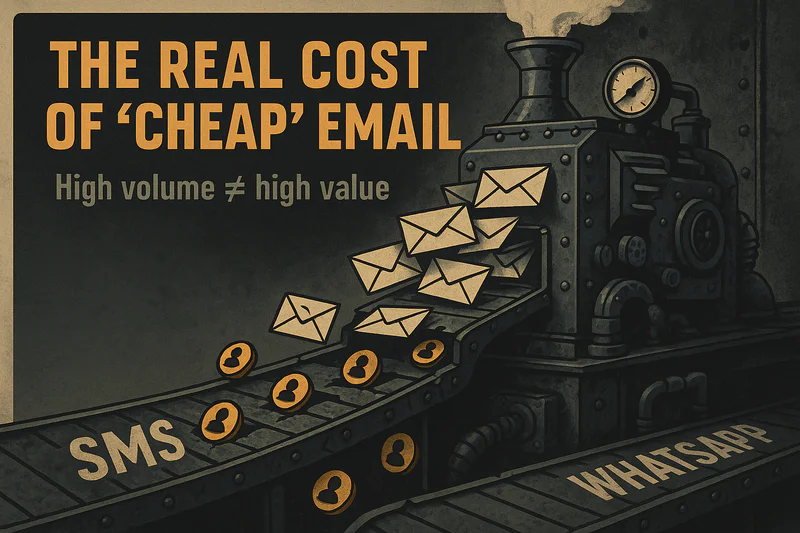
I hear this all the time: "SMS is too expensive compared to email." We fixate on the CPM of a text message or the platform costs of HubSpot email marketing pricing, but we ignore the cost of attention.
If you send 1,000 emails that get a 0.5% click rate, you have wasted 995 opportunities. If you send 200 WhatsApp messages with a 40% response rate, the cost per conversation is infinitely lower. Channel bias makes us optimize for cheap volume rather than valuable engagement.
3. Living by the Old Rulebook
If you are relying on standard HubSpot email marketing certification best practices, you are likely operating on a playbook written five years ago. Those courses are fantastic for understanding the tool, but they often reinforce the idea that the "Workflow" is a linear path of emails.
If you find yourself searching for HubSpot email marketing certification answers or HubSpot email marketing exam answers to figure out why your leads aren't converting, you are looking in the wrong place. The answer isn't in the exam; it's in your customer's pocket.

The Reality Check: Where Your Leads Actually Live
Let's look at the data. Where do your leads actually live?
If you are B2B, you might say "Email." But are you sure? Even B2B buyers are humans. They have phones. They use WhatsApp to talk to their families and Slack to talk to their teams. Their email inbox is a to-do list they are desperately trying to clear, not a place they go to discover new solutions.
To fix the leak, we need to stop thinking about HubSpot for email marketing and start thinking of it as a command center for HubSpot lead generation across all surfaces.
This requires integrating high-engagement channels not as "add-ons," but as primary players.
- WhatsApp: In many regions, this isn't optional. A WhatsApp HubSpot integration allows you to meet leads in an environment where they feel comfortable and conversational.
- SMS: With open rates consistently above 90%, SMS HubSpot strategies cut through the noise. But they require extreme care (more on that later).
The problem is that most RevOps teams treat these as separate silos. You have an "Email Workflow" and maybe a separate "SMS Campaign." That isn't orchestration; that's chaos.
You need to move from a "Channel-First" mentality (e.g., "How do I send an email?") to an "Outcome-First" mentality (e.g., "How do I get a reply?").
The Solution: From "Stateless" Rules to "Stateful" Orchestration
This is the pivot point. This is how you fix the leak.
You need to upgrade your logic from "Stateless" to "Stateful."
- Stateless Automation: "If lead fills form, wait 2 days, send Email 1." This logic is blind. It fires regardless of what else is happening.
- Stateful Orchestration: "If lead fills form, check if they are active on WhatsApp. If yes, send message there. If they reply, update the HubSpot lead generation status and cancel all queued emails."
To do this, you can't just rely on standard HubSpot marketing automation workflows. You need an "Agentic Layer"—a brain that sits on top of HubSpot.
At Zigment, we call this the Conversation Graph.
The Conversation Graph is a temporal knowledge graph that links identities, threads, intents, and sentiments across every channel.
It remembers that "John Smith" on email is the same "John" who texted you yesterday. It functions as a memory and identity resolution layer that ensures your automation never looks stupid.
The "Cross-Channel Pivot" Play
Here is what Stateful Orchestration looks like in practice, using an agentic layer:
- The Trigger: A high-value lead downloads a whitepaper.
- The Plan: The agent checks the Conversation Graph. Has this person consented to WhatsApp HubSpot integration messages? Yes.
- The Action: Instead of the standard email, the agent sends a polite, context-aware WhatsApp message: "Hi [Name], saw you grabbed the report. Do you have a quick question about it, or should I leave you to read?"
- The Branch:
- If they reply, The agent engages, answers questions using your knowledge base, and books a meeting. The email nurture is automatically paused.
- If they don't read it: The agent waits 24 hours and fails over to email.
This isn't just a "workflow." It's a decision loop: Perceive -> Plan -> Act -> Observe. It maximizes the expected business outcome (a booked meeting) while minimizing the cost of spamming a user who is already engaged.
The Guardrails: Managing Consent and "Quiet Hours"
Now, I know what you are thinking. "If I unleash SMS and WhatsApp, won't I annoy people?"
Yes. If you treat SMS like HubSpot email marketing, you will annoy people. You might even get sued.
This is why the "Brain" is so critical. A simple SMS HubSpot integration via Zapier is dangerous because it lacks governance. It doesn't know what time it is where the customer lives. It doesn't know if they opted out five minutes ago on a different channel.
An agentic layer like Zigment solves this with strict Enterprise Governance and Policy packs.
The Policy of "Quiet Hours"
Imagine a lead fills out a form at 11:00 PM their time. A standard HubSpot marketing workflow triggers an SMS immediately. The lead wakes up, annoyed, and blocks you.
An agentic system checks the "Quiet Hours" policy. It sees the local time is 11:00 PM. It holds the message in a queue and releases it at 9:00 AM the next morning. This sounds simple, but it is the difference between being helpful and being harassed.
Consent is Hierarchy
You need to manage consent at a granular level. Just because someone gave you their email doesn't mean you can text them.
- Marketing Consent: Can I send newsletters?
- SMS/WhatsApp Consent: Can I send direct messages?
Zigment’s data model treats these consents as distinct attributes within the User Identity. Before any action is taken—sending a WhatsApp message, scheduling a nudge—the agent verifies the specific consent for that channel. If consent is missing, the agent automatically fails over to a permitted channel (like email) or asks for permission first.
Implementation: How to Fix This Without Ripping Out HubSpot
You do not need to delete your HubSpot portal to fix this. You don't need to fire your Ops manager. You just need to add the missing layer.
Here is a 3-step playbook for the modern HubSpot RevOps leader:
Step 1: The Audit
Look at your HubSpot lead generation reports. Identify the "Black Hole" leads—the ones who opened one email and then vanished. These are likely people who wanted to buy but didn't want to email.
Step 2: The Connection
Integrate your communication channels. Connect your Twilio or WhatsApp Business API to the Zigment layer. This gives the agent the "hands" to do the work.
Step 3: The Brain
Deploy the Conversation Graph. This sits on top of HubSpot. It ingests your HubSpot contact properties, notes, and activities, and builds that "Stateful" memory. You then configure your "Plays"—the goals you want the agent to achieve (e.g., "Book a Demo," "Qualify Lead").
The result? You keep HubSpot as your "System of Record" (CRM), but you use the Agent as your "System of Engagement".

Stop Automating, Start Orchestrating
The era of "set it and forget it" automation is over. In a world where your customers are bombarded with noise, the only way to win is to be the signal.
You can't be the signal if you are sending generic emails to a lead who is begging for a quick text chat. You can't be the signal if you are "Channel-Blind."
By adding a stateful, agentic layer to your HubSpot marketing stack, you aren't just adding new channels; you are adding memory. You are adding the ability to listen, plan, and act with intent.
Zigment provides this exact layer. It creates the Conversation Graph that unifies your data, orchestrates your Next Best Action across Web, SMS, Email, and WhatsApp, and enforces the enterprise safety you need to sleep at night.
The result isn't just "better automation." It's real business outcomes: higher qualified lead rates, more demos booked, and a retention rate that proves you actually know your customers.
Don't let your automation blind you to the opportunities right in front of you. Open your eyes and your channels to the full conversation.