
And why the difference between a decision tree and a goal-driven AI agent is the difference between losing a donor and keeping them for life.
Let's be honest. We've all had that chatbot experience.
You land on a non-profit's website, fired up about a cause, ready to give. A little chat bubble pops up.
"Hi! I'm here to help!
"I want to make a recurring donation"
or "Can you tell me about your impact in Kenya?"
and what comes back feels like it was written by someone who has never met a human before.
"I didn't quite get that. Did you mean: (A) Donate, (B) Volunteer, (C) Contact Us?"
And just like that, the moment is gone. You close the tab. The donation never happens.
This isn't a minor UX inconvenience. It's a donor retention crisis hiding in plain sight and traditional chatbots are right at the centre of it.
The Problem with "Choose Your Own Adventure" Bots
Here's what most chatbots are actually doing under the hood: they're running a script. A decision tree. A glorified flowchart with a chat bubble slapped on top.
Someone built those branches months ago. Every possible conversation the bot can have was pre-mapped, pre-written, and locked in. If a donor says something the bot didn't expect, if they ask a nuanced question, express hesitation, or show genuine emotional interest in the mission the bot hits a wall.
It either sends them back to the main menu or spits out a generic fallback like "I'll connect you with our team!" and then… nothing happens until Monday morning.
The numbers here are brutal. 48% of supporters receive no follow-up after they sign up, and mass emails drive 82% less engagement than personalized messages. Traditional bots aren't fixing this gap they're making it worse by giving donors the illusion of engagement while delivering none of the substance.
So What Does Zigment Actually Do Differently?
Zigment isn't a chatbot company. It's something genuinely new: an agentic AI platform built specifically for customer and donor journeys.
The distinction matters enormously. Where a chatbot follows a script, Zigment's agents don't just answer questions; they push the conversation forward, much like a skilled salesperson would. They understand context. They detect emotional signals. They adapt. And critically they act.
Think about what that means for a non-profit. A donor visits your site after seeing a Facebook ad about clean water in rural communities. With a traditional chatbot, they get the menu: donate, volunteer, learn more.
With a Zigment agent, the conversation starts where the donor already is interested, emotionally primed, ready to be moved. The agent reads intent, responds with mission-aligned messaging, answers specific questions about impact, and can guide that donor to a first gift without ever hitting a dead end.
That's not a chatbot. That's a frontline fundraiser who never sleeps.
The "Conversation Graph": Zigment's Secret Weapon
One of the most innovative pieces of Zigment's platform is something called the Conversation Graph and it's worth pausing on this for a second.
Most tools track what donors do (clicked a link, opened an email, donated $50 in March). Zigment's Conversation Graph goes a layer deeper: it tracks every message, click, and call in a single query able timeline, understanding user mood and intent, detecting urgency or hesitation, and automatically taking the next steps.
So if a potential donor asks three detailed questions about your financials and then goes quiet, the system doesn't shrug. It flags the hesitation, understands the intent signal, and can trigger a follow-up a personalized message, a brochure, an invitation to a call before that lead goes cold. That kind of nuanced, real-time responsiveness is simply impossible for a rule-based bot to replicate.
Omnichannel, and Actually Omnichannel
Here's another place where traditional chatbots fall flat: they live in one place. Your website widget. That's it.
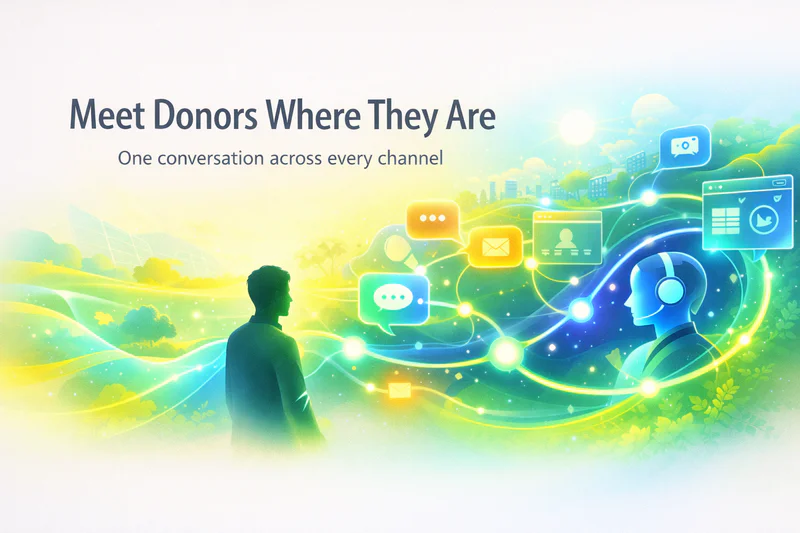
Your donors don't live on your website. They live on Instagram. They DM you on Facebook. They open texts faster than emails. Zigment delivers a smooth journey from ads to Instagram DMs by making every contact meaningful and meeting supporters wherever they are.
This isn't just convenience it's strategy. A donor who clicks a cause-driven Instagram Story and immediately gets a warm, personalized response via DM is infinitely more likely to convert than one who has to navigate to a website and wait for a chat widget to load. Zigment's agents work across WhatsApp, Instagram, Facebook, SMS, email, and web all with the same contextual intelligence, all stitched together in that unified Conversation Graph.
If a lead becomes inactive in the CRM, another agent might follow up on WhatsApp. The system is proactive. It closes loops that humans miss.
The Real Cost of Getting This Wrong
Let's talk numbers for a second. Zigment's platform has demonstrated a 35% increase in lead conversions, an 85% reduction in human resource requirements, and a 12x return on investment for clients.
For nonprofits operating on thin margins with stretched teams, those numbers aren't just impressive they're transformative. An 85% reduction in the manual labor of donor engagement means your team isn't spending Friday afternoon sending follow-up emails to people who filled out a form two weeks ago. It means your fundraisers are free to do what humans actually do well: build deep relationships, tell stories, inspire major gifts.
Zigment's AI creates "first-layer" engagement with donors and volunteers through chat, SMS, and social media while staying true to each organization's mission. It's not replacing your team. It's handling the first 80% of the conversation so your team can focus on the 20% that matters most.
But Won't AI Feel Impersonal?
This is the fear most nonprofits voice when they first hear about AI-powered donor engagement. And it's a fair one. Fundraising is built on trust, empathy, and human connection.
Here's the thing: a decision-tree chatbot is impersonal. It's a form masquerading as a conversation. Zigment's agents, trained on your mission, your voice, and your specific supporter community, are designed to feel the opposite. Zigment is dedicated to crafting AI that doesn't just talk but communicates and that distinction is everything in the non-profit world.
Donors don't want to feel processed. They want to feel heard. A goal-driven AI agent that understands context, responds with warmth, and knows when to escalate to a human (Zigment does this too) creates that feeling far more reliably than a bot that asks them to pick option A, B, or C.
The Bottom Line
The chatbot era isn't over it's just running out of excuses.
For nonprofits serious about donor retention, conversion, and long-term mission impact, the question isn't "should we use AI?"
It's "are we using AI that's actually smart enough to represent our mission?"
A dumb bot says "I didn't understand that."
A Zigment agent says "I hear you let me show you exactly how your gift will create change."
That difference, compounded across thousands of conversations, is the difference between a stagnant donor database and a thriving community of lifelong advocates.
The technology exists. The question is whether you're ready to use it.