
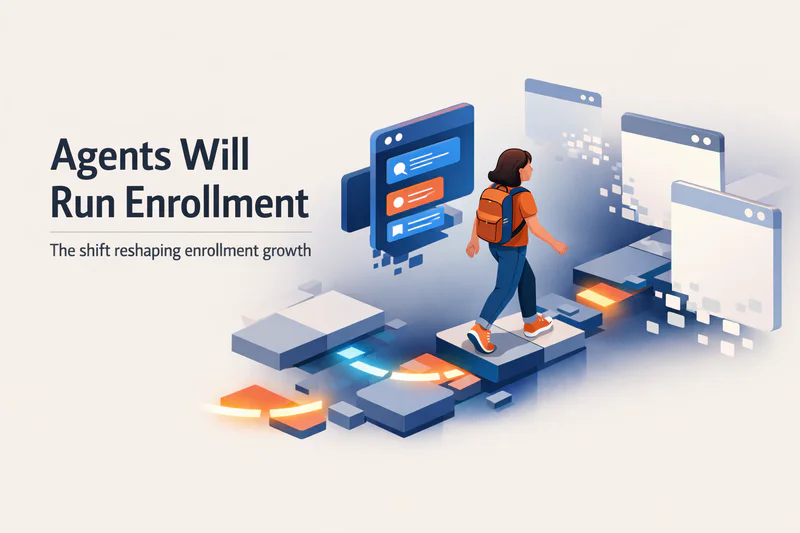
A prospective student visits a university website at 11pm. She is anxious about a financial aid deadline.
She opens the chatbot. It returns a FAQ link. She asks a follow-up. Same link.
She closes the tab!
That moment cost the university nothing visible. Over four years, it cost them $120,000.
This is the real crisis in higher education right now. Universities have invested heavily in Tier-1 support tools like Ocelot and Ivy.ai. Those tools answer questions.
But answering questions is not the same as enrolling students. In 2026, the gap between those two outcomes is where enrollment revenue disappears.
The shift has a name. It is the move from a System of Response to a System of Action. And the institutions that make it first will own the next decade of enrollment growth.
Why Stateless Chatbots Are a Structural Problem, Not a Software Problem
Most AI chatbots for higher education are stateless by design. Every message is treated as an isolated ticket.
Every session starts from zero. The student's history, intent, and emotional state are wiped clean with every interaction.
This is not a bug!
It was the right architecture in 2018. But student expectations have shifted. Today's prospective student moves across WhatsApp, email, web chat, and SMS before making a decision.
A tool that forgets them every time they switch channels is not a support tool. It is a friction generator.
Legacy platforms rely on predefined if-then decision trees. They struggle the moment a conversation moves outside a scripted path. They provide information. They do not take action.
They cannot submit a financial aid document, schedule a campus visit, or flag a stalled application. That implementation burden falls entirely on the student.
The result is a disconnected enrollment experience. Students repeat themselves. Admissions teams operate blind. And the chatbot keeps logging deflected tickets as a success metric while enrollment numbers stagnate.
The Stateful Revenue Agent: From Answering to Acting
A stateful revenue agent does not just respond. It pursues goals. This is the core distinction of agentic AI it operates on a goal-achievement framework rather than a question-answer loop.
Platforms like Zigment are built on this foundation. Zigment's Conversation Graph captures every click, message, sentiment signal, and behavioral marker into a single unified timeline. The system does not reset between sessions. It remembers. It reasons. It acts.
When a student asks about a program eligibility at 11pm, a stateful agent does not return a link. It checks her eligibility against integrated academic records. It identifies any missing transcripts. It follows up via SMS the next morning with a direct link to upload the missing document. The entire sequence runs autonomously without a human counselor initiating a single step.
This is what separates conversational AI for higher education as a concept from conversational AI as an operational system. The agent is not a smarter FAQ. It is an autonomous enrollment partner.
Multi-Turn Reasoning: The Capability Gap Legacy Tools Cannot Close
Multi-turn reasoning is the ability to connect information across multiple conversation exchanges before arriving at a useful response. It is the baseline requirement for any meaningful student interaction. Most legacy chatbots for higher education cannot do it.
Ask a standard bot: "I'm worried I won't qualify."
Without context, the question is unanswerable. The bot either asks a generic clarifying question or returns the wrong resource. The student's trust erodes.
Agentic systems solve this through coordinated, specialized agents working in parallel. A Qualifier agent captures intent. A Follow-Up agent detects inactivity. A Scheduler agent books campus visits. A Reminder agent sends personalized nudges. Each agent handles a distinct function. All agents share the same live context.
This coordination matters especially at scale. Research in adjacent sectors shows that AI agents can filter out up to 90% of non-serious inquiries. Admissions staff can then focus exclusively on the high-intent leads ready to convert. The cost of converting an inquiry into an enrolled student drops by up to 40%.
Multi-turn reasoning is not a premium feature. It is the minimum bar for student engagement software that actually moves enrollment numbers.
Channel Continuity: The Real Meaning of Omnichannel Engagement
Most universities describe their student communication strategy as omnichannel. What they actually mean is that they broadcast the same message across multiple platforms at the same time. That is not omnichannel. That is noise with extra steps.
True omnichannel engagement means context travels with the student. Every channel switch preserves conversation history. Every new message builds on what came before. The student never repeats themselves.
Legacy student engagement software fails this test consistently. Each channel operates in a silo. Admissions teams lose visibility the moment a student switches from web chat to WhatsApp. The conversation thread breaks. The opportunity stalls.
Zigment's platform was built to eliminate exactly this failure. It connects web chat, WhatsApp, Instagram, email, and voice into a single unified thread. When a student picks up a conversation on a different channel, the agent already knows where they left off. It knows their preferred contact time. It knows what they were considering last week.
Persistent memory across channels is not a convenience. It is the mechanism that prevents lead leakage at every stage of the enrollment funnel.
Why Broken Attribution Keeps the Wrong Tools Funded
Most enrolment technology lives in the IT budget. That is the tell. When a tool cannot prove revenue impact, it gets funded like infrastructure minimally, defensively, and always under threat of cuts.
Blind attribution keeps AI chatbots for higher education trapped in that category. The dashboard shows 40,000 chat sessions. It shows 600 enrolled students. It cannot connect those two numbers with any confidence. So the tool gets evaluated on ticket deflection volume instead.
When attribution is broken, investment decisions break too. Admissions teams cannot prove that a specific conversation caused a conversion. Technology budgets stay tied to the wrong KPIs.
Human advisors remain underfunded. The cycle continues and the tools that actually drive enrollment stay perpetually underfunded.
From Quarterly IT Report to Provost-Level Revenue Argument
The moment attribution works, the conversation changes entirely. A platform that can trace with timestamp precision which follow-up sequence reactivated a dormant lead is no longer a support tool. It is a revenue channel.
Zigment's Conversation Graph makes this shift possible. Every interaction is logged with mood, intent, channel, and timestamp in a unified timeline. The platform traces exactly which conversation preceded an application submission. Which message converted a passive browser into a confirmed student.
That data belongs in the enrollment budget, not the IT closet. For universities to escape pilot purgatory, three things must happen. The AI must connect directly to the CRM for real-time data write-back.
Complex cases must escalate to human counselors with full context attached. And success must be measured in application completion rates and time-to-confirmation not questions answered per month.
The technology exists. The integrations are live.
The only question is how many more students close the tab before institutions make the move!