
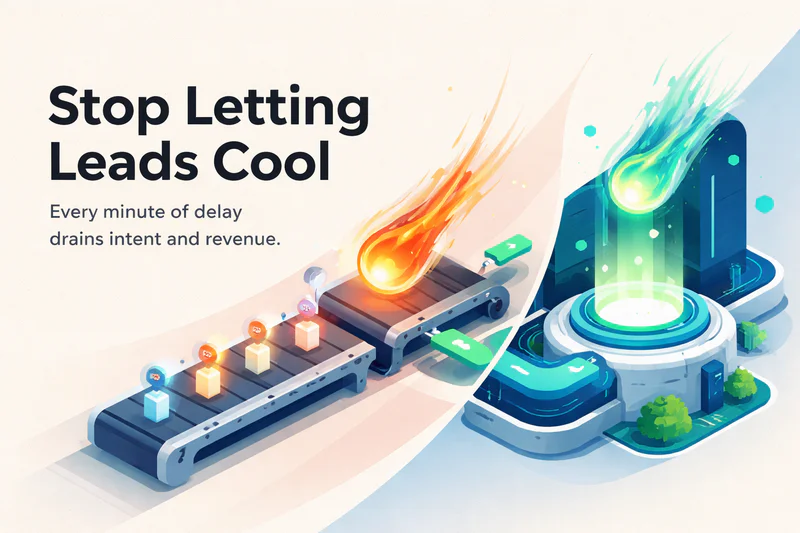
A lead that waits five minutes is dramatically less likely to convert than one contacted immediately. Not tomorrow. Not after a rep finishes lunch. Immediately.
That’s why The End of Lead Routing is no longer a provocative idea, it’s a practical necessity. We’re still pushing high-intent buyers into round robin queues, assigning them to reps who might be in a meeting, off-shift, or juggling five other conversations. Meanwhile, the buyer is ready. Credit card nearby. Calendar open.
Here’s the uncomfortable truth: most revenue loss doesn’t happen because of bad selling. It happens because of delayed engagement.
If a qualified lead comes in at 11:42 PM, why does it sit untouched until 9:03 AM? Why do we “distribute” intent instead of acting on it?
In this article, we’ll break down:
Why traditional lead distribution models are misaligned with modern buying behavior
How round robin logic quietly slows down pipeline velocity
What it means to actually “work” a lead in real time
And how goal-driven agents eliminate routing delays entirely
Let’s get into it.
The End of Lead Routing in a 24/7 Buying Environment
Buyers don’t operate on rep schedules.
They research at night. They compare vendors on weekends. They fill demo forms between meetings. And when they raise their hand, they expect acknowledgment instantly.
Yet most companies still follow this sequence:
Lead submits form
CRM triggers lead distribution
Round robin assigns ownership
Rep receives notification
Rep responds when available

That gap between steps four and five? That’s where deals quietly disappear.
The Availability Gap Is Real
Your team is talented. Hardworking. Committed.
But they are human.
They sleep.
They attend internal calls.
They travel.
They manage multiple active opportunities.
Lead routing assumes availability. Buying behavior doesn’t.
If your system routes a lead to someone who cannot respond immediately, you’ve introduced friction before the first conversation even begins.
How Lead Distribution and Round Robin Became the Default
Round robin wasn’t created to maximize revenue. It was created to ensure fairness.
In a human-only sales environment, that made sense.
Equal opportunity distribution
Balanced workloads
Clear ownership
CRMs were built around this idea: assign first, act later.
But here’s the issue.
Fairness does not equal responsiveness.
Balanced workload does not equal conversion velocity.
When we optimize for equal lead distribution instead of immediate engagement, we subtly prioritize internal operations over buyer experience.
And buyers notice.
Why Routing a Lead to a Sleeping Human Makes No Sense
Let’s be blunt.
If an inbound demo request arrives at midnight and your system assigns it to a rep who starts at 10 AM, what exactly did routing accomplish?
It created a timestamp.
It created ownership.
It did not create engagement.
Those first few minutes after intent are powerful. This is when:
The buyer’s problem is top-of-mind
Competitor tabs are open
Budget conversations are fresh
Urgency is real
Delays cool momentum. Even short ones.
Now imagine a different flow.
Lead submits form
An agent responds within seconds
Contextual questions begin immediately
Qualification happens in real time
Calendar booking is offered instantly
No queue. No waiting. No dependency on calendar alignment.
That’s what “working” the lead actually looks like.
From Lead Routing to Lead Execution
Traditional systems focus on assignment. Modern systems focus on action.
Let’s compare.
Legacy Flow (Lead Distribution Model)
Capture
Route
Notify
Wait
Follow up
Manually qualify
Schedule
Each step depends on human availability.
Agent-First Flow (Execution Model)
Capture
Engage instantly
Qualify dynamically
Book meeting
Sync structured data to CRM
The difference is subtle but powerful.
Instead of pushing leads into queues, we initiate conversations the moment intent appears.
That shift changes everything.
What It Means to “Work” the Lead
Working a lead doesn’t mean sending an automated “Thanks for your interest” email.
It means:
Asking intelligent follow-up questions
Identifying timeline and urgency
Understanding budget signals
Clarifying use case
Suggesting next steps based on responses
Scheduling directly into a rep’s calendar
All before a human even touches the record.
This isn’t assistance. It’s execution.
When the sales rep steps in, they’re not starting from zero. They’re entering a conversation with context, qualification data, and buyer intent already mapped.
That’s leverage.
Operational Advantages of Replacing Lead Distribution with Agents
When we remove routing delays, several things happen quickly.
Speed-to-Lead Becomes Immediate
Engagement shifts from hours to seconds. That alone improves conversion probability.
Qualification Becomes Consistent
Every lead is asked the same structured discovery questions. No variability. No skipped steps.
Reps Focus on High-Intent Conversations
Instead of chasing incomplete forms or cold follow-ups, your team engages:
Pre-qualified prospects
Meeting-ready buyers
Context-rich opportunities
Energy shifts from administrative tasks to revenue-driving conversations.
Revenue Optimization Replaces Fairness Optimization
Round robin optimizes equal distribution. Agent-led systems optimize outcomes.
It’s a different metric entirely.
Operational Advantages of Replacing Lead Distribution with Agents
When we remove routing delays, several things happen quickly.
Speed-to-Lead Becomes Immediate
Engagement shifts from hours to seconds. That alone improves conversion probability.
Qualification Becomes Consistent
Every lead is asked the same structured discovery questions. No variability. No skipped steps.
Reps Focus on High-Intent Conversations
Instead of chasing incomplete forms or cold follow-ups, your team engages:
Pre-qualified prospects
Meeting-ready buyers
Context-rich opportunities
Energy shifts from administrative tasks to revenue-driving conversations.
Revenue Optimization Replaces Fairness Optimization
Round robin optimizes equal distribution. Agent-led systems optimize outcomes.
It’s a different metric entirely.
The End of Lead Routing Requires Goal-Driven Systems
Traditional lead routing systems are queue-driven.
Agentic systems are goal-driven.
The difference?
Queue-driven systems ask:
“Who should own this lead?”
Goal-driven systems ask:
“What needs to happen next to move this buyer forward?”
Those goals might include:
Book a demo
Collect missing information
Revive a dormant inquiry
Nudge toward decision
The system adapts dynamically until the objective is achieved.
That’s the shift we’re seeing across modern revenue teams. Less coordination. More execution.
How Zigment Powers This Shift
At Zigment, we believe leads shouldn’t wait.
Our approach centers on goal-driven planning, where agents act the moment intent appears. They:
Engage instantly
Ask structured qualification questions
Adapt responses in real time
Schedule meetings automatically
Push clean, structured data into your CRM
No dependency on rep availability.
No routing delays.
No idle pipeline time.
Your sales team steps in when the opportunity is ready to close.
That’s how human and agent collaboration should work.
Stop Assigning. Start Executing.
Lead routing was a coordination solution for a human-only sales world.
We don’t operate in that world anymore.
Today, buyers move fast. Intent signals are fleeting. Attention windows are short.
If an agent is always available, always responsive, and always aligned to a defined goal, why would we let a high-intent lead sit in a round robin queue?
The End of Lead Routing isn’t theoretical. It’s operational.
Stop distributing interest.
Start acting on it.