
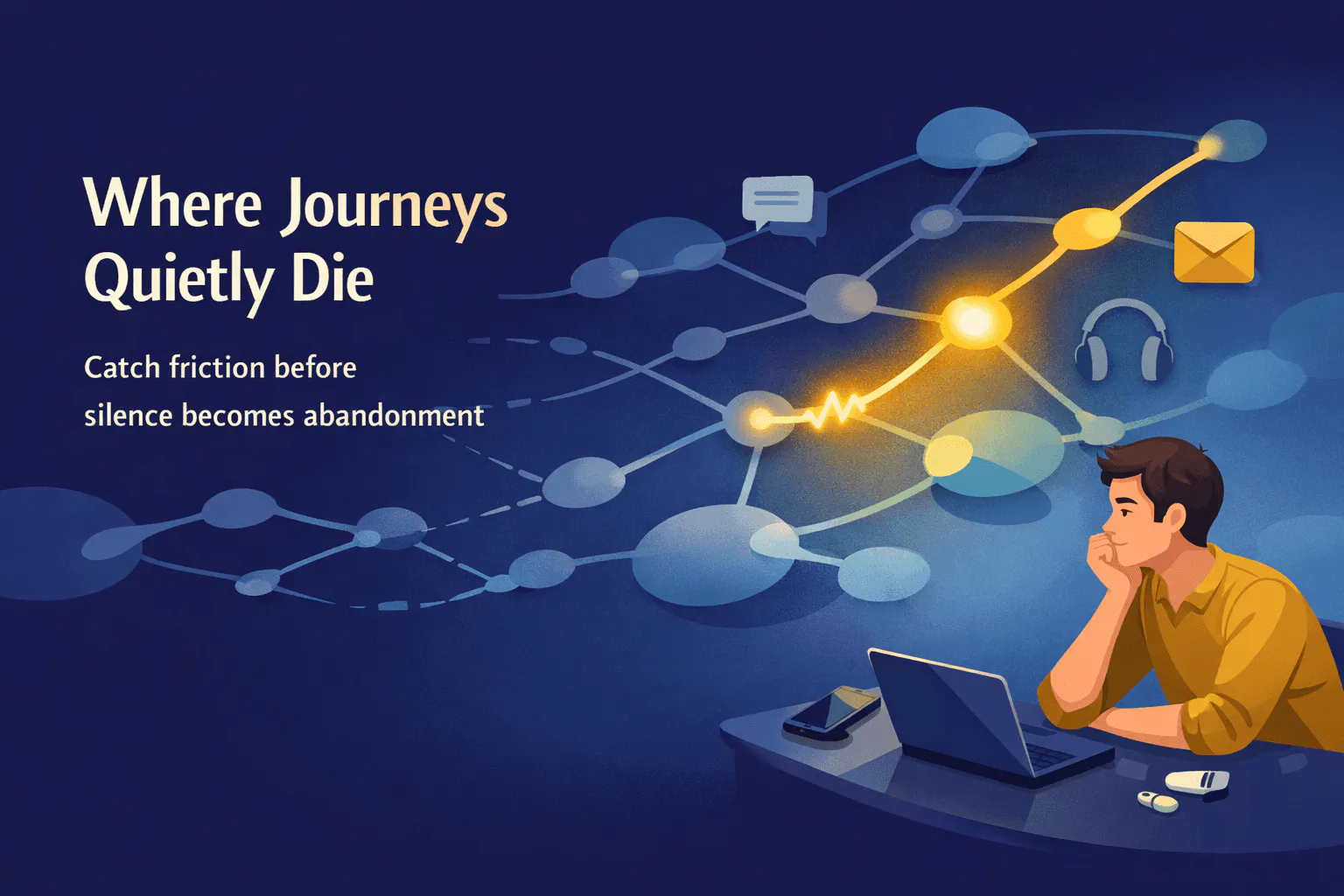
The conversation was going well.
The buyer asked a clear question.
The intent was strong.
Then… nothing.
Five minutes passed. Then ten. When the reply finally arrived, it answered the question,but not this question. The buyer paused, reread the message, and moved on. No complaints. No feedback. Just a silent exit.
We see this pattern every day. Customer journeys don’t collapse because of one big failure. They fade because of small, unaddressed moments, tiny delays, missing context, or responses that arrive one step behind intent.
This is where experience optimization earns its place.
It’s about recognizing early signals while the journey is still alive and intervening before hesitation turns into abandonment. Not through louder messaging or more automation, but through timely, context-aware actions that keep momentum intact.
In the sections ahead, we’ll explore how experience optimization helps teams fix journeys before they break, and why waiting for failure is no longer an option.
What Experience Optimization Really Means
Experience optimization isn’t about polishing interfaces or adding another workflow.
It’s about how journeys behave under real conditions.
Most teams treat customer experience as a design problem. They map ideal paths, define handoffs, and measure outcomes at the end. On paper, everything looks smooth. In reality, customers zigzag. They switch channels mid-thought. They hesitate. They multitask. They change their minds.
A Conversation Graph helps visualize this non-linear behavior, showing how customers move across intents and channels, so teams can adapt in real time
Experience optimization focuses on managing that messiness in real time.
At its core, it means continuously improving customer journeys while they’re happening, not after they’ve failed. The goal is simple: reduce friction at the exact moment it appears.
Where Teams Usually Get It Wrong
Relying on lagging indicators
CSAT, NPS, and conversion reports explain what already broke. They don’t help fix a live journey.Optimizing channels instead of journeys
Faster email replies won’t help if context lives in WhatsApp. Customers experience one journey, not five tools.Overloading humans with decisions
When agents must decide what to say, when to escalate, or which workflow to trigger, every pause compounds friction.

Done right, experience optimization acts like a silent guide, detecting intent shifts and nudging the journey forward before momentum is lost.
Why Customer Journeys Break Long Before Teams Notice
Customer journeys don’t fail where dashboards point.
They fail earlier. Quieter. Harder to detect.
Most breakdowns begin with small signals teams aren’t set up to see or act on in time. A delayed reply. A repeated question. A sudden channel switch. Each moment adds friction, even if nothing looks “wrong” yet.
The Most Common Breaking Points
Fragmented context across channels
When conversations move from chat to email to calls, context gets lost. Customers feel it immediately, even if systems don’t.Speed without understanding
Fast responses mean little if they miss intent. A quick but irrelevant reply creates more friction than a slower, thoughtful one.Too many decisions in live moments
Agents hesitate while choosing what to do next. That hesitation shows up as silence to the customer.Signals that go unnoticed
Repetition, backtracking, or sudden pauses rarely trigger alerts, yet they’re early warnings of a journey at risk.

By the time metrics reflect a problem, the journey has already stalled or ended. Intelligent systems recommending theNext Best Action can intervene at these moments, guiding the journey before momentum is lost.
The Hidden Cost of Reactive Experience Management
Reactive experience management feels safe.
It’s measurable. Familiar. And quietly expensive.
When teams wait for complaints, tickets, or post-journey surveys, they miss the most critical window, the moment when the customer is still deciding whether to continue.
What That Delay Actually Costs
Lost momentum, not just lost customers
Most journeys don’t end with a hard “no.” They stall. Conversations drag. Decisions get deferred. Revenue slips quietly.Customer repetition fatigue
When people have to restate intent or re-explain context, trust erodes fast. The journey feels heavier than it should.Agent inconsistency and burnout
Without real-time guidance, agents rely on judgment under pressure. Responses vary. Effort increases. Outcomes decline.Invisible leakage across the funnel
Drop-offs happen in discovery, follow-ups, and handoffs, long before conversion metrics flag an issue.
Reactive systems document failure. They don’t prevent it.
From Journey Mapping to Journey Orchestration
Journey maps are clean.
Customer behavior isn’t.
Static maps are useful for planning, but they fall apart the moment a customer hesitates, switches channels, or asks something unexpected. Experience optimization requires orchestration.
Journey orchestration adapts in real time. It responds to what the customer is actually doing, not what the diagram predicted.
How Orchestration Changes the Journey
Journeys adjust mid-flow
When intent shifts or hesitation appears, the experience adapts instead of pushing forward blindly.Context stays intact across touchpoints
Whether moving from bot to human or chat to email, the conversation continues without resets.Interventions happen at the right moment
Nudges, clarifications, or escalation appear when friction shows up, not after abandonment.
Mapping shows possibilities. Orchestration manages reality.
The Core Pillars of Effective Experience Optimization
Experience optimization works when it’s systematic, not reactive. High-performing teams consistently align around these pillars:
Real-time signal detection
Hesitation, repetition, silence, and channel switching are early indicators that demand attention.Context continuity across channels
Customers think in conversations, not tools. Carrying intent, history, and tone forward keeps journeys effortless.Decision reduction in critical moments
Fewer choices lead to faster, clearer actions, for customers and agents alike.Timely, proportional intervention
Not every signal needs escalation. Some need clarity. Others need human support. Timing matters.

Miss one pillar, and friction creeps back in.
How Agentic AI Enables Experience Optimization at Scale
Spotting friction early sounds simple, until you try to do it across thousands of live journeys.
Humans can’t monitor every pause or intent shift in real time. They shouldn’t have to. This is where agentic AI becomes essential.
Agentic AI watches behavior as it unfolds and acts with purpose.
What That Makes Possible
Continuous interpretation of intent
Context-aware decisions in the moment
Consistent guidance without rigid scripts
Action during the journey, not analysis after it
The result is experience optimization that scales without losing its human feel.
What Fixing Journeys Before They Break Looks Like
When experience optimization works, it rarely draws attention to itself. That’s the point.
Hesitation triggers clarity, not pressure
Channel switches feel seamless
Repetition signals intent, not annoyance
Escalation happens before frustration peaks
Nothing dramatic happens.
The journey simply continues.
How to Get Started with Experience Optimization
You don’t need to redesign every journey. Start where friction shows up first.
Identify early-risk signals
Map where context breaks
Reduce decisions in live moments
Shift from reporting to intervention
Start small. Optimize a few moments. Build from there.
Experience Optimization Is Preventative
The strongest customer journeys feel effortless because cracks are fixed before they show.
Experience optimization is about moving from reacting to guiding, from measuring failure to preventing it. Zigment makes this possible by monitoring live journeys in real time, detecting hesitation, repeated questions, and context gaps, and helping teams intervene before momentum stalls. It ensures the right action, clarification, routing, or escalation, happens at the right moment, keeping journeys smooth and consistent across channels.
Fix journeys early.
Keep momentum alive.
And let customers move forward without friction.