
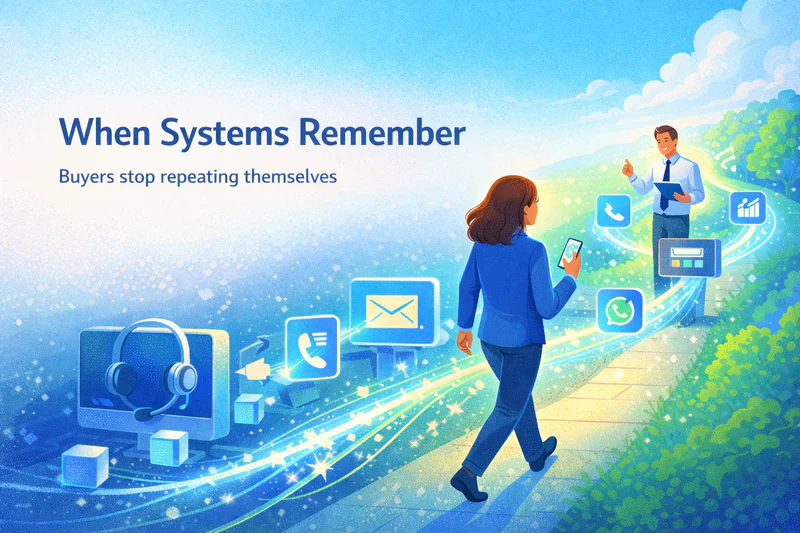
Your marketing stack has amnesia.
Think about it: a prospect downloads your whitepaper at midnight, asks your chatbot about pricing at lunch, then visits your competitors comparison page that evening. Three critical signals. Three different systems. Zero memory connecting them.
So when your HubSpot workflow fires the next morning with "Still considering our solution?" a message written as if yesterday never happened that prospect doesn't just ignore it. They draw a conclusion: This company doesn't actually know me.
Here's the uncomfortable truth: you've spent hundreds of thousands building HubSpot integrations that connect everything, yet your buyer's journey still feels like a game of telephone played across disconnected departments. The HubSpot Salesforce integration syncs data flawlessly. Your HubSpot API pulls reports on demand. Your workflows execute exactly as programmed.
But nobody's orchestrating the narrative. And that gap between what your systems know and what they remember is costing you 10-30% of your qualified pipeline every single year.
The Real Problem: Integration ≠ Orchestration
Here's what nobody tells you: the problem isn't connection it's orchestration!
Your HubSpot Salesforce integration syncs records beautifully. Your HubSpot API pulls data on command. But they're working independently, like musicians who've never rehearsed together.
A prospect fills out your form at 2 AM. Visits pricing twice the next morning. Abandons cart after a frustrating chat. By the time your HubSpot marketing automation triggers the "abandoned cart" email, they've signed with your competitor.
Traditional HubSpot integrations even sophisticated ones like HubSpot and Salesforce integration or HubSpot SFDC integration move data. What they don't move is context. They can't answer: "What did this person say yesterday on chat, how did they feel, and how does that change today's email?"
That gap costs real money.
Why Orchestration Beats Integration
A SaaS company we worked with had every HubSpot integration imaginable HubSpot NetSuite integration, rock-solid HubSpot workflow APIs, a RevOps team living inside HubSpot API documentation. Still bleeding revenue.
A lead would express urgent interest on chat ("I need this for 50 people by next week"), get routed to an SDR, but also auto-enrol in a generic SMB nurture. The prospect would see both, realize the company didn't know them, and disengage.
What was missing: orchestration that remembers.
Clicks and CRM fields don't tell you why a prospect buysnor ghosts. Chat rants carry urgency a pageview never shows. But HubSpot can't query "mildly frustrated" or "high intent but price-sensitive."
That's the difference. Integration connects tools. Orchestration connects your narrative every click, message, mood, and intent in one timeline that drives intelligent action.
What Breaks When You Don't Orchestrate
Most teams try building custom HubSpot APIs (ends with unmaintainable Zapier chains), adding more point solutions (19 integrations, exploding costs), or ripping everything out (rebuilds the same fragmentation with a different vendor).
You don't have a HubSpot problem you have an orchestration problem.
A Better Way: The Conversation Graph
What if you added a stateful orchestration layer on top of what you have?
Enter the Conversation Graph a living record of every interaction across web, email, WhatsApp, SMS, voice. Unlike your CRM, it records what was said, how it was felt, and what was decided.
A prospect downloads your whitepaper. Three days later, WhatsApp: "Interesting but expensive for our size." That evening, pricing page revisit.
Traditional HubSpot integration silos these. With a Conversation Graph, signals merge. The system knows why they hesitate and what comes next.
Instead of "Here's our pricing," it triggers: "Here's how three companies your size approached ROI plus a calculator."
That's orchestration that remembers.
How to Add an "Intelligent Layer" to Your HubSpot Stack
Here's what most teams get wrong: they think adding intelligence means replacing HubSpot. It doesn't.
The smart play is architectural layering let HubSpot do what it does best (structured CRM data, pipeline tracking, reporting) while an agentic layer handles what HubSpot was never built for: unstructured conversations, real-time sentiment, and autonomous action.
Think of it as a division of labor:
HubSpot remains your system of record. Contacts, deals, lifecycle stages, email opens, form submissions all the structured data your RevOps team needs stays exactly where it is. Your HubSpot marketing automation keeps running. Your HubSpot API integrations keep syncing.
The agentic layer becomes your system of action. Every WhatsApp thread, chat transcript, voice note, and support ticket gets captured, interpreted for intent and sentiment, then stored in a unified Conversation Graph that links back to the same customer records in HubSpot.
Here's the power: when a prospect fills out your form at 2 AM (logged in HubSpot), then messages your WhatsApp at noon saying "This looks expensive for our team size" (captured by the agentic layer), then revisits pricing that evening (tracked in HubSpot) the intelligent layer sees all three signals as one continuous narrative.
Instead of triggering your generic "still interested?" workflow, it can:
Suppress the irrelevant nurture email
Send a contextual WhatsApp response addressing their budget concern
Route them to an AE who specializes in mid-market deals
Update HubSpot automatically with the sentiment and next action
All without human intervention. All while respecting your existing HubSpot workflows and governance policies.
The key difference? Composable, not rigid. Traditional HubSpot workflow APIs force you to anticipate every scenario in advance if this, then that. An agentic layer is goal-driven: "Convert this lead to demo" becomes the objective, and the AI autonomously decides the path based on real-time signals, not pre-programmed branches.
This is what Zigment calls "opinion-agnostic" architecture. The agentic layer doesn't fight with your existing stack it respects the logic already embedded in HubSpot and works alongside it. You're not ripping out what works. You're completing what's missing.
Orchestrate, Don't Replace
You've invested in HubSpot, built workflows, integrated Salesforce. Don't throw it away.
Add orchestration turning fragmented integrations into one memory-driven journey where every touchpoint knows what came before and decides what happens next.
From clicks to conversations. From integration to orchestration. The future of HubSpot RevOps starts in three days.