
You've invested heavily in HubSpot. Months configuring workflows, perfecting hubspot email templates, running hubspot training sessions, wrestling with that hubspot email signature generator until every pixel aligned. Your martech stack? Chef's kiss.
Then reality hit.
Prospect submits a form at 11 PM. Your workflow politely emails them at 9 AM. Too late they've ghosted you. Another lead pings you via SMS, then email, then chatbot. Each channel greets them like a total stranger. Your sales team is practically mutinying because those "marketing qualified" leads? Not even close.
Here's the brutal truth: traditional hubspot marketing automation is a one-trick pony in a three-ring circus. Static rules. Single-channel thinking. Zero memory. Companies are haemorrhaging up to thirty percent of potential revenue because their automation can't remember yesterday's conversation, let alone orchestrate across channels.
That HubSpot investment you're so proud of? It's becoming an expensive email blaster.
Agentic AI Changes to Expect
The shift from rule-based automation to agentic AI isn't science fiction it's happening right now, and it's rewriting the playbook for hubspot email marketing and every other channel you operate.
Traditional automation says, "If form submitted, then send email sequence."
Agentic AI says, "This person has a goal, I have a goal, let's figure out the smartest next move together." The difference is profound.
Where your current hubspot email workflows follow predetermined paths regardless of context, agentic systems maintain persistent memory of every interaction.
They understand that the person who downloaded your whitepaper last Tuesday, asked a pricing question via chat on Thursday, and just opened your email on Saturday is the same person with evolving intent not three separate events in three disconnected databases.
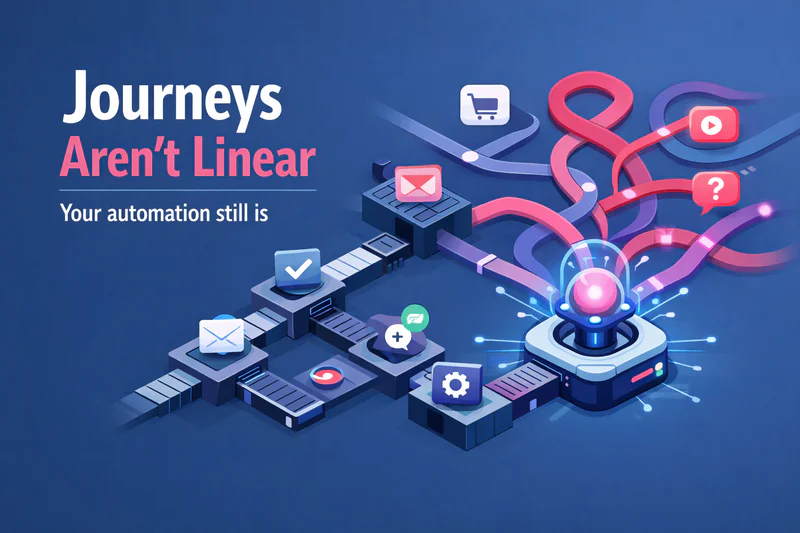
This matters because buyer journeys aren't linear anymore. Your prospects are omnichannel by default, and they expect you to be too.
When your automation can't connect the dots between that SMS conversation and the email they just received, you're not just creating friction you're actively destroying trust.
The revenue operations hubspot teams I talk to are seeing this play out in their dashboards every day. Lower conversion rates despite higher traffic. Longer sales cycles despite more touchpoints. It's not that hubspot training was inadequate or your team isn't executing it's that the underlying paradigm has shifted beneath your feet.
Capabilities to Invest in Now
What separates next-gen marketing automation from the hubspot email templates you're running today?
Three game-changing capabilities: memory, planning, and omnichannel orchestration.
Memory
It isn't about logging events it's about understanding journeys. Every hubspot email opened, every question asked, every objection raised gets woven into a living context graph.
When that prospect returns three weeks later? Your system doesn't start from scratch. It picks up the conversation mid-sentence, across any channel, like you never stopped talking.
Imagine never asking "How can I help you?" to someone you've already helped twice.
Planning
It is where the magic happens. Forget "if-then" rules. We're talking goal-driven intelligence. Your system knows it needs to book a demo with this enterprise prospect.
It remembers their industry pain points from last Tuesday's chat. So it dynamically chooses the next move maybe a personalized video, maybe a peer customer intro, maybe strategic silence while they digest.
The system isn't executing a script. It's thinking.
Omnichannel continuity
It is your unfair advantage. Picture this: prospect starts chatting on your website, continues via hubspot email, follows up through SMS, then switches to WhatsApp mid-flight to Singapore.
At every single touchpoint, context travels with them. Zero repeated questions. No "let me get someone who can help." Just one intelligent, unbroken conversation.
Here's the difference in action: instead of blast-sending that hubspot email signature-branded newsletter to 10,000 contacts every Tuesday at 10 AM, your system spots the twelve people actively researching right now, understands their specific challenges, and reaches out individually with laser-targeted insights at their moment of peak receptivity.
Response rates don't improve. They explode.
Add the Intelligent Layer Without Disruption
Wait are you saying we trash years of hubspot integrations, custom objects, and painstakingly built workflows?
Wait NO!!!!
Here's the beautiful part: you're not replacing HubSpot. You're giving it a brain upgrade.
Think of it like this: HubSpot is your incredibly reliable car great engine, smooth ride, gets you where you need to go. An intelligent orchestration layer is the AI copilot that reads traffic patterns, predicts shortcuts, and navigates in real time. The car doesn't change. The driving gets exponentially smarter.
Your hubspot crm integrations? Untouched.
Your data model? Intact.
Your team's hard-won hubspot marketing chops?
More valuable than ever.
What changes is who makes the decisions. Instead of rigid HubSpot workflows calling every shot, you introduce an agentic layer that reads your HubSpot data, thinks strategically about next best actions, and feeds intelligent instructions back. HubSpot handles execution and record-keeping. The intelligent layer handles orchestration and memory.
This pattern already works brilliantly with the best hubspot integrations for sales intelligence and analytics. All the benefits of hubspot—that rock-solid CRM, bulletproof delivery, enterprise-grade features—stay right where they are. You're just making them wildly smarter.
Start small, win big: Pick one high-value journey—demo requests, maybe—and layer in stateful orchestration. Watch conversion rates climb. Measure the lift. Show your CFO the numbers. Then expand to other use cases.
Low risk. High reward. Zero disruption.
Vendor Evaluation Checklist
When you're ready to add this intelligent layer, the vendor landscape can feel overwhelming. Here's what actually matters:
Persistent conversation memory: Can the system maintain context across weeks or months, not just within a single session?
Does it connect web behavior, email engagement, hubspot sms integrations, and every other channel into one coherent timeline?
Goal-driven planning: Does it merely react to triggers, or can it actively reason about how to move prospects toward outcomes?
Can it adjust tactics based on what's working for similar profiles?
True omnichannel reach: Are we talking just email and web chat, or does it genuinely span SMS, WhatsApp, in-app, and any channel your buyers actually use?
Enterprise governance: Can you set guardrails? Review AI decisions before they execute? Maintain brand voice and compliance standards?
Human-in-the-loop capabilities aren't optional they're essential.
HubSpot-native integration: Does it treat HubSpot as a first-class citizen, or is this a generic platform with a half-baked connector? You want bidirectional sync, custom object support, and deep workflow integration.
This is where solutions like Zigment come into play!
Zigment adds a stateful, agentic layer directly on top of your HubSpot instance persistent memory via a Conversation Graph, goal-driven planning with Next Best Action intelligence, and genuine omnichannel continuity across web, app, email, SMS, and WhatsApp.
The result? Higher qualified-lead rates, more booked demos, faster first response times, and materially better retention all while your team maintains full governance and human oversight.
The agentic AI era isn't coming it's here.
Your HubSpot investment doesn't have to be a casualty. With the right architectural thinking and the right augmentation layer, it becomes more valuable than ever.
The question isn't whether to evolve, but how quickly you can move before your competitors figure this out first.