
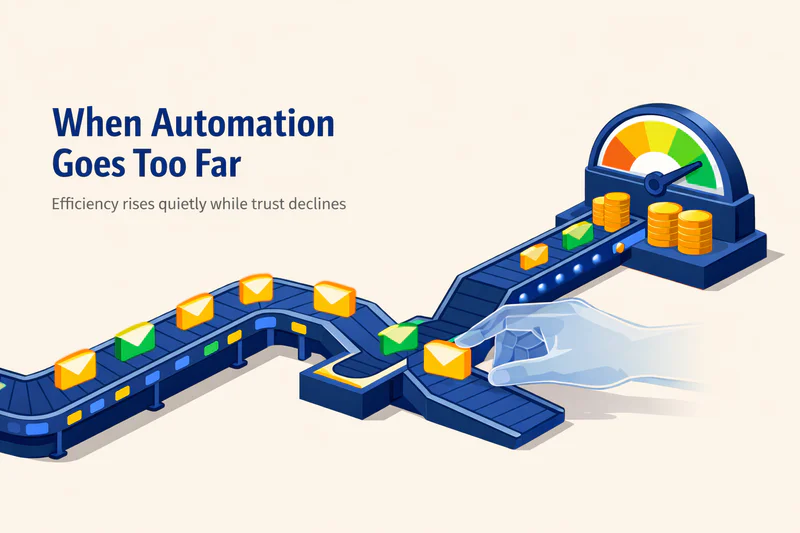
A study found that companies that aggressively automate customer interactions often see cost savings rise, while customer satisfaction quietly drops. That gap is where revenue slips.
The Human-in-the-Loop Paradox lives in that tension. We automate to move faster. We automate to scale. We automate to reduce cost. And yet, the very systems designed to increase efficiency can weaken trust, stall deals, and flatten relationships when they remove the human touch too early.
If you lead revenue, sales ops, or AI initiatives, this decision matters more than ever. Automation can accelerate pipeline velocity. It can also silently erode close rates. The difference comes down to knowing when to let systems run and when to step in.
In this article, we’ll break down:
Where automation should dominate
When escalation becomes critical
How to design clear guardrails using AI governance
Practical sales automation best practices that protect conversion
Because the goal isn’t more automation. The goal is better outcomes.
What Is the Human-in-the-Loop Paradox?
The Human-in-the-Loop Paradox describes a recurring mistake: the more confident we become in automation, the more tempted we are to remove human oversight entirely, even when judgment still matters.
On paper, automation wins:
Faster response times
Lower operational cost
Consistent messaging
24/7 engagement
But revenue systems aren’t spreadsheets. They’re conversations. And conversations carry nuance.
A pricing objection.
A hesitant tone.
A subtle shift in urgency.
These signals don’t always fit neatly into predefined workflows.
Without structured human checkpoints, automated systems can:
Misinterpret buyer intent
Escalate frustration instead of resolving it
Miss upsell or cross-sell moments
Delay intervention until churn is inevitable
This is where AI governance enters the picture. Governance frameworks define boundaries, what the system handles, what it flags, and what must be reviewed by a human. When those boundaries are unclear, automation expands by default.
And that’s when performance starts to dip.
Why Over-Automation Breaks Revenue Systems
Over-automation often begins with good intentions. We want faster speed-to-lead. We want fewer manual tasks. We want cleaner data.
But here’s what we’ve seen happen:
1. Complex Deals Get Flattened
High-value B2B deals involve multiple stakeholders, shifting budgets, and internal politics. Automated responses can handle FAQs. They cannot navigate competing priorities across five decision-makers.
2. Objections Go Unresolved
A scripted response to a pricing concern feels efficient. A thoughtful conversation that reframes ROI closes deals.
There’s a difference.
3. Silent Churn Accelerates
When engagement becomes robotic, buyers disengage quietly. Response times may look strong in dashboards, but depth of conversation declines.
Strong sales automation best practices focus on reducing friction, not removing human persuasion.
Efficiency is valuable. Relationship equity is priceless.
Where Automation Actually Wins (And Should)
Automation is incredibly powerful when deployed intentionally. The key is alignment with risk and complexity.
Here’s where it excels:
High-Volume, Low-Risk Interactions
Initial lead qualification
Meeting scheduling
FAQ responses
Basic onboarding steps
Speed-to-Lead Optimization
Immediate outreach increases response probability. Automated qualification ensures no inbound request waits in a queue.
Data Capture and Consistency
Systems record every interaction. Humans forget details. Automation doesn’t.
When designed well, automation strengthens the human touch by clearing space. Your top reps spend time persuading instead of scheduling. They focus on strategy instead of repetitive tasks.
That’s intelligent orchestration.
When to Escalate: Signals That Demand the Human Touch
Escalation should never feel accidental. It should be engineered.
We recommend defining clear triggers such as:
Revenue-Based Triggers
Deal value exceeds a defined threshold
Contract customization requested
Behavioral Signals
Repeated pricing objections
Sudden drop in engagement
Sentiment analysis detecting frustration
Complexity Indicators
Multiple stakeholders join the thread
Compliance or regulatory questions arise
Timeline compression or urgency shifts
The human touch matters most when stakes rise. Escalation is not an admission of system failure. It is strategic deployment of expertise.
Clear escalation rules are foundational to AI governance. Every automated workflow should include a visible exit ramp.
Designing the Decision Layer: Solving the Human-in-the-Loop Paradox
The solution isn’t choosing between humans and automation. It’s designing a decision layer that routes intelligently between them.
Here’s a practical framework:
Step 1: Define Risk
Financial exposure
Brand reputation
Regulatory implications
Step 2: Define Complexity
Number of decision-makers
Customization required
Emotional intensity
Step 3: Set Escalation Triggers
Revenue thresholds
Sentiment shifts
Intent signals (pricing, negotiation, contract terms)

This layered approach ensures automation handles what it should and humans step in precisely when value creation peaks.
Strong sales automation best practices build workflows with escalation embedded from day one. Governance ensures accountability. Leadership ensures discipline.
AI Governance: The Guardrails That Protect Growth
Without AI governance, automation expands unchecked.
Governance frameworks should include:
Clear ownership of automated workflows
Logged escalation events
Performance audits across conversion stages
Bias monitoring and compliance checks
When oversight is structured, teams gain confidence in automation. Leaders see measurable performance improvements instead of vague optimism.
Human oversight reduces financial risk. It protects long-term trust. It ensures automation remains aligned with strategy.
Revenue Impact: Orchestration Creates Advantage
Companies that master orchestration see compounding benefits:
Faster qualification cycles
Higher close rates
Improved retention
More accurate forecasting
Automation drives speed. Humans drive persuasion.
When both operate within clear boundaries, systems become more predictable. Revenue becomes more durable. Teams operate with confidence instead of guesswork.
The competitive edge lies in precision, knowing exactly when to step in.
Action Plan: Apply This in Your Sales Process
If you want to operationalize the Human-in-the-Loop Paradox, start here:
Map Your Customer Journey
Identify every automated touchpoint.Tag Each Stage by Risk Level
Low, Medium, High.Define Escalation Triggers
Revenue, sentiment, complexity.Embed Human Checkpoints
Strategic intervention moments.Review Performance Monthly
Compare automated-only vs escalated deals.
Small refinements create outsized gains.
Final Takeaway: Automation Should Scale Trust
The Human-in-the-Loop Paradox isn’t a technology problem. It’s a design decision.
Automation should scale responsiveness and free up cognitive bandwidth. It should create space for deeper conversations, not replace them. When escalation is intentional and governance is clear, systems become smarter over time.
This is exactly where platforms like Zigment fit in.
Zigment is built around orchestration, not blind automation. It helps revenue teams:
Automate high-volume qualification and follow-ups
Detect behavioral and intent signals in real time
Trigger intelligent escalations to sales reps
Maintain governance visibility across the funnel
Instead of choosing between AI and the human touch, Zigment connects the two. Automation handles speed. Reps handle strategy. Leadership retains oversight.
That’s how you resolve the Human-in-the-Loop Paradox in practice by building systems that know when to move fast and when to bring in expertise.
Know when to automate.
Know when to escalate.
And design your revenue engine to do both deliberately.