
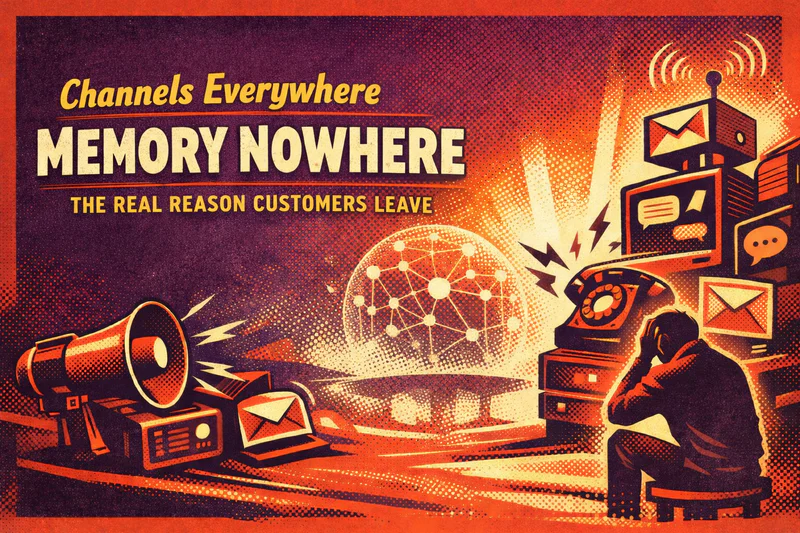
Here's a frustrating truth: 67% of customers have abandoned a purchase because they had to re-explain their issue to multiple support agents.
Two-thirds of your potential revenue is walking out the door not because your product failed, but because your system
That's the continuity gap. And it's costing you more than you think.
A true omnichannel experience isns forgot who they were talking to.'t just about being present on every channel it's about creating a conversation that remembers. When a customer emails you on Monday, chats on Tuesday, and calls on Wednesday, they shouldn't feel like they're starting from scratch each time.
Let's fix that gap together.
The Core of Omnichannel Experience: Memory Across Every Touchpoint
Most companies confuse presence with intelligence. They're everywhere Instagram, email, SMS, WhatsApp, phone support yet somehow, their brand has amnesia.
1. Megaphone Chaos vs. Real-Time Context
Let me paint you two scenarios.
Scenario A: The Megaphone Approach
Maria gets an email about yoga classes at your fitness centre. She clicks through and asks about beginner schedules via chat. The bot has no clue she came from the email.
Two hours later, she gets an SMS promoting the exact same yoga offer she already inquired about. When she calls to book, the agent asks her to spell her name and explain what she's interested in from scratch.
Maria feels invisible. Frustrated. Like just another number in your database.
Scenario B: Real-Time Conversational Context
Maria opens the email. The system notes her click.
When she starts chatting, the AI already knows: "Hi Maria! I see you're interested in our beginner yoga sessions. We have three spots left for the 7 AM Monday/Wednesday class you were viewing.
Want me to hold one for you?"
Same customer. Different universe.
The difference?
Real-time conversational context that bridges every touchpoint. When your systems extract intent and sentiment in the moment and carry it forward, customers stop feeling like strangers in their own journey.
What True Seamlessness Requires
A seamless omnichannel experience means:
Chat history automatically informs SMS replies – No starting over when switching channels
Email clicks trigger contextual WhatsApp nudges – The system remembers what caught their attention
Phone agents see complete interaction timelines – Before they even say hello
Every channel accesses the same memory bank – Preferences, pain points, and progress are universal
This isn't technology showing off. It's customers feeling seen.
Wondering if your current stack can deliver this kind of continuity? Let's map what a truly unified journey looks like.
Omni Experience vs. Illusion: 5 Signs You're Faking It
You might think you're delivering an omni experience, but you're actually running multichannel theater. Here's how to tell the difference.
The Omnichannel Authenticity Checklist
Sign #1: Your Channels Don't Recognize Each Other
Test this right now: Start a chat conversation, then send an email about the same issue. Does the email responder know about your chat? If not, you're faking it.
Real omnichannel means every channel pulls from the same customer context. Period.
Sign #2: No Cross-Channel Identity Resolution
Can your system connect the anonymous website visitor, the email subscriber, the phone caller, and the social media DM sender into ONE unified profile?
If you're managing separate databases for each channel, you don't have omnichannel. You have organized chaos.
Sign #3: Zero Fatigue Management
Here's the brutal test: Can a customer receive an email, SMS, push notification, and WhatsApp message about the same promotion within an hour?
If yes, congratulations you've built an omnichannel spam machine. True omnichannel marketing solutions include frequency and fatigue management that caps total message volume across ALL channels, not just within them.
Sign #4: Manual Channel Orchestration
Do your marketers have to manually coordinate "send email on Monday, SMS on Wednesday, call on Friday"? That's not orchestration. That's exhausting.
Real systems use behavioural triggers and AI decisioning to determine the optimal channel, timing, and message based on individual customer patterns automatically.
Sign #5: Sentiment Goes Unnoticed
When a customer shifts from interested to frustrated mid-conversation, does your system notice? Does it adjust its approach, escalate to human support, or modify messaging tone?
If sentiment changes don't trigger adaptive responses, you're broadcasting at customers, not conversing with them.
End-to-End Customer Experience: Closing the Continuity Gap
An end to end customer experience isn't just about closing deals. It's about maintaining context from the first anonymous visit through years of renewals, upsells, and support interactions.
Where Continuity Typically Breaks Down
Identity Loss
Customer ID from marketing automation doesn't match CRM record doesn't match support ticket system. Result? Three different "versions" of the same customer, and nobody realizes they're all talking to the same person.
Context Decay
Systems capture data but don't surface it when needed. The information exists somewhere in your tech stack, but the frontline employee can't access it in real-time during the critical moment of interaction.
Temporal Gaps
Batch processing means yesterday's conversation doesn't inform today's interaction. By the time data syncs overnight, the moment has passed and the customer has moved on or moved to a competitor.
Tired of patchwork integrations that promise unity but deliver silos? Let's get specific about what separates winners from losers.
5. Multi Channel vs Omnichannel: The Definitive Breakdown
Revenue Operations leaders constantly ask me: "What's the real difference between multi channel vs omnichannel?"
Let me settle this once and for all.
The Brain vs. The Megaphone: An Analogy
Multichannel is having connected tools but disconnected brains.
You've integrated your email platform with your CRM, your chat system with your helpdesk, your SMS gateway with your marketing automation. Data flows between systems. Great!
But here's the problem: each system makes decisions independently. Your email platform decides to send a nurture sequence. Simultaneously, your chat system decides to trigger a promotion. Your SMS gateway decides it's time for a review request. Nobody's coordinating. Nobody's thinking holistically about the customer experience.
Omnichannel is having a centralized intelligence layer a single brain that sees everything, remembers everything, and orchestrates everything.
This is what platforms like Zigment's Conversation Graph deliver. Every interaction feeds the graph. Every decision considers the full context. Every action is coordinated across the entire customer experience.
The result? Experiences that feel effortless to the customer because they're intelligently coordinated behind the scenes.
Measuring True Omnichannel Success: The Metrics That Matter
Open rates don't matter. Chat session counts don't matter. Even conversion rates in isolation don't tell the full story.
True omnichannel experience success requires measuring continuity and harmony, not just channel performance.
Four Critical Metrics
Continuity Score What percentage of cross-channel interactions maintain context without customers repeating themselves?
Formula: (Seamless transitions ÷ Total channel switches) × 100
When customers move from chat to email to phone, how many "starting over" moments do they face? This score reveals what dashboards hide.
Measure:
Message overlap (same promo across channels within 24 hours)
Contradictory messaging (conflicting offers/info)
Timing conflicts (email during active chat)
Revenue Per Conversation Stop measuring revenue per channel. Measure revenue per unified conversation thread.
Track complete journeys WhatsApp inquiry → email nurture → phone close. Strong omnichannel drives measurably higher revenue per conversation than fragmented approaches.
Customer Effort Score Across Touchpoints After any interaction: "How easy was it to get your issue resolved?"
Track across channels and at channel switches. The gap between best and worst scores shows exactly where continuity breaks and loyalty dies.
Real Results: Transformation Through Continuity
A mid-sized BFSI company deployed Zigment's Conversation Graph for loan applications.
Before: Anonymous website visits → generic emails → customers re-explaining on calls → disconnected SMS reminders.
After: Website behavior shaped emails → email responses timed SMS → phone agents saw full journey → follow-ups referenced every touchpoint.
Impact: Higher application completion, reduced handling time, improved satisfaction scores, lower cost per loan.
That's transformation from eliminating the continuity gap.
Your Next Move: From Fragmentation to Flow
The gap between multichannel chaos and omnichannel success? Memory that drives action.
Does your brand remember your customers who they are, what they need, where they stopped and act on it in real-time?
If customers are repeating themselves across channels, you're bleeding trust and revenue daily.
The fix exists now: unified data platforms, intelligent orchestration, and agentic AI like Zigment's Conversation Graph turn omnichannel from buzzword to competitive edge.
Your customers don't want omnipresence. They want recognition. Conversations that remember. Experiences that flow. Brands that understand.
Your customers aren't asking for much just that you remember the conversation you started.