
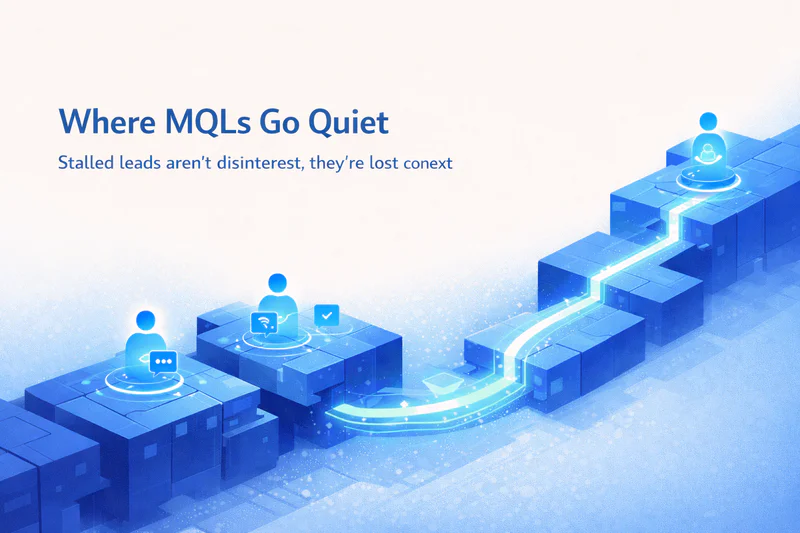
You know that sinking feeling when you open HubSpot and see 247 MQLs just sitting there?
They filled out forms. Got enrolled in nurture sequences. Clicked emails. Then silence. SDRs called. You tweaked workflows HubSpot, adjusted subject lines, A/B tested. Nothing.
The brutal math: if 30% of MQLs stall between "interested" and "ready to talk," and your average deal is $50K, you're watching seven figures evaporate quarterly. Not because your product isn't good your tech stack forgot the conversation.
Welcome to the stuck MQL problem. It's an orchestration failure.
Where HubSpot Workflows Break Down
HubSpot workflows excel at linear sequences: form submitted → send email → wait three days → follow up. But modern B2B journeys aren't linear.
A prospect researches Monday, asks a question via Instagram Tuesday, ignores your email Wednesday, then pings WhatsApp Thursday about implementation timelines. Each touchpoint lives in a different system. Each conversation resets context. Your five-touch nurture fires whether or not the lead just told your chatbot "not interested."
Static CRM fields miss nuanced signals like frustration, urgency, or evolving intent that live in conversations. When a lead says "this looks expensive" in chat, that sentiment never reaches HubSpot's lead score.
When they ask about integrations on three channels, nobody connects those dots into "high technical interest, needs documentation." Result? Outbound sequences spam disqualified leads, sales wastes time on contacts gone cold, and real opportunities slip through unnoticed.
The revenue impact is measurable. When response time exceeds ten minutes, conversion drops 80 percent. When leads repeat context across channels, engagement falls by half.
For a mid-market SaaS company with $10M ARR and 500 monthly MQLs, these delays cost $1.2M in lost pipeline annually qualified buyers who drifted away because follow-up felt generic and slow.
From Rules to Decisions, From One Channel to Every Channel
The fix isn't more workflow branches or another point solution it's a fundamental shift from rule-based automation reacting to single events, to stateful orchestration making decisions based on continuous, cross-channel context.
Stateful orchestration means your system remembers. When a prospect moves from email to WhatsApp to web chat, the conversation doesn't reset. When they express frustration in one channel and interest in another, both signals inform the next action. When they go silent for two weeks then return with a technical question, your system knows they're an MQL who showed SQL-level intent last month.
This requires three pieces HubSpot can't provide alone: persistent conversational memory capturing actual words, sentiment, and intent across channels; goal-driven planning that asks "what's the most helpful action right now?" instead of following pre-written sequences; and omnichannel continuity so leads experience one coherent conversation regardless of channel.
The Zigment Approach: Agentic Intelligence on HubSpot
Zigment doesn't replace HubSpot it adds a stateful, agentic layer extending what HubSpot does well with what it can't: cross-channel conversational memory, intent-based decisioning, and autonomous orchestration.
At the core is Zigment's Conversation Graph, a marketing memory bank for your entire customer journey. Every interaction across web, email, SMS, WhatsApp, Instagram, and voice logs into one queryable timeline, capturing not just what happened but what was said, how it felt, and what changed. When a lead expresses urgency in chat, that signal becomes structured, searchable data.
When they ask the same question on two channels, the Graph connects those threads. Sales sees the full narrative objections, content consumed, sentiment trajectory not just "Lead Status: MQL."
Goal-driven agentic AI plans actions instead of following workflows. If a lead goes cold after three emails but showed high pricing-page engagement, the system suppresses generic outreach and triggers a personalized message offering a tailored ROI model.
If a lead responds on WhatsApp but ignores email, all follow-up shifts to WhatsApp. The agent reasons across your stack, decides in real time, takes autonomous action while keeping humans in the loop for approvals and edge cases.
Omnichannel continuity means no conversation resets. When customers switch from Instagram to email to WhatsApp, Zigment maintains one thread. Your rep seeing a WhatsApp message knows exactly what was discussed in web chat. Your support team answering email knows the lead expressed pricing concerns two days ago. Everything flows back into HubSpot for reporting and visibility.
Enterprise governance is built in: SOC 2 Type II, ISO 27001, HIPAA, GDPR compliant, with policy guardrails ensuring autonomous actions stay within brand and legal boundaries. You define what AI can do send follow-up email yes, offer $5,000+ discount needs approval. Full traceability with audit logs shows why each action was taken. Human override available at every step.
Fallback & Escalation: When AI Needs Humans
Stateful orchestration isn't replacing your HubSpot revenue operations team it's giving them superpowers.
Your agentic layer handles 80%: auto-respond to WhatsApp questions within seconds, suppress irrelevant nurture when someone's talking to sales, escalate high-intent signals immediately, track everything in HubSpot.
For the 20% enterprise deals needing custom pricing, nuanced security questions, heated renewals you need human-in-the-loop.
Enterprise governance essentials your HubSpot RevOps leader needs:
Clear escalation rules: "If deal >$100K, route to senior AE within 30 minutes"
Audit trails: Every AI decision logged, every override documented
Contact policies: "Max two messages per week across all channels"
The orchestration layer enforces these while HubSpot marketing automation handles structured workflows, emails, and reporting. They work together.
The Path Forward
HubSpot remains powerful for contact management, campaigns, and reporting. But when B2B buyers message on Instagram, ask questions on WhatsApp, and expect instant personalized responses 24/7, workflows can't keep up.
The gap between what HubSpot tracks and what drives buying decisions intent, sentiment, cross-channel continuity is where qualified leads fall through.
Stateful orchestration bridges that gap. By layering persistent memory, goal-driven decisioning, and omnichannel engagement on HubSpot, teams get stability plus intelligence. Stuck MQLs become active pipeline. Cold leads resurface with high intent. RevOps leaders finally answer what happened to those 488 leads because now they're being systematically, intelligently re-engaged.
The future isn't replacing your CRM. It's making it smarter, more contextual, genuinely conversational. For teams ready to stop losing qualified buyers to broken handoffs and generic automation, that future is here.