
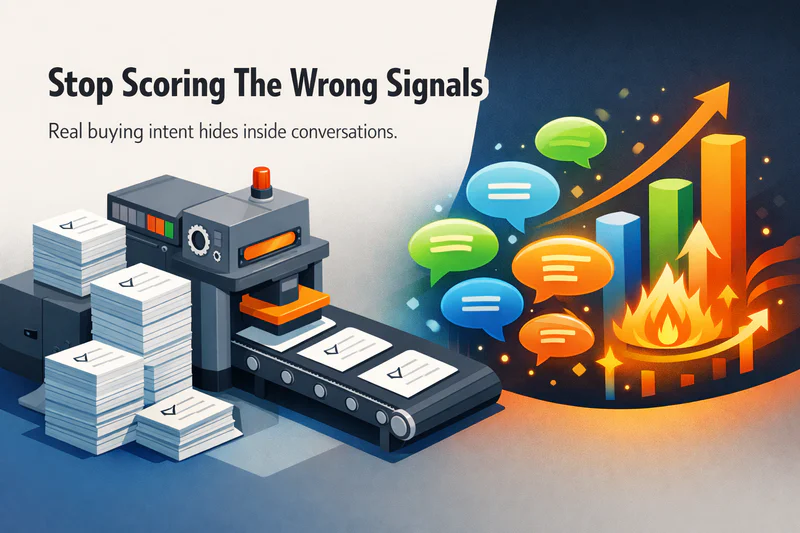
“Your hottest lead probably didn’t raise their hand on a form.”
They said it in a sales call.
They hinted at it in live chat.
They revealed it in a support ticket.
Yet most lead scoring systems still reward form fills, page visits, and email clicks as if those signals tell the whole story. They don’t. The real intent, the urgency, the budget clarity, the internal pressure, lives inside conversations. That’s why this is quickly becoming a revenue priority for modern B2B teams.
If you’re responsible for pipeline, this matters. Because when two leads submit the same demo request, but only one says, “We need this live before Q2,” your scoring model should treat them differently. In this article, we’ll break down exactly how to capture those hidden signals and turn everyday conversations into measurable revenue intelligence.
Why Traditional Lead Scoring Models Fall Short
Traditional lead scoring was built for a different era. An era when:
A whitepaper download meant strong interest
A pricing page visit signaled buying intent
A job title told you purchasing power
Those signals still matter. But they lack depth.
Here’s where conventional models struggle:
Static firmographic data – Company size doesn’t reveal urgency.
Surface-level behavioral tracking – Page visits show curiosity, not commitment.
Equal weighting of form fills – A casual inquiry scores the same as a time-sensitive buyer.
No context around pain or timeline – You can’t “click” urgency.
The result? Sales teams chase Marketing Qualified Leads that aren’t actually ready. Reps waste time. Speed-to-lead suffers. Conversion rates flatten.
Structured data tells you who they are.
Conversations tell you how ready they are.
Scoring Leads Based on Unstructured Conversation Data
Unstructured conversation data includes the words your prospects and customers actually use. It lives in:
Email threads
Live chat transcripts
Sales call recordings
CRM notes
Support tickets
Messaging platforms like WhatsApp or Slack
This data doesn’t arrive neatly labeled. It’s messy. Contextual. Emotional. And incredibly valuable.
Inside those exchanges, buyers reveal:
Budget confirmation
Decision-making hierarchy
Contract timelines
Competitive comparisons
Operational urgency
Expansion opportunities
Imagine this scenario:
Two prospects fill out a demo form.
Both receive identical traditional scores.
But during qualification:
Prospect A says: “We’re evaluating vendors for next quarter.”
Prospect B says: “Our current contract expires in 30 days.”
Those statements carry dramatically different revenue implications. Conversation-based scoring captures that difference immediately.
When we move beyond form fills, we shift from activity scoring to intent scoring. That’s where prioritization becomes sharper and pipeline becomes healthier.
Implementation Framework: Moving Beyond Form Fills
Adopting this model doesn’t require rebuilding your tech stack. It requires discipline and structure.
Here’s a practical framework:
Step 1: Centralize Conversation Data
Aggregate email, chat, call transcripts, and support tickets into a single analysis layer.
Step 2: Tag Historical Outcomes
Label conversations from closed-won and closed-lost deals.
Step 3: Identify High-Intent Language
Extract patterns tied to urgency, budget, and authority.
Step 4: Assign Weighted Scores
Not all signals carry equal value. Urgency tied to a timeline should score higher than general curiosity.
Step 5: Integrate With CRM
Surface dynamic scores directly in sales workflows.
Step 6: Continuously Refine
Review model performance quarterly. Adjust weightings based on revenue outcomes.
Governance matters here. Ensure compliance with privacy standards and maintain transparency with customers about data usage.
Common Mistakes to Avoid
Even strong teams can misstep. Watch for these pitfalls:
Over-relying on keyword detection without contextual analysis
Ignoring sentiment and tone
Automating scoring without human oversight
Failing to align scoring signals with actual revenue results
Treating implementation as a one-time setup
Conversation intelligence improves over time. It requires iteration.
The Future of Lead Scoring: Intent-First Revenue Teams
The next evolution of revenue operations is intent-first.
We’re already seeing shifts toward:
Real-time deal acceleration alerts
Conversation-driven churn prediction
Expansion forecasting based on support interactions
Predictive revenue intelligence models
The competitive edge won’t come from collecting more data. It will come from interpreting richer data.
Teams that master conversational intent will respond faster, prioritize smarter, and close with greater confidence.
Where This Shift Leads And How Zigment Powers It
When you begin weighting urgency, authority, budget clarity, and pain intensity directly from real exchanges, your forecasting improves. Speed-to-lead tightens. Sales energy goes exactly where buying momentum is strongest.
That’s where Zigment fits naturally into this evolution.
Zigment brings together conversations across sales, support, chat, and messaging channels into a unified intelligence layer. Its AI analyzes those interactions in real time, identifying:
High-urgency language
Buying committee signals
Budget confirmation
Expansion intent
Churn risk indicators
Instead of asking reps to manually interpret scattered transcripts, Zigment surfaces prioritized insights directly inside existing workflows. Your CRM reflects live intent, not static form data. Your team knows which accounts are heating up. And leadership gains visibility into revenue signals that used to stay buried in inboxes.
The result is simple but powerful:
Better prioritization
Faster response times
Higher conversion efficiency
Stronger expansion visibility
If you’re evaluating your current lead scoring model, ask yourself:
Are we scoring activity?
Or are we scoring intent?
Because the teams that move beyond form fills don’t just generate pipeline. They understand it. And with the right conversational intelligence layer in place, that understanding turns into measurable growth.