
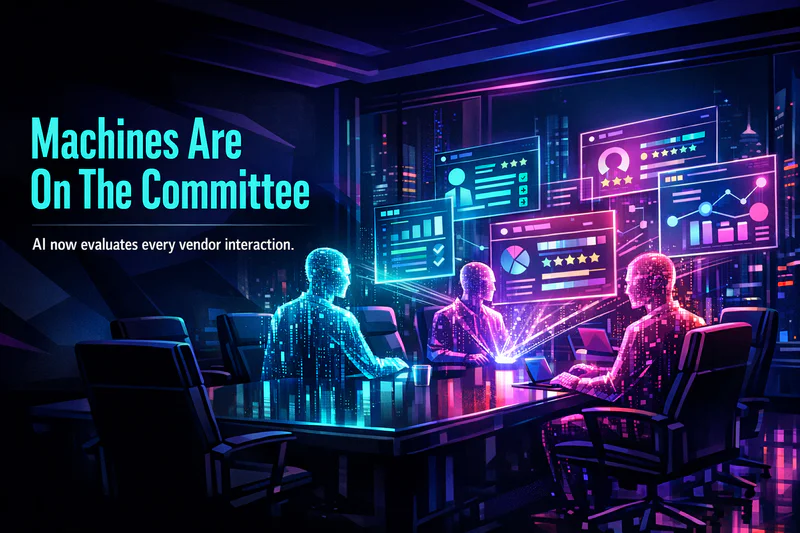
A procurement AI scans your website at 2:13 AM.
It extracts your value proposition.
Compares your claims.
Ranks you against three competitors.
By morning, you’re either shortlisted or invisible.
Selling to Machines: How to Optimize Your Outreach for Buyer-Side AI Agents isn’t a thought experiment. It’s the structural shift shaping the future of B2B sales. Buyer-side AI is now embedded inside research workflows, procurement tools, and even internal buying committees. Before a human books a demo, an algorithm has already formed an opinion.
Here’s the real question:
Is your company structured for machine evaluation or still optimized only for human persuasion?
Let’s break this down.
Selling to Machines: How to Optimize Your Outreach for Buyer-Side AI Agents in the Future of B2B Sales
Most teams think AI is helping sellers.
That’s yesterday’s story.
The real transformation is happening on the buyer side. AI agents now:
Summarize vendor websites
Compare pricing models
Extract ROI metrics
Score vendor fit
Flag compliance risks
Generate shortlists for buying committees
Machines are no longer tools. They are participants.
Inside modern buying committees, AI acts as a silent analyst. It reviews every vendor interaction before humans debate internally. And because machines operate on structured signals, fragmented messaging becomes a liability.
This is where most B2B companies struggle.
Their website says one thing.
Their sales deck says another.
Their chatbot collects data that never connects to CRM.
From a machine’s perspective, that’s chaos.
And chaos lowers confidence.
The Real Problem: Fragmented Signals Kill Machine Trust
Buyer-side AI does not interpret brand tone. It processes structured signals.
When your data lives in silos, three things happen:
Claims are inconsistent across channels
Intent signals aren’t connected to identity
Context gets lost between touchpoints
Imagine a prospect:
Visits your pricing page
Downloads a fintech case study
Asks a chatbot about compliance
Returns two days later via LinkedIn
If those signals aren’t unified, neither a human nor a machine sees the full story.
In the future of B2B sales, fragmented data means reduced visibility inside AI-driven evaluation workflows.
Clarity wins. Structure wins. Memory wins.
Buyer-Side AI Needs Structured Conversations, Not Static Content
Most companies optimize for content.
Very few optimize for conversation intelligence.
Buyer-side AI evaluates:
Repeated problem-solution framing
Consistent ICP definitions
Verifiable outcomes
Channel-wide signal coherence
It does not reward clever copy.
It rewards structural clarity.
This is why the rise of AI sales leads is fundamentally different from traditional inbound.
AI sales leads arrive shaped by algorithms. They are pre-filtered, pre-informed, and often pre-qualified by research assistants. By the time they engage, they expect relevance immediately.
If your system cannot understand their context in real time, you lose momentum.
What Optimizing for Buyer-Side AI Actually Requires
Let’s move from awareness to action.
1. Unify Identity Across Channels
You need a persistent memory layer that connects:
Website behavior
Chat conversations
CRM records
Email engagement
Ad interactions
Without identity continuity, AI cannot assess intent progression.
2. Structure Your Value Proposition Across Every Touchpoint
Machines compare signals across pages and interactions.
Ensure consistency in:
ICP definitions
Industry segmentation
Outcome metrics
Core differentiators
If your homepage says “enterprise platform” but your case studies highlight startups, machine confidence drops.
Alignment increases extractability.
3. Move from Static Content to Agentic Engagement
Buyer-side AI expects responsiveness.
Static landing pages are passive.
Agentic systems execute.
You need AI that:
Engages instantly
Qualifies contextually
Adapts based on conversation
Routes intelligently
Captures structured intent signals
This is orchestration, not automation.
Automation follows rules.
Orchestration understands journeys.
4. Turn Conversations Into Structured Data
Here’s where most companies fail.
They deploy chatbots.
They collect responses.
They store transcripts.
But transcripts are not structured intelligence.
If conversation signals are not mapped into:
Clear attributes
Intent categories
Buying stage indicators
Objection patterns
Then they are invisible to both sales teams and buyer-side AI systems evaluating vendor maturity.
In modern buying committees, sophistication signals matter. A company that demonstrates structured engagement appears operationally stronger.
Machines notice that.
The Shift from Marketing Funnels to Conversation Graphs
Traditional funnels assume linear movement.
Reality looks nothing like that.
Prospects zigzag:
Research anonymously
Revisit weeks later
Ask technical questions before pricing
Engage across multiple devices
The future of B2B sales demands a model that reflects this non-linearity.
This is where the concept of a Conversation Graph becomes critical.
Instead of isolated touchpoints, you create a structured map of:
Every interaction
Every intent signal
Every response
Every stage transition
Now, when buyer-side AI evaluates your organization, it doesn’t see fragmented noise.
It sees coherent, structured progression.
And that increases trust.
What Happens If You Don’t Adapt?
You may never know you lost.
AI-generated shortlists exclude you silently.
Competitors with clearer signal architecture rank higher.
AI sales leads engage but stall due to contextual gaps.
The loss isn’t loud.
It’s invisible.
Where Zigment Fits in the Age of Buyer-Side AI
Buyer-side AI is reshaping how vendors are evaluated.
Zigment prepares you for that reality.
It does three critical things:
Unifies fragmented signals into a structured Conversation Graph
Deploys agentic AI that executes across channels in real time
Transforms unstructured conversations into machine-readable intelligence
This means your value proposition isn’t scattered. It’s structured.
Your engagement isn’t reactive. It’s orchestrated.
Your data isn’t siloed. It’s interconnected.
So when buying committees rely on AI to evaluate vendors, your signals are coherent. Your positioning is extractable. Your differentiation survives screening.
Zigment doesn’t just help you sell faster.
It ensures your company is structurally visible in the future of B2B sales — where machines participate, evaluate, and influence outcomes before humans even speak.
Because in the age of AI-driven buying committees,
clarity is leverage.
And structure is strategy.