“Integration isn’t orchestration.”
Most revenue teams learn that the hard way.
Your HubSpot dashboard says the deal is warm. Zendesk shows an unresolved issue. WhatsApp holds the most honest buyer conversation and none of them are talking to each other. So the team reacts late. Or worse, reacts wrong.
This is where The Conductor’s Guide: Unifying HubSpot, Zendesk, and WhatsApp into One System begins. Not with another integration check
The Real Problem Isn’t Integration, It’s Fragmented Decision-Making
Most teams we talk to already have HubSpot, Zendesk, and WhatsApp “integrated.”
Data flows. Fields sync. Events fire.
And yet decisions are still broken.
Here’s why:
HubSpot decides based on form fills and lifecycle stages.
Zendesk decides based on tickets and SLAs.
WhatsApp decisions happen manually, in the moment, often outside any system.
Each tool optimizes for its own job. None of them understands the full customer state.
So when a buyer signals urgency on WhatsApp, HubSpot keeps sending nurture emails.
When support escalates an issue in Zendesk, sales keeps pushing for a demo. When intent shifts, automation doesn’t.
The issue is missing shared decision logic.
Integration moves information.
Orchestration aligns action.
That gap is where revenue leaks quietly, consistently, and at scale.
The Familiar Failure Pattern in Modern HubSpot Programs
If this feels uncomfortably familiar, that’s the point.
A prospect starts engaging seriously. Not on email, but on WhatsApp. Questions get specific. Timelines get mentioned. Real intent shows up.
Then the cracks appear.
HubSpot fires a generic nurture because a workflow doesn’t know about the WhatsApp thread.
Zendesk opens a support ticket, but sales never sees it.
A rep follows up two days later, unaware that momentum already cooled.
Nothing is “broken.”
Everything is just… unaware.
This is the default failure pattern of stateless systems:
Automations react to events, not context
Channels operate in parallel, not in coordination
Every team acts with partial truth
The buyer experiences it as noise.
Internally, it shows up as lost deals you can’t quite explain.
When leadership asks, “Why did we lose this?”
The answer is scattered across three tools and no one system can tell the story.
Quantifying the Revenue Impact of Disconnected Systems
Context loss doesn’t show up as a line item on your P\&L. But it hits revenue all the same.
We see it surface in predictable places:
Slower speed-to-lead, even with automation in place
Lower MQL-to-demo conversion, despite rising inbound volume
Pipeline slippage between stages that “should” convert
Buyer drop-off after moments of high intent
Here’s the uncomfortable truth.
A 10–15% delay in first meaningful response doesn’t just slow deals. It compounds across the funnel.
By the time RevOps reviews the quarter, the damage is already done.
And when the CXO asks, “Where did we lose momentum?” Dashboards show activity. Reports show effort.What they don’t show is the missed moment, the signal that mattered most, ignored because it lived in the wrong system.
Why the Current Approach Breaks at Scale
Most HubSpot programs don’t fail on day one.
They fail quietly right around the point where volume, channels, and teams increase.
Here’s where the model cracks:
Rules don’t age well
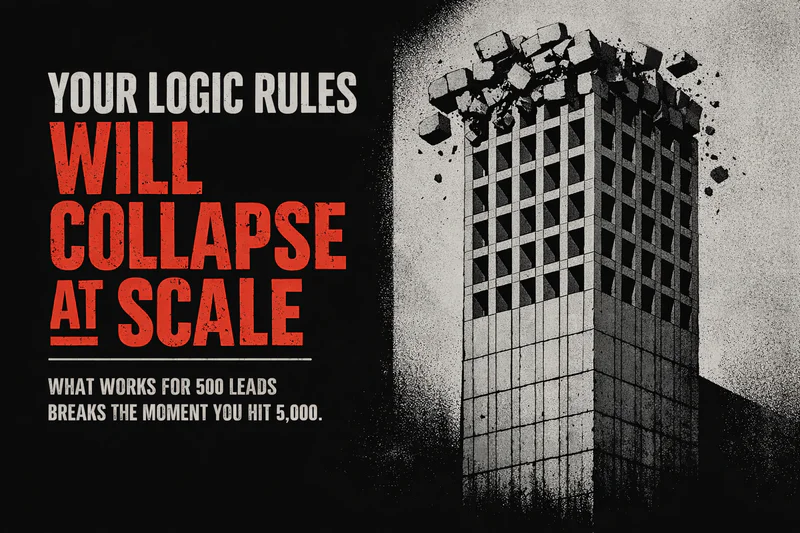
What worked at 500 leads collapses at 5,000.Workflows don’t remember
Every trigger acts as if it’s the first interaction.Channels don’t negotiate
Email, WhatsApp, chat, and support all act independently.
As complexity grows, teams respond by adding more logic.
More branches. More exceptions. More “if this, then that.”
The result isn’t control.
It’s fragility.
Automation becomes harder to trust. Reps override it. RevOps babysits it.
At scale, rules-based systems don’t just slow you down.
They actively work against coordinated, revenue-safe decisions.
Reframing the Solution, From Rules to Orchestration
Fixing this doesn’t mean adding more workflows. It means changing how decisions get made.
The shift looks like this:
From rules → to intent-aware decisions
From last event wins → to cumulative context matters
From one channel at a time → to every channel in sync
Think of your stack like an orchestra.
HubSpot is great at keeping time, stages, attribution, lifecycle.
Zendesk knows when something is wrong.
WhatsApp captures the real voice of the buyer.
What’s missing is a conductor.
Orchestration introduces a shared understanding of the customer’s current state, what they’re trying to do, what just happened, and what should happen next. One decision. Many systems. No contradictions.
And importantly, this doesn’t replace HubSpot.
It makes HubSpot smarter by giving it context it was never designed to hold on its own.
A Practical Playbook for Unifying HubSpot, Zendesk, and WhatsApp
This is where strategy turns into execution.
Unifying HubSpot, Zendesk, and WhatsApp doesn’t start with tools.
It starts with decisions.
Here’s a practical, RevOps-friendly playbook you can actually run:
1. Define a Shared Customer State
Agree on what “current state” means across teams. At minimum:
Lifecycle stage and pipeline context from HubSpot
Open issues, urgency, and sentiment from Zendesk
Intent signals and timing from WhatsApp conversations
This becomes the single source of truth for action, not just reporting.
2. Map Cross-Channel Decision Points
Identify moments where one channel should influence another:
High-intent WhatsApp message pauses email nurture
Critical support issue delays sales outreach
Pricing discussion triggers seller follow-up, not automation
3. Replace Rigid Workflows with Next Best Action
Instead of firing tasks blindly:
Decide what should happen next
Then execute it in the right system, on the right channel
Coordination beats complexity. Every time.
Implementation on Top of HubSpot (Without Breaking What Works)
This is the part most teams worry about. Fairly.
Orchestration sounds powerful but also risky. The good news? You don’t need to rebuild your stack to make it work.
A safer approach looks like this:
Keep HubSpot as the system of record
Pipelines, contacts, attribution, and reporting stay exactly where they are.Respect governance and ownership
Permissions, approvals, and audit trails still apply.Add human-in-the-loop controls
Sensitive actions pricing, escalation, deal risk require confirmation, not blind automation.

Nothing gets bypassed. Nothing gets duplicated.
Instead, orchestration sits on top of HubSpot, informing actions with context from Zendesk and WhatsApp before anything fires.
The result is trust.
From reps. From RevOps. From leadership.
And trust is what makes automation usable at scale.
Where Zigment Fits: The Conductor Layer on Top of HubSpot
This is exactly where Zigment comes in.
Zigment adds a stateful, agentic layer on top of HubSpot, without replacing it.
At the core is aConversation Graphthat maintains persistent memory across:
HubSpot interactions
Zendesk tickets
WhatsApp, SMS, email, web, and app conversations
On top of that memory, Zigment enables:
Goal-driven planning instead of rigid workflows
Next Best Action decisions informed by full context
Omnichannel continuity, so actions never contradict each other
Enterprise governance, with policy controls and human approval where needed
For mid-market and enterprise B2B teams running HubSpot, with multi-channel engagement and a RevOps leader accountable for pipeline speed, this changes outcomes fast.
Higher qualified-lead and demo-booked rates.
Faster, more relevant responses.
Better retention driven by shared context.
When every system knows the score, revenue finally sounds… intentional.