
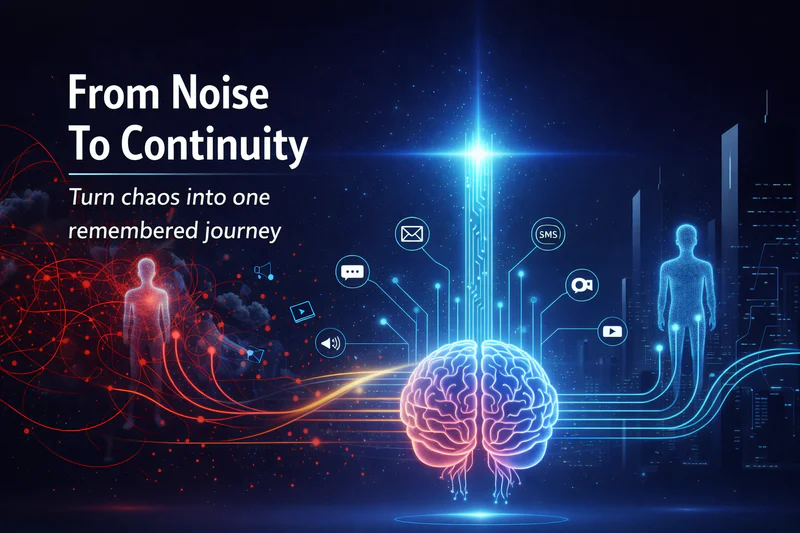
Your customer just told three different people the same story. First to your chatbot. Then to your email support team. Finally to someone on the phone—who asked them to start from the beginning.
They're not coming back.
This isn't a customer service problem. It's an amnesia problem. And according to Salesforce research, 76% of customers expect consistent interactions across departments, yet your systems treat every channel like it's meeting them for the first time.
The result? You're not building relationships. You're conducting a series of one-night stands.
Here's what nobody tells you: the companies winning at retention aren't the ones with the most channels. They're the ones whose channels actually talk to each other.
The Illusion of Being "Everywhere"
Being present on SMS, WhatsApp, email, and voice doesn't automatically equal omni channel customer engagement.
Let's be clear about something: you're not running an orchestra if every musician is playing a different song.
Most companies today are using what I call the "megaphone approach." They're loud, they're everywhere, but they're not listening. And more importantly, they're not remembering.
Here's what typically happens:
A customer asks about pricing on your website chat
Two days later, they get an email blast about a completely unrelated product
They call support with a question, and the agent has no idea about the chat conversation
They receive a WhatsApp message that contradicts what the email said
This isn't omnichannel engagement. This is chaos with good branding.
Why Multichannel Integration Isn't Enough?
Multichannel integration sounds impressive on paper. You've connected your tools! Your data flows between systems! You can technically reach customers anywhere!
But here's the problem: connection doesn't equal comprehension.
Think of it like a relay race where every runner forgets they're in a race. Sure, you've got talented athletes (your channels), and they're all technically on the same track (your platform). But if each runner drops the baton the context, the history, the understanding of where the customer actually is in their journey you're not finishing anything. You're just exhausting everyone involved.
The difference between multichannel and true omni channel engagement comes down to memory and intent. Does your platform remember that the person texting you right now is the same person who abandoned their cart yesterday? Does it know they're frustrated? Excited? Ready to buy but just need one question answered?
If the answer is no, you're running multiple monologues, not one conversation.
Your customers shouldn't have to be their own CRM. There's a better way to maintain context across every interaction.
The Continuity Gap: Where Revenue Goes to Die
Let me introduce you to the real villain in this story: the continuity gap.
This is what happens when customer context evaporates between touchpoints. The customer knows what they want. They've told you three times. But your systems don't talk to each other in a meaningful way, so they're stuck repeating themselves like they're caught in some corporate version of Groundhog Day.
Here's what closes that gap:
Cross-Channel Identity Resolution
You need to know that the email address, phone number, and chat session all belong to the same human. Not just technically linked in a database, but actively recognized in real-time as one continuous relationship. This is the foundation of effective omni channel customer engagement.
Frequency and Fatigue Management
Just because you can reach someone on five different channels doesn't mean you should. A proper omnichannel engagement platform knows when to pull back. It understands that three emails in one day about the same promotion isn't "thorough follow-up" it's harassment. Strategic frequency and fatigue management prevents member burnout and preserves trust.
Real-Time Conversational Context
Real-Time Conversational Context This is the secret sauce. Your platform should capture mood, intent, and urgency as they happen. Is this person browsing casually or urgently trying to solve a problem before a deadline? The next message you send should reflect that understanding.
Without these three elements, you're just guessing. And guessing costs money.
If you're tired of guessing what your customers actually need, it might be time to implement systems that actually know.
What an Omni Channel Customer Engagement Platform Actually Does
An omni channel customer engagement platform isn't just software that connects your channels. It's the brain that orchestrates them.
Here's what that looks like in practice:
Single Customer View (SCV)
Every interaction, preference, purchase, and complaint lives in one place. Not scattered across twelve different tools that kind of, sort of sync when they feel like it. A true omni channel customer engagement platform maintains this unified view automatically.
Individualized Experiences at Scale
Personalization isn't adding someone's first name to an email template. It's understanding that Customer A prefers detailed explanations over email, while Customer B wants quick answers via SMS, and Customer C will only engage through WhatsApp after 6 PM.
Next Best Action Intelligence
The platform doesn't just track what happened. It predicts what should happen next. Should you send a discount code? Wait another day? Switch to a different channel? Escalate to a human? The system knows.
This is how you move from broadcasting to conversing. From interrupting to assisting. This is how omni channel customer engagement actually delivers results.
How Zigment Makes Continuity Actually Happen Through Omni Channel Engagement
Most platforms promise omni channel engagement, but they're still playing catch-up with data that's already outdated. By the time your system processes what happened, your customer has already moved on probably to a competitor.catch-up with data
Zigment's approach is different. We built an Agentic AI layer that sits on top of your existing stack and actually coordinates it in real-time. Here's how:
The Conversation Graph
This isn't just another analytics dashboard. The Conversation Graph extracts qualitative signals from every interaction the tone, the hesitation, the urgency, the satisfaction level. It understands the emotional context, not just the transactional data. This powers truly intelligent omnichannel engagement.
Revenue-Focused Autonomous Actions
While traditional platforms wait for rules to trigger, Zigment proactively identifies opportunities through revenue-focused autonomous actions. A member at your gym hasn't shown up in two weeks?
The system doesn't just send a generic "we miss you" email. It analyzes their previous behavior, understands their goals, and crafts an intervention that actually resonates—maybe a personal training session offer, maybe a class recommendation, maybe just a genuine check-in.
Flexible, Template-Less Flows
Your customers don't follow templates, so why should your engagement? Zigment adapts in real-time through flexible template-less flows, creating individualized journeys that respond to actual behavior rather than forcing everyone through the same predetermined funnel. This is agentic AI journey orchestration in action.
This is what true omni channel customer engagement looks like: not louder, not everywhere, but smarter and more genuinely helpful.
The Bottom Line
You can keep adding channels. You can keep integrating tools. You can keep sending more messages.
Or you can actually maintain continuity through genuine omni channel customer engagement.
The companies winning at customer engagement right now aren't the ones shouting the loudest across the most platforms. They're the ones who remember every conversation, understand every context, and act like they actually know who they're talking to.
Because your customers aren't asking for more touchpoints. They're asking for one coherent experience that doesn't waste their time or make them repeat themselves.
That's the promise of real omnichannel engagement. And honestly? It's not that complicated once you have the right brain orchestrating everything.