
Your pipelines run. Your dashboards refresh. Data moves from Salesforce to Snowflake to HubSpot on schedule.
And yet your revenue team still can't answer: Why did this deal go cold?
What did the customer say before they churned?
What is this prospect's intent right now?
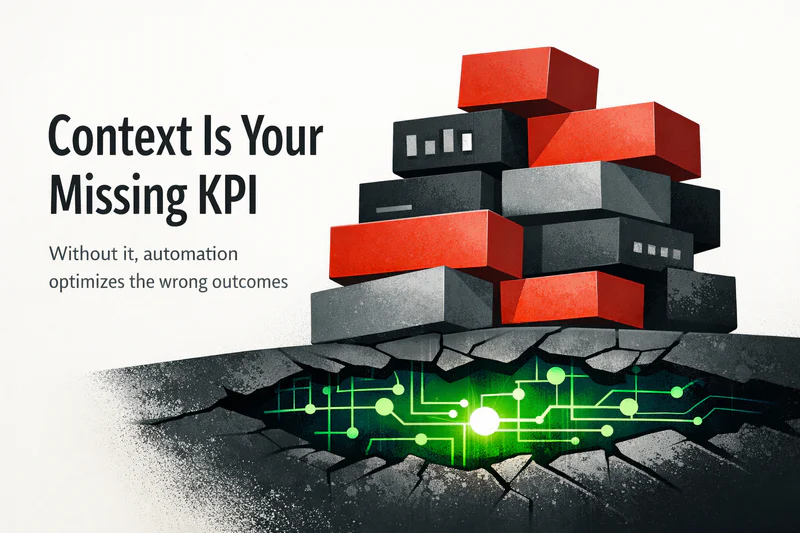
That's the Intelligence Gap. Standard integration moves records. It doesn't move context. Here's why that distinction kills your ROI and what fixes it.
Common Roadblocks That Prevent Clean Data Integration
Siloed Systems With No Shared Identity
Your CRM holds one version of the customer. Your billing tool holds another. Your support desk holds a third. None of them share a canonical identifier that persists across systems.
The result: duplicate records, conflicting lifecycle stages, and zero reliable way to answer "who is this person and what have they actually done?"
The Automation Ceiling
Legacy CDPs were built for structured, transactional data form fills, email opens, purchase events. They were never built to capture qualitative signals:
Urgency in a chat message
Hesitation in a support ticket
The sentiment shift between two sales calls
When your automation fires without this context, it fires blind. You're triggering sequences based on what happened not why it happened or what's coming next.
Schema Drift and Silent Failures
Source systems change constantly. A field gets renamed. A data type shifts. A new team starts logging events in a different format.
Without enforced schema contracts between producers and consumers, these changes silently corrupt downstream pipelines often for days before anyone notices.
No Continuous Buyer Journey Timeline
Your data exists as disconnected snapshots, not a continuous story. A customer's first inquiry, three support conversations, product usage pattern, and last sales call live in four different systems with no thread connecting them.
You can't query a timeline that was never built.
Governance Blind Spots
PII flows across pipeline stages without consistent lineage tracking. Teams don't know where sensitive data lives, who accessed it, or what transformed it. Under GDPR, CCPA, or SOC 2 that's not a minor gap. That's exposure.
Can Data Orchestration Be Consumed "As a Service"?
Data orchestration as a service shifts the model entirely. Instead of "build and maintain a pipeline," the question becomes: "layer intelligence on top of what you already have."
No ripping out HubSpot. No Salesforce migration. No Big Bang rebuild.
The Marketing Memory Bank Model
Think of it as a stateful layer that sits above your existing tools and maintains context across all of them. Every interaction email, chat, WhatsApp, web event, CRM note gets aggregated into a single, query-ready record per customer.
That record:
Persists between sessions
Survives tool migrations
Is available to any downstream system or AI agent in real time
The Conceptual Shift That Matters
Traditional integration asks: How do I move data from A to B?
Orchestration as a service asks: How do I maintain a coherent, living understanding of every customer regardless of which tool they're touching?
Where Agentic AI Enters the Picture
A stateful orchestration layer doesn't just store context it acts on it.
A prospect messages at 2 AM on WhatsApp. Instead of waiting for a rep to open their CRM the next morning, an AI agent with full historical context responds in under five seconds right tone, right information, full history loaded.
That's not a chatbot. That's orchestrated intelligence.
How Does a Unified Data Layer Solve Fragmented Customer Data?
Two Data Types. One Problem.
Legacy CDPs are good at one thing: quantitative event data. Page views, email clicks, purchase amounts, session durations. It tells you what happened.
What gets lost is qualitative dialogue data the actual words a customer used, the sentiment behind a support escalation, the buying signal buried in a chat transcript. That tells you why it happened and what happens next.
A unified data layer merges both.
The Conversation Graph: A Living Customer Record
Merging quantitative and qualitative data into one persistent structure creates what's called a Conversation Graph a structured, continuously-updated representation of the full customer relationship.
It includes:
Events and interactions across every channel
Sentiment signals and inferred intent
Full identity continuity tied to one persistent ID
What Becomes Possible Downstream
With a true Single Customer View (SCV) as a live operational resource not a reporting artifact your teams can answer questions that were previously unanswerable:
What is this customer's current readiness to buy?
What context did the last three touchpoints establish before I make this call?
Which accounts are showing early churn signals based on sentiment trends not just usage metrics?
Why This Is a Revenue Operations Problem, Not Just an Engineering One
RevOps sits at the intersection of sales, marketing, and customer success three functions running separate systems with separate definitions of the same customer.
When a deal stalls, the AE needs to know what the champion said across the last three touchpoints. Not that three emails were sent and one was opened.
When a CSM gets an escalation, they need the full history of what was promised during the sales cycle. Not just the contract date and ARR.
The intelligence gap is a context problem!
A unified data layer built with identity continuity and qualitative signal capture as first principles is what closes it.
The companies that bridge the gap between moving data and understanding it will operate at a speed and accuracy that rule-based automation simply cannot match.