
The race toward total autonomy has hit a critical wall.
While enterprises rush to deploy "efficient" bots to handle scaling demands, the human element is frequently left behind and the stakes are higher than ever.
According to PwC’s "Future of Customer Experience" report, while speed is a top priority, 73% of consumers point to customer experience as the deciding factor in their brand loyalty.
Yet, the same data suggests they will abandon a brand after just one lacklustre automated interaction.
We are moving from a world where we had to understand computers to a world where computers must understand us — Satya Nadella, CEO of Microsoft.
If your autonomous system can process a transaction but fails to recognize the frustration in a user’s tone, you aren't building a solution; you are building an expensive barrier.
This is the "missing intelligence layer." It is the bridge between robotic task execution and true comprehension.
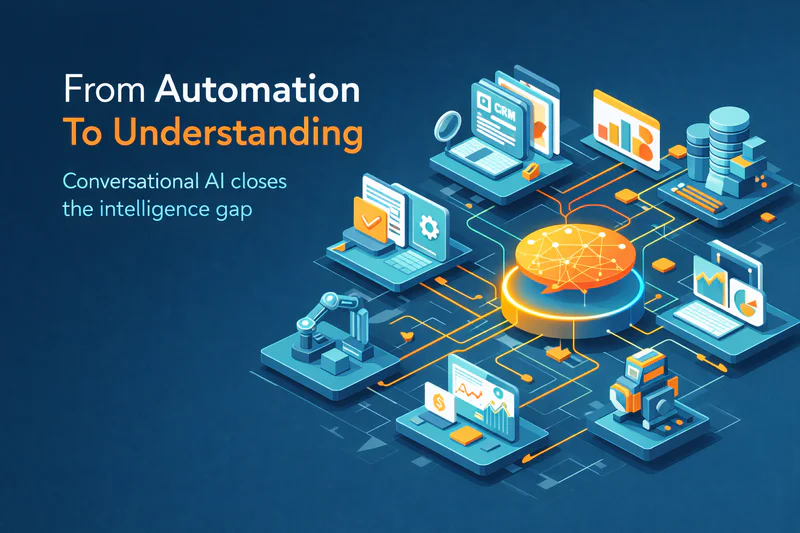
conversational AI serves as the cognitive nervous system of your tech stack. It moves beyond simple keyword matching to grasp the nuance, sentiment, and subtext of human intent. In 2025, the competitive advantage isn't just being "always on" it's being always understood.
The Intelligence Gap: Why Autonomy Without Understanding Fails
We've all been there. You type "I need help NOW" into a chat window, and the bot cheerfully responds with a 5-step troubleshooting guide. Frustrating, right?
That's the autonomy gap.
Traditional automation fires off tasks based on keywords and rigid decision trees. But real conversations? They're messy, emotional, and full of context that spreadsheets can't capture.
Conversational AI bridges this gap by doing what humans do naturally: reading between the lines. It detects urgency in "NOW."
It recognizes frustration in short, clipped responses. It understands that "I guess it's fine" probably means the opposite.
Without this layer, your agentic AI is just sophisticated automation wearing a friendly mask.
The real breakthrough happens when systems can reason through ambiguity, understand intent beyond keywords, and take autonomous actions based on human-centric communication.
Want to see how conversational intelligence transforms customer interactions? Let's explore what makes this technology different.
From Read-Only Bots to Write-Enabled AI conversational Agents
Remember the chatbots of 2015?
"Press 1 for sales, 2 for support." They were digital phone trees with a text interface. Clunky. Inflexible. Universally despised.
But here's what really limited them: they could only read and respond. They couldn't act.
Today's AI conversational agent is fundamentally different because it operates with what we call "task-oriented autonomy."
These agents don't just answer questions they execute multi-step workflows using natural language as their control interface.
The Shift from Read-Only to Write-Enabled Systems
Traditional chatbots: "Your flight departs at 3pm tomorrow."
Modern AI conversational agent: "I see your 3pm flight conflicts with your calendar. I've found an earlier option at 11am with your preferred airline and aisle seat. Should I rebook it?"
This is the evolution from passive information retrieval to active problem-solving. Here's what sets them apart:
Multi-step reasoning: They break complex goals into sequential actions (check calendar → search flights → compare options → execute booking)
Environmental interaction: They can "write" to the world by triggering API calls, updating databases, and coordinating between systems
Goal-oriented persistence: If one approach fails, they try alternatives until the objective is met
Natural language interface: You don't need to know SQL or API syntax just explain what you need in plain English
The conversational agent becomes an execution layer, not just an information layer. It's the difference between a librarian who finds books and a personal assistant who reads them, summarizes the insights, and books your follow-up meeting with the author.

Bridging Silos: Conversational AI as Enterprise Orchestration Layer
Small-scale conversational AI is impressive. Enterprise-scale?
That's where things get complex and where the real value emerges.
A conversational AI enterprise system doesn't just handle customer queries. It acts as the connective tissue between your fragmented software ecosystem, turning natural language into a universal integration protocol.
The Silo Problem Every Enterprise Faces
Your sales team uses Salesforce. Marketing lives in HubSpot. Support operates in Zendesk. Finance runs on NetSuite. Customer data is scattered across all of them, and none of these systems talk to each other naturally.
Enter the conversation intelligence platform as orchestration layer.
Here's how conversational AI bridges these gaps:
Cross-system queries: A customer asks, "What's the status of my order?"
The AI queries your CRM for the order details, checks your logistics system for shipping status, pulls payment info from your billing platform, and synthesizes everything into one coherent response.
Automated workflows across departments: An enterprise client mentions expansion plans during a support call. The conversational agent automatically creates a sales opportunity in your CRM, notifies the account manager, schedules a strategy call, and updates the customer success platform all without human intervention.
Real-time data synchronization: When a prospect changes their requirements mid-conversation, the system updates records across marketing automation, sales CRM, and product databases simultaneously, ensuring everyone works from the same truth.
Stakeholder updates via natural language: Instead of logging into five different platforms, executives can ask, "How are our Q4 enterprise deals progressing?" and get synthesized insights pulled from sales, finance, and customer success systems.
Security and Compliance at Scale
Healthcare, finance, and education sectors can't compromise on data protection. Your conversational AI enterprise solution needs role-based access controls that understand context.
The AI knows that a customer service rep can view account details but can't process refunds over $500. It understands that a sales manager can see pipeline data but not individual rep commissions. It enforces these permissions through conversational guardrails, not just system-level access controls.
Consistent brand voice: Whether your customer interacts on Monday or Friday, via chat or email, they get the same quality response that reflects your company values because the conversational layer maintains context and personality across all touchpoints.
Conversational Intelligence Sales: From Recording Tool to Proactive Revenue Driver
Here's where it gets interesting for revenue teams. Every sales conversation contains signals that traditional CRMs completely miss.
Conversational intelligence sales systems don't just record calls they analyse, learn, and autonomously act on patterns humans would miss across thousands of interactions.
From Passive Analysis to Autonomous Coaching
Traditional call recording: "Meeting lasted 37 minutes. 4 participants."
Conversational intelligence in sales: "Prospect mentioned budget constraints twice, competitor pricing three times, and used urgency language ('need this yesterday') five times. Recommended action: Send pricing flexibility proposal within 24 hours with ROI calculator focused on time-to-value. Flag for senior sales leader review due to deal size."
Here's what autonomous conversational intelligence enables:
Real-time coaching during calls: Your rep starts giving a generic pitch. The AI detects the prospect mentioned compliance concerns and surfaces relevant case studies and talking points on the rep's screen mid-conversation.
Proactive follow-up sequences: After analyzing call sentiment and engagement patterns, the system automatically crafts personalized follow-ups that address specific objections raised, questions left unanswered, and next steps aligned with the buyer's timeline.
Pattern recognition across the pipeline: The AI notices that deals stall after demo calls where technical objections aren't addressed within 48 hours. It automatically triggers technical resource allocation and implements reminder workflows before opportunities go cold.
Autonomous opportunity scoring: Instead of static lead scores, the system continuously updates opportunity quality based on conversation sentiment, engagement depth, decision-maker involvement, and competitive positioning revealed through dialogue.
Extracting Qualitative Signals from Unstructured Dialogue
These systems extract what we call qualitative signals that spreadsheets can't capture:
Mood indicators: Is the prospect excited, skeptical, or just browsing?
Urgency markers: Do they need a solution by end-of-quarter, or are they in early research mode?
Decision authority clues: Are they the final decision-maker, or do they need to convince their boss?
Competitive intelligence: What alternatives are they considering, and what concerns do they have?
Hidden objections: What are they not saying directly but implying through hesitation or topic avoidance?
These signals trigger intent based workflows that act on what matters, turning your conversational agent into a proactive member of the sales team, not just a passive recording tool.
Natural Language as the Operating System: The Reasoning Core Behind Conversational Agents
For a system to be truly agentic, it must understand intent, not just keywords. This is the fundamental shift that separates sophisticated automation from genuine intelligence.
Why Traditional Keyword Matching Fails
Old approach: Customer types "password" → Route to password reset flow.
Seems logical, right? Except when the customer actually said: "I've reset my password three times and I'm still locked out."
Keyword matching saw "password" and triggered the wrong workflow. A conversational agent with a reasoning core understands the full context: frustration, repeated attempts, escalation needed.
This reasoning capability comes from Large Language Models (LLMs) that power modern conversational AI:
Handling ambiguity: Human language is inherently ambiguous. "Can you help me with this?" could mean "Please fix my problem" or "Are you capable of assisting?" LLMs understand intent from context, not just words.
Multi-turn context retention: The system remembers you mentioned budget constraints five messages ago and connects it to your current question about enterprise features, adjusting its response accordingly.
Novel problem solving: When faced with unique situations not in its training data, the reasoning core can "hallucinate" solutions by combining known patterns in creative ways much like humans do when encountering new problems.
Intent inference: You don't say "I want to cancel." You say "This isn't working for us anymore." The LLM understands the underlying intent and routes appropriately.
Natural Language as Universal Interface
Here's why this matters for autonomy: natural language becomes the operating system for your entire tech stack.
Instead of building custom integrations between every system, you build one conversational interface. Want to pull last quarter's revenue by region? Ask in plain English. Need to create a project timeline based on team capacity? Describe what you need conversationally.
The AI conversational agent translates your natural language request into the technical operations required: database queries, API calls, data transformations, and result synthesis. You operate your entire business infrastructure through conversation.
This is fundamentally different from search or commands. It's reasoning, execution, and orchestration through human language.
Sounds powerful, but how do you prevent autonomous systems from making costly mistakes? Trust is the final piece.
The Conversation Graph: Unified Intelligence for Autonomous Action
Most growth stacks suffer from "data amnesia." Your CRM tracks email opens, and your support platform monitors tickets, but these isolated data points fail to capture the full human story.
A Unified Conversation Graph solves this by merging qualitative dialogue with quantitative behavioral metrics into a single, actionable timeline. Think of it as a "Shared Intelligence Bank"—where every interaction and context point is available the moment a decision needs to be made.
This enables high-impact, autonomous actions across the funnel:
Intelligent Routing: If a customer mentions they are "considering alternatives" during a billing query, the system doesn't just file a ticket—it alerts an account manager with a real-time retention strategy.
Dynamic Personalization: Messaging evolves beyond simple tags like
{FirstName}to content crafted from actual conversation history and detected priorities.Proactive Engagement: By identifying dialogue patterns that correlate with churn (such as specific technical hurdles), the system automatically triggers educational outreach before the user loses interest.
Omnichannel Continuity: Context follows the user from LinkedIn to email to voice, ensuring they never have to repeat their story.
This isn't just about better bots; it’s about making your entire stack smarter by giving every system access to centralized conversational intelligence.
The Bottom Line: Autonomy Needs Understanding
Agentic AI promises autonomous systems that handle complex tasks without constant human supervision. But autonomy without understanding? That's just fast, efficient failure.
Conversational AI provides the intelligence layer that transforms rigid automation into systems that truly understand customers. It extracts meaning from messy, emotional, unstructured dialogue and turns it into structured decisions your business can act on.
The question isn't whether you need conversational intelligence. It's whether you can afford to build autonomous systems without it.
Because your customers won't wait around while your AI learns the hard way that "I'm fine" doesn't always mean fine.
Ready to build autonomous systems that actually understand your customers? Discover how Zigment's Conversation Graph transforms dialogue into actionable intelligence across your entire revenue stack.