
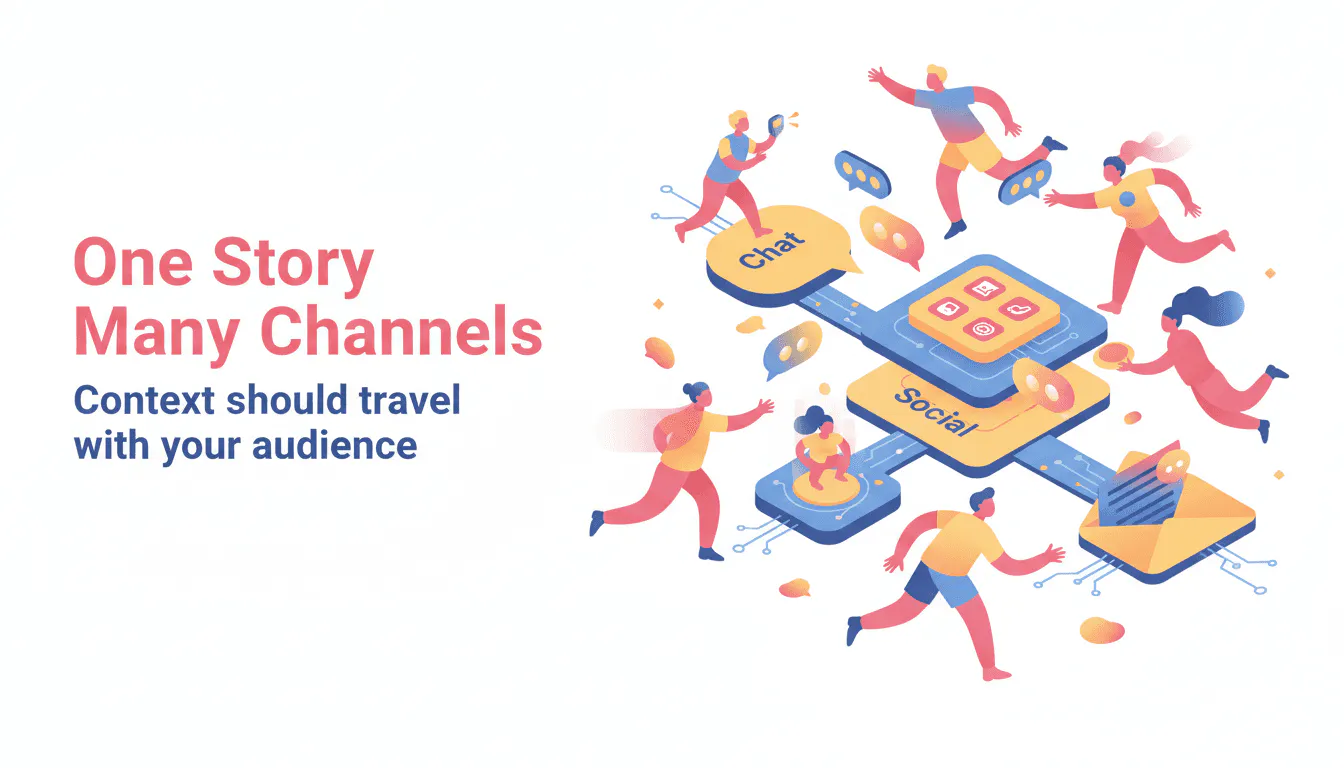
A single interaction rarely tells the full story anymore. Someone might discover your brand through a creator post, return days later through a DM, and only then open an email that finally clicks. None of these moments are random. They’re connected by intent, timing, and context.
Attention is earned in fragments, and each fragment tells a story, if your brand can remember it.
This is exactly where omnichannel storytelling for Gen Z becomes critical. Gen Z doesn’t need more touchpoints. They expect coherence across the ones that already exist. When chat, social, and email operate in isolation, the experience feels fragmented even if each message is well-written.
This article breaks down how Gen Z actually moves across channels, why disconnected messaging weakens trust, and how brands can design cross-channel stories that feel intentional rather than repetitive.
What Omnichannel Storytelling for Gen Z Really Means
Omnichannel storytelling refers to the practice of delivering a unified narrative across multiple channels while adapting the message to the context of each interaction. For Gen Z, this means conversations continue rather than restart when they move from social to chat to email.
Unlike basic multichannel integration, omnichannel storytelling relies on:
Shared context across platforms
Messages that evolve based on prior interactions
A consistent narrative voice without copy-paste repetition
Gen Z users are highly aware when brands fail to connect these dots. They don’t expect perfection, but they do expect brands to acknowledge previous interactions and respond accordingly.
This level of cross-channel communication signals competence and respect, two qualities that strongly influence engagement.
How Gen Z Interacts With Chat, Social, and Email
Gen Z uses channels differently depending on intent, not preference. Each platform serves a specific role in how they evaluate, question, and commit.
Common patterns include:
Social platforms for discovery, social proof, and relevance
Chat interfaces for clarification, real-time questions, and trust-building
Email for follow-ups, confirmations, and deeper information
This is why Gen Z social + email marketing only works when the two are aligned. An email that ignores a recent chat interaction feels outdated. A chat response that contradicts an email erodes confidence.
It’s not about speed; it’s about precision. Each interaction must land where it matters most.
Gen Z isn’t moving quickly because they’re impatient. They move deliberately because they know what information they need at each step.
Why Channel Silos Undermine Engagement
When channels operate independently, even strong content can feel irrelevant. The issue isn’t frequency, it’s misalignment.
Common breakdowns include:
Emails that promote actions already taken
Chat responses that ignore recent social engagement
Ads that repeat messages users have clearly moved past
These gaps weaken customer engagement strategies because they signal a lack of awareness. Gen Z is highly attuned to context and expects brands to recognize behavioral cues across touchpoints.

Effective omnichannel experiences don’t push users forward prematurely. They respond to where the user actually is.
Creative Continuity Marketing Across Channels
Creative continuity marketing ensures that a brand’s core idea stays consistent while the execution adapts to context. This is especially important for Gen Z, who notice tonal mismatches quickly.
Strong creative continuity includes:
A shared narrative across platforms
Channel-specific messaging that reflects user intent
Progression in ideas rather than repetition
This approach supports omni channel personalization by tailoring not just what is said, but when and where it appears. The result feels natural, not engineered.
Consistency without context is noise; context without consistency is confusion.
Cross-Channel Storytelling Examples for Gen Z
Practical examples illustrate how omnichannel storytelling works in real scenarios.
Example 1:
A social post introduces a relevant use case
A DM answers specific questions related to that use case
An email provides detailed resources aligned with the conversation
Example 2:
An email announces a feature update
Social content demonstrates it visually
Chat addresses objections or edge cases
These cross-channel storytelling examples for Gen Z show how each interaction builds on the last without restarting the narrative.
Building the Best Omnichannel Strategy for Gen Z
The best omnichannel strategy for Gen Z focuses less on volume and more on coordination.
Key components include:
Shared data and behavioral signals across platforms
Orchestration that adapts messaging in real time
Intent-based sequencing rather than fixed funnels
Continuous feedback loops between channels

This form of multichannel integration prioritizes relevance and timing, which Gen Z consistently rewards with engagement.
Omnichannel Marketing Tips 2026: What to Prepare For
Looking ahead, omnichannel marketing tips 2026 emphasize restraint and intelligence.
Emerging patterns include:
Fewer messages with higher contextual relevance
AI-driven orchestration replacing rigid workflows
Greater emphasis on listening before responding
Gen Z will continue to engage with brands that demonstrate awareness rather than persistence.
Why This Matters Going Forward
When chat, social, and email are aligned, Gen Z experiences a brand as a single, thoughtful conversation rather than disconnected messages. Each interaction builds on the last, showing awareness of intent and context without being intrusive. That continuity is what earns trust, relevance, and engagement over time.
Achieving this level of coherence isn’t possible with isolated tools or static workflows. It requires orchestration, systems that gather signals from every touchpoint, understand what the user is trying to do, and deliver the right action at the right moment. Zigment enables brands to do exactly that, turning scattered interactions into one evolving story that feels seamless across chat, social, email, and product experiences.
For brands aiming to stay relevant with Gen Z, the difference isn’t in sending more messages, it’s in making every message count. When executed well, omnichannel storytelling builds lasting engagement and positions your brand as thoughtful, responsive, and connected.