
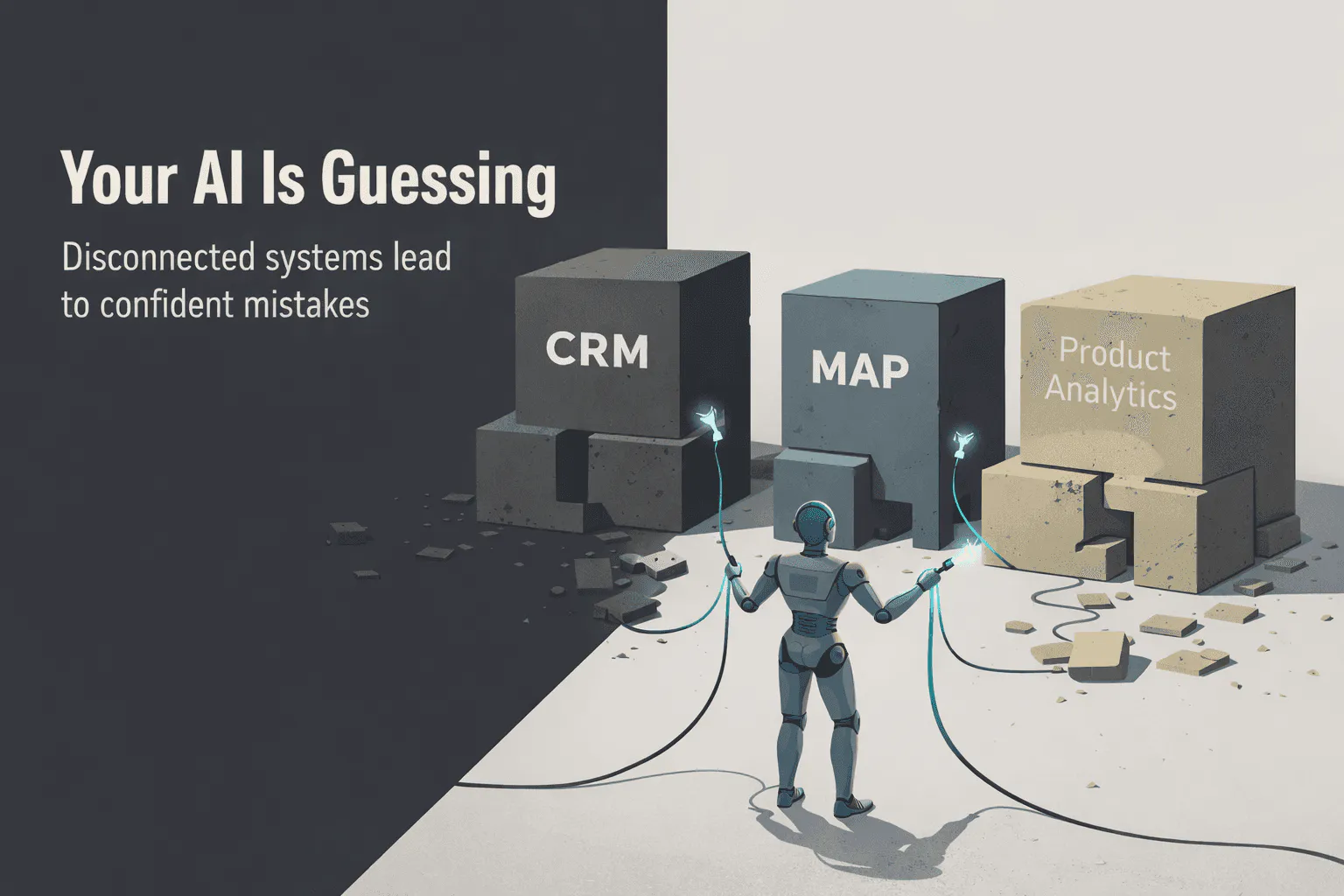
Your lead scoring AI just flagged a Fortune 500 prospect as "low priority."
Three weeks later, your competitor closed the deal.
The culprit?
Your AI was trained on siloed data from marketing. It never saw the high-intent signals sitting in your sales engagement platform. Or the usage data in your product analytics tool. Or the conversation intelligence from your call recordings.
Welcome to 2025, where your biggest competitive threat isn't bad AI it's fragmented data feeding that AI bad inputs.
The Black Box in Your Revenue Engine
Marketing and RevOps teams have embraced agentic AI with unprecedented speed. Salesforce closed 18,000 Agentforce deals since October 2024. The promise is compelling: autonomous agents that don't just assist they execute.
AI-driven lead scoring. Predictive analytics for customer lifetime value. Algorithmic email optimization. Chatbots qualifying prospects. Dynamic pricing engines. Multi-agent orchestration across your entire revenue stack.
Gartner reported a 1,445% surge in multi-agent system inquiries from Q1 2024 to Q2 2025, signalling that we're moving from single-purpose automation to orchestrated agent networks.
And when it works? It's transformative. Capital One's Chat Concierge saw 55% higher lead conversion. A US homebuilder trained AI agents on top performers and tripled conversion-to-appointment rates.
But here's the uncomfortable technical reality nobody discusses at conferences: 75% of RevOps professionals cite data inconsistencies as the most frustrating part of their tech stack.
Your agents are only as intelligent as the data they can access. And right now, that data is scattered across 15+ disconnected systems.
When Marketing Automation Goes Wrong?
Let's get technical for a moment.
The accountability gap in agentic AI isn't just an organizational problem it's an architecture problem.
The data silo reality: Your CRM holds account data. Your MAP has behavioral signals. Your product analytics platform tracks usage. Your conversation intelligence tool has intent data. Your customer success platform owns retention signals.
None of them talk to each other in real-time.
According to Fullcast's 2025 Benchmarks Report, 63% of CROs lack confidence in their Ideal Customer Profile definition a problem made worse by siloed data.
So when your lead scoring agent makes a decision, it's working with maybe 30% of the available context. That's like asking someone to solve a puzzle with two-thirds of the pieces missing.
Lead qualification failures:
Your AI decides a $2 million opportunity isn't sales-ready because the lead score is low.
Why is it low? Because your agent only sees email engagement (marketing data) and missed the fact that three C-level executives from that account spent 45 minutes on your pricing page yesterday (product data) and mentioned your competitor by name in a sales call last week (conversation intelligence).
Attribution chaos:
Companies with poor alignment between marketing and sales lose an average of 10% of annual revenue through inefficient processes.
Your multi-touch attribution model uses ML to distribute credit across touchpoints. But it can't attribute value to what it can't see. So budgets flow to channels that leave digital breadcrumbs while high-value dark social and partner referrals get defunded.
Segmentation at scale with gaps:
Your personalization engine segments audiences brilliantly. Except it's segmenting based on incomplete customer profiles because customer success data, support ticket sentiment, and product usage patterns aren't flowing into the system.
The result? Only 16% of RevOps professionals say their tech provides strong, data-driven insights that lead to revenue-impacting decisions.
The "Just Trust the Algorithm" Problem (When the Algorithm Has Tunnel Vision)
Here's the dangerous part: The pressure to appear data-driven means questioning algorithmic recommendations feels anti-innovation.
Your demand gen manager notices automated nurture dropping high-value prospects early. But the system's "AI optimization" is supposedly smarter than any human.
Except it's not smarter. It's just faster at processing incomplete information.
Agentic AI systems pursue goals autonomously they plan, call tools and APIs, coordinate with other agents, and act. That's powerful. That's also terrifying when those agents can't see the full picture.
The technical challenge: Modern foundation models are incredibly capable. OpenAI's Responses API and Agents SDK formalize tool use, while Anthropic added computer use for Claude, and Google's Gemini pushed context to million-plus tokens.
But none of that matters if your agents are calling APIs that return partial data from siloed systems.
Who Should Own Algorithmic Marketing Decisions?
The solution isn't abandoning agentic AI. If 2024 was the year businesses embraced generative AI, 2025 was the year they demanded AI with consistent performance, enterprise-grade security, and measurable ROI.
But we need technical accountability frameworks that address the root problem: data fragmentation.
Marketing and RevOps leaders must demand unified data architecture before deploying agents at scale. Ask: What percentage of our customer data can this agent actually access? What's the latency between data generation and agent availability? How are we handling data conflicts across systems?
Workato Enterprise MCP (Model Context Protocol) provides the foundation for the agentic era, offering the context, trust, and accuracy that production AI deployments require.
Marketing operations as data orchestrators: Instead of siloed tools or departments working independently, agentic orchestration connects everything. Your agents need a centralized knowledge base what Workato calls an "Agent Knowledge Base"—that unifies business data into a single, context-rich source of truth.
Using semantic search, RAG (Retrieval-Augmented Generation), and federated queries, it lets agents access your data intelligently.
Cross-functional data governance: AI agents operate across departments, connecting siloed teams into one cohesive flow. A sales agent collaborates with a marketing agent to prioritize leads, while a customer success agent prepares onboarding all based on the same shared data stream.
This requires:
Unified data models across systems
Real-time data synchronization
Clear data ownership and SLAs
Semantic layers that let agents understand context, not just fields

Building Accountability Into Your Revenue Stack
Here's what actually works in 2026:
Implement unified data architecture FIRST. Adobe's shift from customer experience management to customer experience orchestration uses content, data, and journeys with AI to create experiences informed by customer data.
You need integration platforms that support Model Context Protocol (MCP) and Agent-to-Agent (A2A) communication. MCP standardizes how agents connect to external tools, databases, and APIs, transforming custom integration work into plug-and-play connectivity.
Human-in-the-loop with full context. Route decisions requiring oversight to the right person via Slack or Teams, with Agent Studio allowing for observability and full conversation history for auditability.
But make sure those humans see the SAME data the agents do. No more "the AI saw different numbers than I'm seeing in my dashboard."
Agent performance monitoring with data quality metrics. Track not just what your agents decide, but what data they had access to when deciding. Specialized agents like "The Listener Agent" constantly monitor prospect calls, tracking every mention of pain points and needs.
Create scorecards that measure:
Data completeness scores per decision
Cross-system data latency
Conflict resolution rates
Agent accuracy vs. data coverage correlation
Build knowledge graphs, not just databases. Modern platforms enable stateful multi-step tasks over large corpora with long-context models. Your agents need to understand relationships between data points, not just access individual records.
When an agent evaluates a lead, it should see: account firmographics + behavioral signals + product usage + conversation sentiment + competitive intel + market timing all connected and contextualized.
Orchestration layers for multi-agent coordination. Rather than deploying one large LLM to handle everything, leading organizations implement "puppeteer" orchestrators that coordinate specialist agents.
A researcher agent gathers information from multiple data sources. A scoring agent evaluates based on unified context. A routing agent considers availability and specialization. All working from the same truth.
The Revenue Leader's Responsibility (Get Technical or Get Left Behind)
The hardest part? Companies with poor marketing-sales alignment lose 10-15% of potential revenue. But the data silo problem is deeper than alignment it's architectural.
Revenue leaders must develop what I call "data architecture literacy." Not understanding database schemas, but understanding:
How data flows (or doesn't) between your systems
What latency exists between data generation and agent availability
Where data quality breaks down
How agents resolve conflicts when systems disagree
What context agents are missing when they make decisions
AI agents will likely require orchestration for intelligent automation, with open source and proprietary communication protocols competing to lead the way.
The leaders winning in 2025 aren't just deploying agents they're building enterprise-grade orchestration platforms. By 2026, around 75% of the fastest-growing companies will have a RevOps model in place, and those models will be built on unified data foundations.
Signing Off on Machine-Generated Revenue
Every consequential decision in your revenue engine should have:
A human signature
Full visibility into what data the agent accessed
Audit trails showing data provenance and quality
Override protocols when data completeness is below threshold
By 2028, 15% of day-to-day work decisions could be performed by AI agents, and a third of all enterprise software applications are expected to include agentic AI.
Your revenue engine will run on orchestrated agent networks. That's the future, and honestly? It's incredibly exciting.
But those agents need to see the full picture. Not fragments. Not silos. Not 30% of the context.
As one marketing leader noted, successful implementation integrates automation into core processes without losing human creativity and oversight.
The companies that win won't be the ones with the most AI agents. They'll be the ones whose agents have access to unified, real-time, contextual data across the entire customer journey.
Build the data foundation. Then deploy the agents. Not the other way around.
Because when your board asks why you missed targets next quarter, "our AI agents were working with incomplete data from siloed systems" is just a more technical way of saying you weren't ready for the agentic era.
And in 2025? That's a choice, not a constraint.