
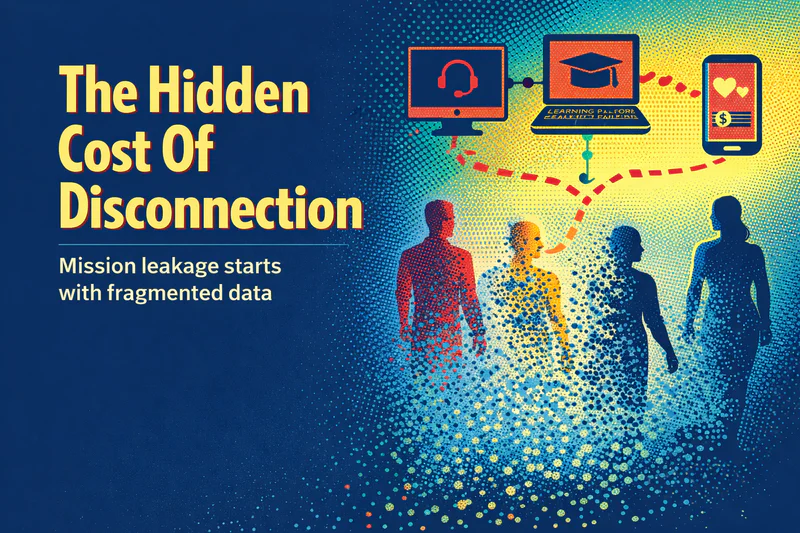
In the 2026 educational landscape, institutions don’t suffer from a lack of data; they suffer from a lack of coordination. For years, the standard approach to scaling was to buy a new "point solution" for every problem. Need to track grades?
Get an LMS. Need to manage enrollment? Buy a CRM. Need to engage students? Launch a mobile app.
The result is a fragmented ecosystem of Data Silos. These silos are more than a technical nuisance they are the primary barrier to the next generation of "Agentic" learning.
When your student's quiz performance doesn't talk to your tutoring bot, you aren't providing personalized education; you're just managing a collection of disconnected tools.
The Anatomy of the EdTech Data Silo
A data silo occurs when student information is trapped within specific software, inaccessible to the rest of the learning journey. In EdTech, this creates a "blind" institution:
The SIS (Student Information System): Knows a student's demographics but has no idea they've been asking a chatbot about transfer credits for three hours.
The LMS (Canvas/Moodle): Knows a student is failing Module 4 but doesn't know they recently expressed high interest in a specific career path on a career-services portal.
The Support Desk: Sees a ticket about a login error but lacks the context that this student is a "high-risk" learner who hasn't logged in for a week.
When these systems are disconnected, the student experience feels robotic and repetitive. This leads to "Frustration Walls" points where a student gives up because the technology doesn't "know" them.
The Fallacy of the "Big Bang" Migration
Traditionally, the only fix was a Big Bang Migration: ripping out every legacy system to move to a single, all-in-one "Super Platform." For schools and EdTech providers, this is often a disaster. These migrations are:
High Risk: Data loss during "lift and shift" is common.
Culturally Disruptive: Teachers and staff are forced to abandon familiar tools, leading to adoption "rejection."
Obsolescence: By the time a 2-year migration is complete, the AI models it was built for are already out of date.
The Shift to the AI Orchestration Layer
The modern alternative is Orchestration. Instead of moving your data, you build an Intelligence Layer that sits on top of your existing tools. This layer acts as a "Digital Brain" that has its hands on every tool you already own.
Key Innovations in Orchestration:
Real-Time Event Processing: Unlike old systems that "sync" once a day, an orchestration layer reacts in milliseconds. If a student fails a quiz, the brain instantly triggers an AI agent to offer a specific micro-lesson.
The Conversation Graph™: This is the game-changer. It maps every interaction from a voice note in 2024 to a quiz result in 2026 onto a single Cognitive Timeline. The AI can finally understand the why behind a student’s struggle by looking at the relationships between their past questions and current performance.
Adaptive Middleware: This software layer (like Zigment.ai) scans for "micro-behaviors" like hesitating on a paragraph or irregular login patterns—to intervene with surgical precision.
Agentic AI: From Passive Support to Active Mentorship
The true power of orchestration is the move from reactive chatbots to Agentic AI. Traditional AI waits for a student to ask a question. Agentic AI is proactive it has educational goals and takes action to achieve them.
Using an orchestration layer, an AI Agent can:
Identify a Struggle: "I see this student has revisited the 'Mitosis' video three times but failed the practice quiz."
Formulate a Plan: "I will fetch a 3D simulation of a cell and send it to their WhatsApp with a supportive note."
Execute & Update: The agent sends the content, monitors the interaction, and writes a structured "Intent Signal" back to the SIS so the human teacher is informed.
Security: Protecting the "Learning Record"
In EdTech, data privacy isn't just a feature; it's a legal and ethical mandate. Orchestration layers provide a "Trust Dividend" by ensuring:
Data Isolation: Proprietary student data is never leaked to public model training (e.g., your data doesn't train the next public GPT).
Hallucination Guardrails: AI outputs are validated against your institution’s specific curriculum benchmarks before the student sees them.
Auditability: Every autonomous action taken by the AI is logged in the Conversation Graph, providing a "reasoning path" that teachers and parents can review.
The Bottom Line
The "Big Bang" migration is a relic of the past. The future of EdTech belongs to the platforms that can layer intelligence over their existing infrastructure. By adopting an AI Orchestration Layer, institutions can finally break their data silos, eliminate "admin drain," and provide a learning experience that is proactive, personalized, and deeply informed by the student’s entire journey.
The question for EdTech leaders is no longer "Should we move our data?" it’s "How quickly can we start orchestrating it?"