
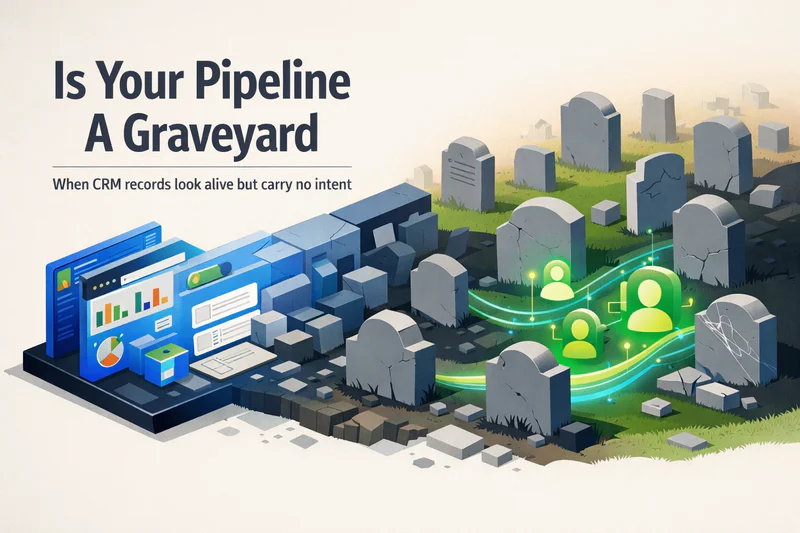
There's a question every RevOps engineer dreads in a pipeline review meeting: "Is this data actually real?"
You've got thousands of records in Salesforce. Contacts, leads, accounts a seemingly rich pipeline. But scroll a little deeper and the picture gets darker. Contacts who haven't opened an email in 14 months.
Leads marked "working" by a rep who left the company in Q2. Decision-makers whose job titles are two promotions out of date. Duplicate records that have quietly split your customer's history across four separate entries.
Your Salesforce instance isn't a pipeline. It's a graveyard and most of the leads inside it are already dead.
The bad news: Gartner estimates organizations lose an average of $12.9 million annually due to poor data quality. The worse news: traditional data hygiene tools can't fix this. They clean the surface deduplicating emails, validating formats but they can't tell you the one thing that actually matters: does this contact still want to buy?
That's the problem conversational revenue orchestration was built to solve.
The Zombie Lead Problem Nobody Talks About
In RevOps, we obsess over lead scoring, routing logic, and attribution models. What we don't talk enough about is the slow rot happening inside the CRM itself.
Around 18–25% of B2B contact data becomes outdated every year. That means if you haven't touched a record in 18 months, there's a better-than-even chance the phone number is wrong, the person has changed roles, or the company has pivoted entirely. Your CRM records these contacts as "open." Your scoring model treats them as opportunities. Your sales team wastes cycles chasing ghosts.
This is the zombie lead problem. These aren't just inactive leads they're records that look alive in your system but carry no real intent signal. And because they're sitting in Salesforce alongside your genuinely warm pipeline, they contaminate everything: your forecasting, your segmentation, your CAC calculations, your board decks.
On average, 60–73% of a company's data remains unused for analytics. The reason isn't always poor tooling. Often, it's that the data simply can't be trusted
For a CFO asking "why is our pipeline-to-close ratio declining,"
and a CTO asking "why isn't our AI-driven scoring model working,"
the real answer is often the same: the data feeding your revenue engine is contaminated at the source.
Why Traditional Data Hygiene Fails the Middle of the Funnel
At the top of the funnel, data problems are relatively easy to solve. Validation rules, enrichment APIs, and duplicate matching can catch bad records before they enter the system.
Many companies decide to run a one-time "data scrub," hire a service to clean up duplicates and verify emails, feel great for a week and then the data gets messy again. Because they treated the symptom, not the disease.
The disease is this: CRM data decays because nobody is actively talking to the contacts inside it. The moment a lead goes quiet, their record begins to die. And the longer your team waits to re-engage, the more likely the signal is gone entirely.
Leads contacted within 5 minutes of showing intent convert 21x more than those reached an hour later. And most of your zombie leads were once warm they just went cold while your team was busy chasing other things, or waiting for the "right moment" to follow up.
The "right moment" passed months ago. The question now is: can you find out which ones are still salvageable?
Conversational Revenue Orchestration: The Active Layer Your CRM Needs
This is where conversational revenue orchestration changes the game.
Traditional CRM integration tools are passive. They record what happened calls logged, emails sent, stages updated. They're archaeologists of your revenue motion, cataloguing the past. What they don't do is act on the present. They can't reach out to a dormant contact on WhatsApp and ask a qualifying question. They can't detect hesitation in a reply and automatically route that signal to a human rep. They can't tell a zombie lead apart from a sleeping giant.
Zigment is built as the active layer on top of your Salesforce data the orchestration engine that doesn't just read your CRM, but actually engages your contacts to verify, update, and enrich intent in real time.
Here's how it works in practice:
Step 1 — Signal detection.Zigment's Conversation Graph ingests your Salesforce records and identifies dormant contacts: leads that haven't engaged in a defined window, contacts with stale activity, accounts with no recent touchpoints. These are your zombie candidates.
Step 2 — Agentic re-engagement. Instead of sending another generic drip email, Zigment deploys AI agents that initiate real, contextual conversations across the channels your contacts actually use WhatsApp, SMS, email, web chat. These aren't scripted chatbots. They understand mood, intent, and urgency, and they adapt mid-conversation based on how the contact responds.
Step 3 — Intent verification. The agent's job is simple: determine whether this contact still has genuine buying intent. Is the project still alive? Has the budget been allocated? Has the decision-maker changed? The conversation extracts this signal and writes it back to Salesforce updating the record with verified, real-time intent data.
Step 4 — Orchestrated handoff. Contacts who re-engage with high-intent signals are automatically escalated to your sales team, with full conversation context attached. Contacts who confirm they're no longer in-market get cleanly marked, so your pipeline reflects reality. Dead records become accurately dead. Live opportunities resurface.
The result is a CRM that cleans itself not by deleting bad data, but by talking to it.
The Shift from Passive CRM to Conversational Revenue Orchestration
The era of the CRM as a passive record-keeper is over. The RevOps teams that will win in 2026 and beyond aren't the ones with the cleanest field completion rates they're the ones whose CRM data is actively verified by real conversations.
Zigment's approach is direct: conversation is the data. Every interaction your AI agents have with a contact generates a structured, query able signal that flows back into Salesforce. Not just "email opened" or "link clicked" but actual intent. Whether they're ready to buy, still evaluating, waiting on budget approval, or completely out of market.
This isn't automation for automation's sake. It's conversational revenue orchestration a model where AI agents continuously work through your mid-funnel, separating the dead from the dormant and handing the salvageable opportunities back to your human team with context they can actually use.
Your Salesforce data doesn't have to be a graveyard. The leads are in there. Some of them are still alive. The only way to know which ones is to ask.