
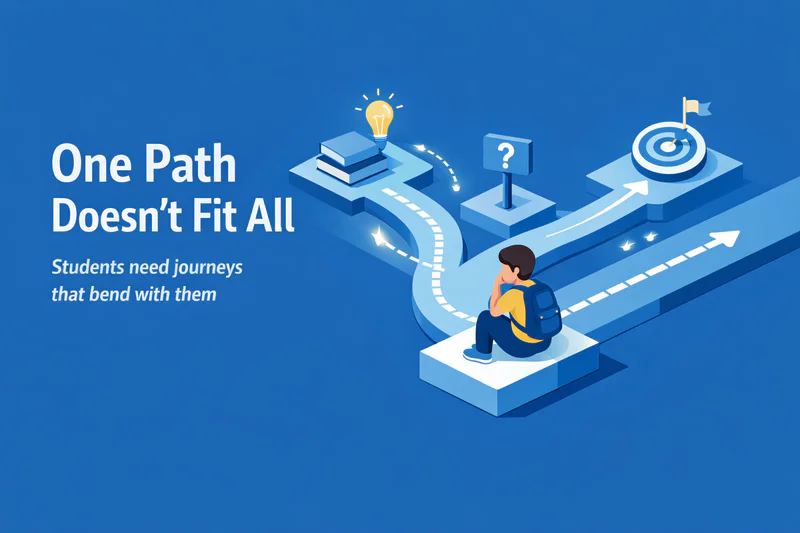
Most student journeys are designed once and followed forever.
That’s the problem.
Learners change their minds mid-lesson. Confidence rises and falls. Motivation spikes, then stalls. Yet many personalized learning platforms still rely on fixed paths, static rules, and delayed signals to decide what happens next. By the time the system reacts, the moment has already passed.
Branching Student Journeys by Intent offers a different approach. Instead of waiting for outcomes like completion or dropout, journeys adapt in real time based on expressed need, hesitation, curiosity, readiness, or overwhelm. The system listens first, then responds, reshaping the experience while the student is still engaged.
In this article, we’ll break down how to design dynamic, adaptive student journeys that branch automatically based on intent and mood. You’ll see what signals matter, where most personalization models break down, and how intent-driven orchestration creates truly personalized student learning experiences without adding complexity for educators or teams.
Why Traditional Personalized Learning Falls Short
Personalization in education isn’t new.
But much of it stops at the surface.
Most personalized learning platforms personalize content, not journeys. They adjust what a student sees, but not how the experience unfolds over time. That distinction matters more than it sounds.
Here’s where traditional personalization breaks down:
Static paths, dynamic students
Learning flows are often locked in once a student is tagged or segmented. But intent shifts constantly, sometimes within a single session.Rules replace understanding
If a student scores below X, show lesson Y. If they click twice, send reminder Z. These rules ignore context, emotion, and motivation.Signals arrive too late
Completion rates and assessments show outcomes, not early warning signs. By the time a system “notices” a problem, engagement has already dropped.One definition of success
Traditional models assume every student should move forward at the same pace, toward the same milestones, in the same order.

True personalization requires more than adjusting difficulty levels or content recommendations. It requires understanding why a student is hesitating, exploring, or ready to move forward, and responding in the moment.
That’s where intent-based branching enters the picture.
What Branching Student Journeys by Intent Really Mean
Branching by intent is about choosing the right path at the right moment.
Intent reveals what students truly need in the moment.
Intent Is a Live Signal, not a Label
Student intent reflects what a learner needs right now, clarity, reassurance, momentum, or challenge. It shows up through actions and language:
Repeated pauses or rewinds
Short, uncertain questions
Fast progression without friction
Requests for validation before moving forward
Unlike personas or profiles, intent can shift multiple times within a single session.
Branching Happens at Decision Moments
Intent-based branching focuses on key moments where direction matters:
Should the student continue, slow down, or explore deeper?
Do they need encouragement or acceleration?
Is this a learning moment or a confidence moment?
Journeys adjust at these points without forcing students to restart or backtrack.
The Outcome: Responsive Learning Flows
When journeys branch by intent:
Hesitant students receive support instead of pressure
Curious learners unlock exploration paths
Ready students move forward without unnecessary steps
That’s how personalized student learning experiences stay relevant, moment by moment, not module by module.
Signals That Reveal Student Intent and Mood in Real Time
Students communicate constantly, even when they say very little. The key is knowing where to look.
Every pause or question is an opportunity to guide.
Behavioral Signals
These show up through interaction patterns:
Pausing frequently on the same concept
Replaying videos or rereading instructions
Skipping ahead without reviewing guidance
Each behavior points to a different need, clarity, confidence, or speed.
Conversational Signals
Language reveals intent faster than metrics:
“Just checking…” often signals hesitation
“What happens if…” suggests exploration
“I’m ready to submit” shows commitment
These cues are especially powerful in chat-based or assisted learning environments.
Emotional and Timing Signals
Mood appears in when students act:
Late-night activity often indicates urgency
Sudden silence after high engagement suggests friction
Rapid progress followed by a pause can mean doubt
When personalized learning platforms capture these signals in real time, journeys can adapt immediately, keeping learners supported before disengagement begins.
Designing Dynamic, Adaptive Student Journeys
Designing intent-based journeys isn’t about building dozens of paths. It’s about making the right decisions at the right moments.
Start With the Core Journey
Every adaptive experience needs a stable foundation. Map the primary student flow from discovery to completion. This core journey acts as an anchor, ensuring that personalization enhances clarity rather than introducing chaos.
Model Intent States Instead of Personas
Personas tend to freeze students in time. Intent states stay flexible.
Common states include:
Hesitant
Curious
Confident
Ready
These states describe what a student needs in the moment, allowing journeys to adapt as those needs evolve.
Identify Meaningful Branching Moments
Branching works best at points of decision or friction:
After complex lessons
During enrollment or progression steps
When engagement patterns shift noticeably
Limiting branching to high-impact moments keeps experiences focused and intuitive.
Align Responses with Student Mood
Support should match emotional context. Hesitation calls for reassurance. Curiosity benefits from optional depth. Readiness deserves momentum.
Design for Movement, Not Lock-In
Adaptive journeys allow students to move freely between paths. This flexibility preserves trust and creates personalized learning experiences that feel responsive rather than restrictive.
Examples of Intent-Based Branching in Education
Intent-based branching shows up in small moments that shape long-term outcomes.
Supporting Hesitant Students
When learners pause before progressing, journeys can shift toward reassurance:
Short explanations instead of dense material
Peer stories or instructor guidance
Low-pressure prompts that encourage continued exploration
Empowering Curious Learners
Curiosity signals readiness to go deeper:
Optional advanced modules
Related topics surfaced at the right time
Exploratory paths that don’t interrupt core progress
Accelerating Ready Students
Some learners want momentum:
Streamlined enrollment or submission steps
Fewer reminders and confirmations
Clear next actions that reduce friction
Re-Engaging Struggling Students
When engagement drops, timely intervention matters:
Targeted nudges
Context-aware support
Gentle redirection to foundational concepts
These branches enable customized education that adapts naturally, meeting students where they are and guiding them forward with intention.
The Strategic Impact of Intent-Driven Personalization
Intent-driven personalized journeys change how students experience learning and how institutions measure success.
Higher Completion and Retention
When support aligns with student intent, learners stay engaged longer and progress with confidence.
Reduced Cognitive Overload
Adaptive pacing prevents students from feeling rushed or overwhelmed, especially during complex topics.
Stronger Student Trust
Responsive journeys signal attentiveness. Students feel seen, not managed.
Scalable Personalization
Intent-based branching allows personalized learning software to adapt at scale without manual intervention.
Together, these outcomes transform personalization from a feature into a system-wide capability one that supports students consistently across the entire learning lifecycle.
How Zigment Orchestrates Branching Student Journeys by Intent
Students don’t follow straight lines. Their journeys reflect confidence shifts, questions, and moments of doubt. Systems that expect otherwise fall behind.
Zigment is built for this reality. Its strength lies in Journey Orchestration, designing experiences that adapt continuously based on intent and mood. By listening to real-time signals across conversations and interactions, Zigment enables journeys to branch naturally as student needs change.
Hesitant students can be routed into nurturing tracks that build clarity and confidence. Curious learners receive deeper exploration without disruption. Ready students move forward faster, guided toward enrollment or course completion with minimal friction.
The result is personalized learning platforms that respond while students are still engaged, not after momentum is lost. When journeys listen first and act with purpose, personalization becomes meaningful, scalable, and sustainable.