
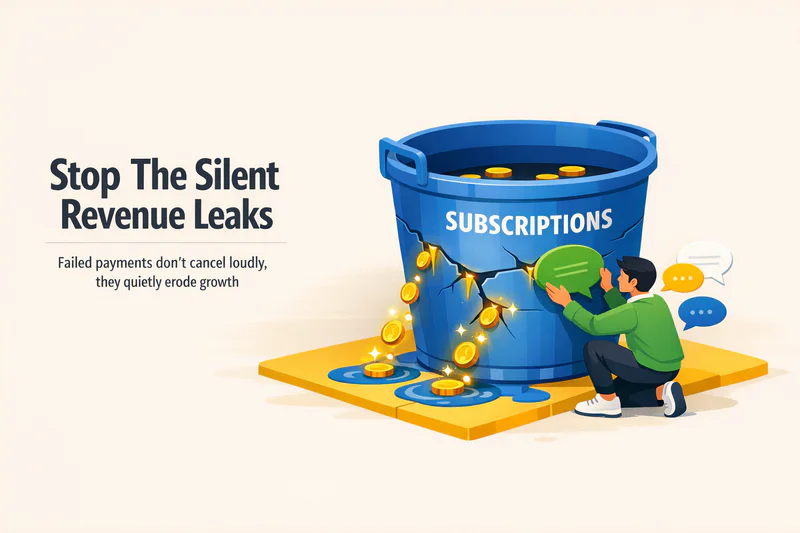
Revenue doesn’t usually disappear in dramatic exits. It slips away quietly. A declined card here. An expired payment method there. No angry cancellation email. No formal goodbye. Just silence.
Fixing the Leaky Bucket starts with automating failed payment recovery without ruining relationships. And that’s where many subscription businesses stumble.
A customer’s payment fails. Your system triggers a rigid reminder. Then another. Then a final warning. The tone feels abrupt. The timing feels mechanical. What could have been a small billing hiccup turns into irritation and sometimes churn.
Here’s the reality: most failed payments aren’t protests. They’re interruptions. Banks block transactions. Cards expire. Spending limits hit unexpectedly. These moments require clarity and care, not pressure.
If we treat every failed payment like a compliance issue, we risk losing good customers. If we handle it like a conversation, we protect revenue and trust at the same time.
Let’s talk about how.
The Hidden Cost of Failed Payments
Failed payments look operational. They’re not. They’re revenue events.
When a payment fails, three things happen immediately:
Cash flow is interrupted
Customer experience is tested
Churn risk increases

If recovery workflows are weak, temporary friction turns permanent. A customer who intended to continue simply doesn’t update their card in time. Access pauses. Momentum breaks. The relationship cools.
From a revenue recovery perspective, this is preventable loss.
From a churn prevention perspective, this is avoidable attrition.
And here’s the deeper issue: most companies measure cancellations carefully but treat failed payments as billing noise. They live inside finance dashboards instead of growth conversations.
That’s a mistake.
Failed payment recovery isn’t back-office cleanup. It’s frontline retention strategy.
Why Traditional Dunning Management Feels Robotic
Most dunning management systems follow a predictable script:
Payment failed notification
Reminder
Urgent warning
Account suspension
Efficient? Yes.
Effective? Not always.
The problem isn’t automation itself. It’s uniform automation.
Traditional workflows:
Send identical messages to every segment
Escalate tone too quickly
Ignore customer history
Focus on urgency over understanding
A five-year loyal customer receives the same template as a brand-new trial user. There’s no recognition of value. No context. No nuance.
When communication feels mechanical, customers disengage. Some fix the issue. Others ignore it. A few feel annoyed enough to reconsider the subscription entirely.
Revenue recovery should feel supportive. Instead, many dunning flows sound like collections departments.
That’s where the relational damage begins.
The Psychology Behind Payment Failure
When a payment fails, customers don’t think, “Let me damage this company’s revenue.”
They think:
“Why did this happen?”
“Is my card compromised?”
“Did something change with my plan?”
“I’ll deal with this later.”
There’s often mild embarrassment. Sometimes confusion. Occasionally stress.
Tone matters in this moment.
If your message reads like an accusation, it creates friction.
If it reads like assistance, it creates resolution.
The difference between churn prevention and churn acceleration can be a single line of copy.
For example:
“Your payment failed. Update immediately.”
versus“Looks like something interrupted your payment, want help fixing it?”
Same objective. Completely different emotional response.
Failed payment recovery isn’t only technical retry logic. It’s human psychology.
Fixing the Leaky Bucket with Intelligent Failed Payment Recovery
Modern revenue recovery requires more than scheduled reminders. It requires context.
Here’s what intelligent failed payment recovery looks like in practice:
1. Segment Before You Send
Not all customers are equal in lifecycle stage or value.
High-LTV users deserve a different tone than short-term accounts.
2. Adapt Tone Dynamically
First failure? Friendly nudge.
Repeated failure? Clear but respectful escalation.
3. Use Multi-Channel Orchestration
Email for detail
SMS for urgency
In-app prompts for immediacy
Meet customers where they already are.
4. Smart Retry Logic
Align retries with likely bank approval windows.
Avoid random, repetitive attempts that feel chaotic.
5. Offer Flexible Options
Update card
Switch payment method
Short grace period
Downgrade instead of cancel
Revenue recovery improves when customers feel supported, not cornered.
When we approach dunning management as an experience layer rather than a billing trigger, churn prevention becomes measurable and sustainable.
Conversational Recovery: The Missing Layer in Dunning Management
Automation shouldn’t mean one-way communication.
Conversational recovery adds a critical layer: responsiveness.
Instead of sending static reminders, systems can:
Detect replies
Interpret intent
Adjust tone
Route complex cases to humans
Imagine this flow:
A customer replies, “I’m traveling. Will fix next week.”
A robotic system continues escalating.
A conversational system pauses urgency and extends a grace window.
That’s the difference.
Conversational dunning management recognizes that:
Not all non-payments signal risk
Some signal confusion
Others signal temporary constraints
By incorporating intent detection and sentiment awareness, businesses reduce defensive reactions and increase resolution speed.
This directly strengthens churn prevention because customers feel heard, not chased.
Revenue recovery works best when it feels like assistance.
When failed payment recovery becomes a dialogue instead of a demand, relationships stay intact and payments resolve faster.
Automation Without Relationship Damage: Best Practices
If you want automation and retention to coexist, apply these principles:
Track sentiment, not just clicks
Recognize loyalty in messaging
Avoid immediate suspension for first-time failures
Give customers a clear timeline before escalation
Provide transparent next steps
Also, align teams internally.
Billing, customer success, and growth shouldn’t operate in silos. When revenue recovery data feeds churn prevention strategy, messaging becomes smarter over time.
Test subject lines.
Analyze response rates.
Monitor post-recovery retention.
Failed payment recovery shouldn’t end at card update. Measure whether recovered customers stay.
Retention quality matters as much as recovery speed.
Measuring Success in Failed Payment Recovery
To evaluate your revenue recovery performance, track:
Recovery rate percentage
Time-to-recovery
Involuntary churn rate
Post-recovery retention
Customer sentiment after resolution
If recovery improves but long-term retention drops, your tone may be damaging trust.
The goal isn’t aggressive collection. It’s durable relationships.
Churn prevention and revenue recovery should move in the same direction. If they don’t, your dunning management strategy needs refinement.
Revenue Recovery Without Relationship Loss
Failed payments are inevitable. Relationship damage isn’t.
Fixing the Leaky Bucket requires more than automated reminders. It requires awareness of context, of tone, of intent.
Most dunning management systems optimize for speed.
The smarter approach optimizes for resolution and retention.
When failed payment recovery feels empathetic, customers respond faster. They stay longer. They trust more.
This is where Zigment fits in.
Zigment uses empathetic sentiment analysis to detect tone and intent in customer interactions, allowing businesses to handle payment failures delicately while still protecting revenue. Instead of rigid workflows, you get conversational recovery that strengthens churn prevention while improving revenue recovery outcomes.
Because getting paid matters.
But keeping the relationship matters more.
If your recovery flow feels transactional, it may be time to make it relational.