Here's a scenario that will make any CFO wince.
A SaaS company has a client. Eight years. $60,000 a year.
Half a million dollars in lifetime revenue. Solid account they pay on time, rarely complain. Everyone on the CS team assumes they're happy.
They weren't. Their usage had quietly dropped by 50% over twelve months. No one noticed. No one reached out. The only call they ever got from the vendor? An upsell pitch.
They didn't renew. And by the time the vendor noticed, the client had already signed with a competitor.
Your Happiest-Looking Accounts Might Be Your Biggest Churn Risk
We've been conditioned to worry about the loud customers. The ones who open tickets, write angry emails, threaten to cancel. But here's the uncomfortable truth: those customers are actually engaged. They're fighting for a better outcome. They still care.
The ones you should be losing sleep over?
They say nothing. They attend QBRs with a smile. They fill out NPS surveys with a safe "7". And then one morning, your CSM opens Salesforce and finds a cancellation request from an account they thought was healthy.
Traditional support models focus on the 10% of customers who open tickets, while ignoring the "silent 90%" users who encounter friction, never complain, and ultimately leave.
Think about what that means at scale. For every angry customer your team is managing, nine others are quietly building their exit strategy and you have zero visibility into it.
The Numbers Are Brutal!
Let's talk business impact for a moment, because this is where RevOps managers and CFOs need to get uncomfortable.
Churn is the silent killer of recurring revenue. The impact of churn ripples far beyond lost MRR it affects your CAC payback, LTV projections, and ultimately, investor confidence.
And the cost comparison between losing a customer and winning a new one? Acquiring a new customer is anywhere from five to 25 times more expensive than retaining an existing one.
A 5% retention boost increases profits by up to 95%. Existing customers typically spend 67% more than new acquisitions.
For a $10M ARR business running at a 7% annual churn rate, that's $700,000 walking out the door annually from accounts that mostly never raised a complaint.
B2B SaaS companies report an average annual retention rate of 74%, with top performers pushing net revenue retention past 120%. The gap between average and elite isn't product features. It's the ability to detect and act on risk before it becomes a cancellation.
Why CSMs Can't Catch This Alone?
Here's where it gets real.
A typical CSM manages 30–80 accounts. They have QBRs, onboarding calls, escalations, renewal conversations, and upsell goals all running simultaneously. They're smart, motivated, and genuinely trying to help their customers succeed.
But they're human. And humans miss subtle signals.
While one negative ticket might not be alarming, a pattern of declining sentiment over 30 days is a strong indicator of potential churn. For instance, when a customer's tone shifts from positive to neutral or worse, from neutral to negative it's a clear warning sign.
The word "clear" is doing a lot of work in that sentence. Because in practice, that shift looks like this:
Month 1: "Thanks for the update, looking forward to the new feature."
Month 2: "Got it, we'll take a look when we have time."
Month 3: "Sure."
No complaint. No ticket. Just shorter sentences and cooler tone. A CSM reading fifty such email threads a week will not catch that pattern manually. No human can.
Silent churn doesn't announce itself. But it leaves breadcrumbs. The customer checked out long before they left we just didn't see it.
What "Sentiment Drift" Actually Looks Like in Email and Chat
The academic research is catching up to what CS leaders have known intuitively for years. Negative sentiment trends in customer feedback, support interactions, and social media posts serve as reliable indicators of potential churn, with predictive models achieving accuracy rates above 80%.
But there's a critical difference between negative sentiment and sentiment drift and it's the drift that's dangerous.
Sentiment drift is the gradual, almost imperceptible shift from warm to cool. It doesn't trigger keyword alerts. "Frustrated" and "cancel" don't appear in the emails. Instead, you see:
Responses getting shorter over weeks
Less first-name usage, more formal sign-offs
Fewer questions (disengaged people stop being curious)
Replies that acknowledge but don't commit: "We'll discuss internally"
Missing the warmth of early interactions no emojis, no exclamation marks, no "great call!"
The most concerning shift occurs when communication becomes cold and detached. If conversations transition from friendly and collaborative to short and formal, it's a sign the customer is mentally checking out.
And the thing is?
Your CSM might feel something is off. But without data, that intuition doesn't become an action item. It becomes a vague worry that gets buried under the next renewal call.
How Zigment's Conversation Graph Catches What Humans Miss
This is where the mechanism matters — not just the concept.
Most retention tools look at what happened: login frequency, feature usage, support ticket volume. These are lag indicators. By the time they move, the customer is already gone emotionally.
Zigment's Conversation Graph works differently. It's built around a core insight: the language of customer communications is a leading indicator, not a lagging one.
Zigment's Conversation Graph tracks every message, mood and click in a single timeline, capturing qualitative signals like mood and intent on the event timeline. Each interaction is stored as a structured node — including sentiment, confidence score, and intent classification — instantly searchable and able to trigger a nurture path.
Here's what that looks like in practice. A customer email comes in. The Conversation Graph doesn't just log it. It parses it — extracting:
Sentiment polarity (positive / neutral / negative, with scores)
Intent signals (information request vs. frustration expression vs. feature comparison)
Tone velocity — how fast sentiment is shifting compared to the account's own historical baseline
That last part is the critical innovation. The system isn't comparing a customer to an average. It's comparing them to themselves, three months ago.
A Conversation Graph understands language and sentiment, tracks evolving intent, and lets teams act on that context within seconds, connecting your tools instead of creating another silo. The workflow engine reads that context and triggers the next best action.
So when an account that was consistently scoring +0.7 sentiment in Q1 is now at +0.2 in Q3 even if all their written messages still sound "fine" the system flags it. A CSM alert fires. Not because anything bad was said. Because the warmth disappeared, and disappearing warmth is the pre-signal to cancellation.
Zigment analyzes interaction data from calls and brand conversations to uncover intent, emotion, and KPI-driven insights, enabling the creation of tailored customer journeys. Agentic AI enhances conversation analysis, extracting mood, intent, and sentiment, enabling intelligent actions.
For RevOps managers, this feeds directly into your health score models — not as a soft signal, but as a quantified, timestamped data point alongside your usage metrics.
From Signal to Action: What the Workflow Looks Like
Detecting the signal is step one. The real value is what happens next.
Spot at-risk accounts through sentiment patterns identify churn risk early by detecting emotional decline across repeated high-value interactions. Trigger win-back workflows activate automated recovery actions, like call-back offers or targeted outreach, based on sentiment and customer value.
In Zigment's framework, the Conversation Graph doesn't just alert it orchestrates. When a sentiment drift threshold is crossed, the system can:
Auto-generate a CSM alert with a summary of the sentiment trend and specific conversation excerpts that drove the flag
Trigger a personalized outreach sequence a warm, non-salesy check-in email timed to when the customer is most likely to respond
Escalate to a senior stakeholder if the account value and drift severity meet defined criteria
Push updated health scores to your CRM in real time, so your entire revenue team is working from the same picture
Customers stay when they feel looked after. Zigment leads with a customer-first mindset and acts early when there are signs of risk outreach listens first, fixes what's wrong, and sets honest expectations. Trust grows, renewals follow, and expansion feels natural.
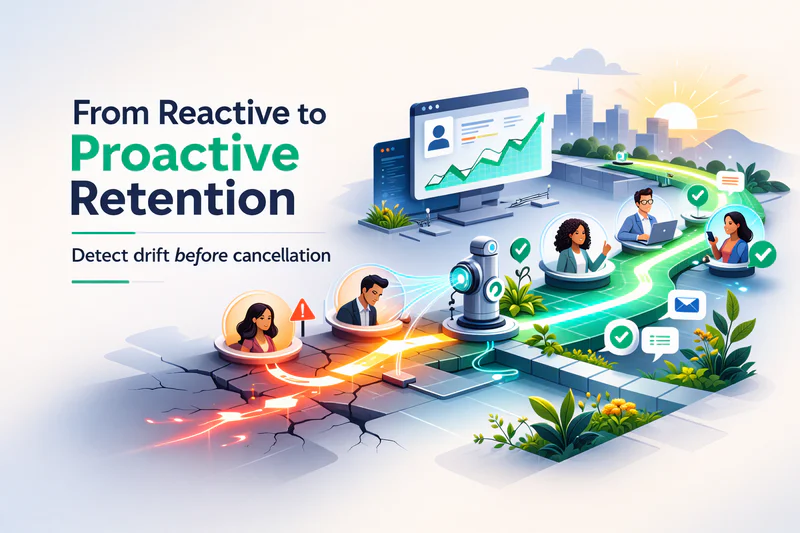
This is the shift from reactive to proactive retention and it's where revenue teams start seeing meaningful NRR improvement.
The Bottom Line
Your CRM is full of accounts that look healthy. Some of them aren't.
They're not angry. They're not escalating. They're just getting quieter, colder, shorter one email at a time. And by the time that shows up in your dashboards, the budget committee has already voted to switch vendors.
Zigment's Conversation Graph is designed specifically for this problem. Not to replace your CSMs but to give them a superpower: the ability to see sentiment drift before it becomes a cancellation, across every email, every chat, every interaction, in one unified timeline.
The accounts you keep are more valuable than the accounts you win. It's time to start treating them that way.